element14 Community
element14 Community
    Register Log In
  • Site
  • Search
  • Log In Register
  • Community Hub
    Community Hub
    • What's New on element14
    • Feedback and Support
    • Benefits of Membership
    • Personal Blogs
    • Members Area
    • Achievement Levels
  • Learn
    Learn
    • Ask an Expert
    • eBooks
    • element14 presents
    • Learning Center
    • Tech Spotlight
    • STEM Academy
    • Webinars, Training and Events
    • Learning Groups
  • Technologies
    Technologies
    • 3D Printing
    • FPGA
    • Industrial Automation
    • Internet of Things
    • Power & Energy
    • Sensors
    • Technology Groups
  • Challenges & Projects
    Challenges & Projects
    • Design Challenges
    • element14 presents Projects
    • Project14
    • Arduino Projects
    • Raspberry Pi Projects
    • Project Groups
  • Products
    Products
    • Arduino
    • Avnet & Tria Boards Community
    • Dev Tools
    • Manufacturers
    • Multicomp Pro
    • Product Groups
    • Raspberry Pi
    • RoadTests & Reviews
  • About Us
  • Store
    Store
    • Visit Your Store
    • Choose another store...
      • Europe
      •  Austria (German)
      •  Belgium (Dutch, French)
      •  Bulgaria (Bulgarian)
      •  Czech Republic (Czech)
      •  Denmark (Danish)
      •  Estonia (Estonian)
      •  Finland (Finnish)
      •  France (French)
      •  Germany (German)
      •  Hungary (Hungarian)
      •  Ireland
      •  Israel
      •  Italy (Italian)
      •  Latvia (Latvian)
      •  
      •  Lithuania (Lithuanian)
      •  Netherlands (Dutch)
      •  Norway (Norwegian)
      •  Poland (Polish)
      •  Portugal (Portuguese)
      •  Romania (Romanian)
      •  Russia (Russian)
      •  Slovakia (Slovak)
      •  Slovenia (Slovenian)
      •  Spain (Spanish)
      •  Sweden (Swedish)
      •  Switzerland(German, French)
      •  Turkey (Turkish)
      •  United Kingdom
      • Asia Pacific
      •  Australia
      •  China
      •  Hong Kong
      •  India
      • Japan
      •  Korea (Korean)
      •  Malaysia
      •  New Zealand
      •  Philippines
      •  Singapore
      •  Taiwan
      •  Thailand (Thai)
      • Vietnam
      • Americas
      •  Brazil (Portuguese)
      •  Canada
      •  Mexico (Spanish)
      •  United States
      Can't find the country/region you're looking for? Visit our export site or find a local distributor.
  • Translate
  • Profile
  • Settings
Business of Engineering
  • Technologies
  • More
Business of Engineering
Blog The kilogram has been redefined
  • Blog
  • Forum
  • Documents
  • Quiz
  • Events
  • Polls
  • Files
  • Members
  • Mentions
  • Sub-Groups
  • Tags
  • More
  • Cancel
  • New
Join Business of Engineering to participate - click to join for free!
  • Share
  • More
  • Cancel
Group Actions
  • Group RSS
  • More
  • Cancel
Engagement
  • Author Author: Catwell
  • Date Created: 30 Nov 2018 7:15 PM Date Created
  • Views 1105 views
  • Likes 4 likes
  • Comments 0 comments
  • business of engineering
  • on_campus
  • cabeatwell
  • units of measure
  • school
  • kilogram
  • university
  • business
  • innovation
Related
Recommended

The kilogram has been redefined

Catwell
Catwell
30 Nov 2018

image

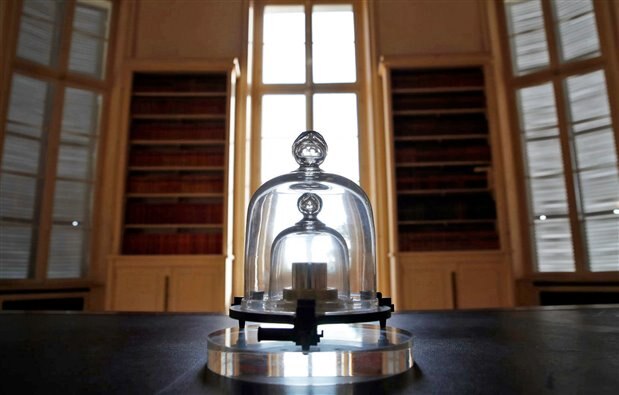
The decision has been in the works for several years now (Photo via Associated Press)


I kind of live for news like this. Recently, scientists voted to change the definition of the kilogram along with the ampere, the Kelvin, and the mole. The decision was made at the General Conference on Weights and Measurements in Versailles, France.


So what exactly does this mean? The measurements will now be based on “fundamental constants of nature,” which are more precise than their current definitions. In other words, they’ll be defined in terms of physical constants. The kilogram will now be defined by the Planck Constant, h, while the ampere, Kelvin, and mole will be defined by the elementary electrical charge known as the Boltzmann constant and the Avogadro constant. The value of the Planck constant will be fixed at exactly 6.62607015 x 10 -34.


Originally, the kilogram was designed to equal the mass of a liter of water. Soon, this was represented by a cylinder, which was then adopted by other countries. This is known as Le Grand K, which is housed in Paris. Only a few people have access to this meaning others had to rely on imprecise measurements. Now, anyone with the know-how will be able to use the fixed value of the Planck constant to measure mass.


Though it sounds like an overnight change, it’s actually been in the works for quite some time. It’s a chance scientists are thrilled about, but it doesn’t mean a whole lot to most people. For instance, a kilogram of ground beef will still amount to the same number of hamburgers. Rather, the change benefits scientists helping them to make more accurate measurements. This also means the measurements will be universal.


“The SI redefinition is a landmark moment in scientific measurement,” says Jan-Theodoor Janssen, director of research at the UK’s National Physical Laboratory. “This will pave the way for far more accurate measurements and lays a more stable foundation for science.”

The new definitions will be put in place May 20, 2019.


Have a story tip? Message me at: cabe(at)element14(dot)com

http://twitter.com/Cabe_Atwell

  • Sign in to reply
element14 Community

element14 is the first online community specifically for engineers. Connect with your peers and get expert answers to your questions.

  • Members
  • Learn
  • Technologies
  • Challenges & Projects
  • Products
  • Store
  • About Us
  • Feedback & Support
  • FAQs
  • Terms of Use
  • Privacy Policy
  • Legal and Copyright Notices
  • Sitemap
  • Cookies

An Avnet Company © 2025 Premier Farnell Limited. All Rights Reserved.

Premier Farnell Ltd, registered in England and Wales (no 00876412), registered office: Farnell House, Forge Lane, Leeds LS12 2NE.

ICP 备案号 10220084.

Follow element14

  • X
  • Facebook
  • linkedin
  • YouTube