


(Image via Fabacademy)
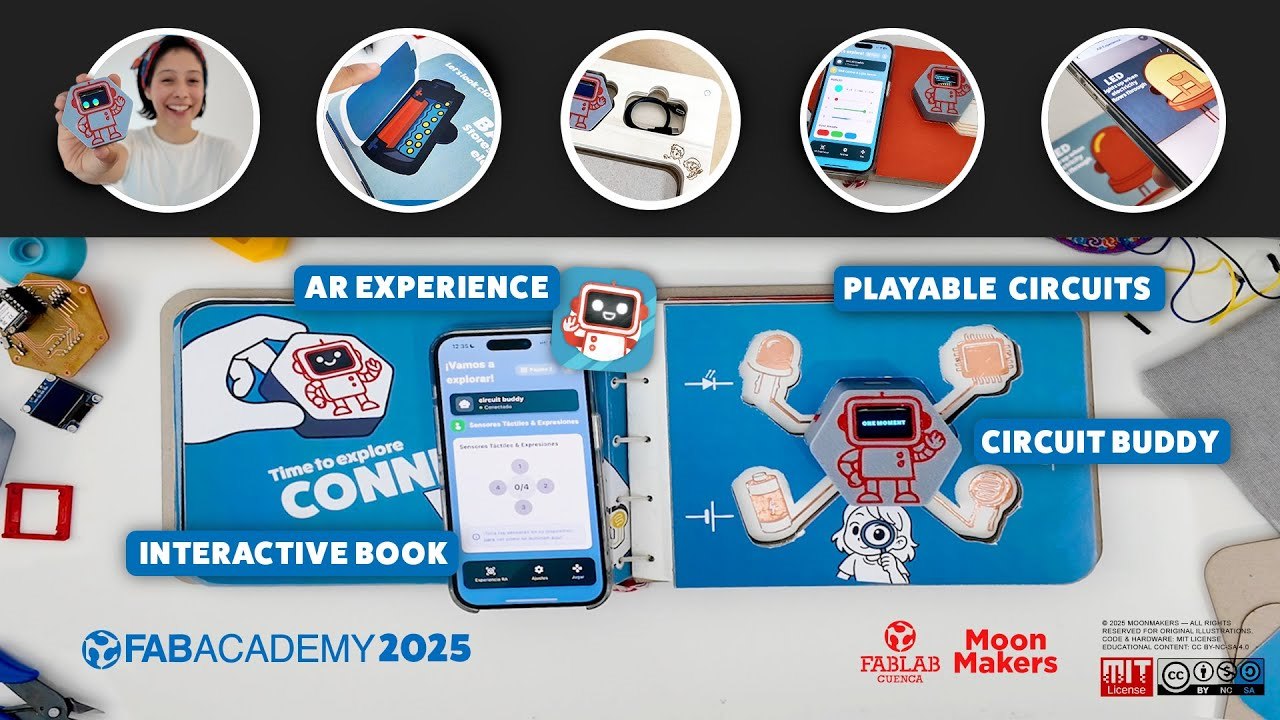
When Ana Camila Luna Lopez set out to build her final project for the 2025 Fab Academy, she didn’t just want to make any circuit design; she wanted to make an innovative teaching tool that could help kids learn through interaction.
“The idea came from my own journey learning — I often found traditional approaches very text‑heavy and intimidating for beginners,” states Lopez. “I wanted to design something that felt playful and welcoming, especially for kids and curious beginners who wanted to learn by doing. This age group is full of creativity and imagination, and I believed that giving them a tool where they could ‘play’ with circuits, instead of just reading about them, could spark a lifelong interest in STEAM.”
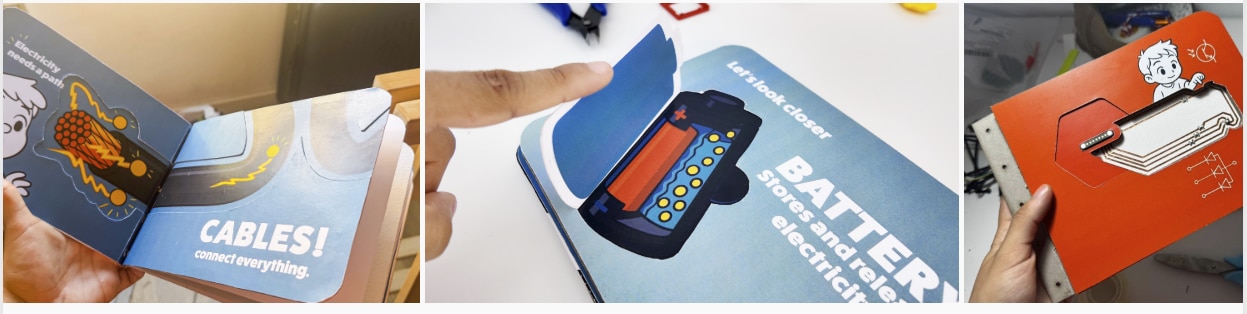
Circuit Lab is an innovative learning tool that teaches students circuit design through interactive learning. (Image via Fabacademy)
That tool manifested into Circuit Lab, a modular, interactive educational book (Fig. 1) that teaches electronics through hands-on engagement. More than a textbook or kit, Circuit Lab is a fully tactile learning experience where every page is a functional module featuring real components, including LEDs, sensors, displays, capacitive touch pads, and more.
Each page is designed to connect to a central “learning board,” acting as a hub where users can plug in and play. One page features custom-designed touchpads that light up when touched, another displays feedback on an OLED screen, while yet another allows users to see a functioning circuit in action. It’s circuit design education broken into chapters you can actually hold, feel, and build.
Lopez’s development process was just as modular as the book itself. She designed and milled her own PCBs using KiCad, wrote firmware for microcontrollers, modeled 3D-printed parts, and prototyped with laser-cut enclosures. She documented every step as well, from early sketches and board layouts to iterative testing and final assembly.
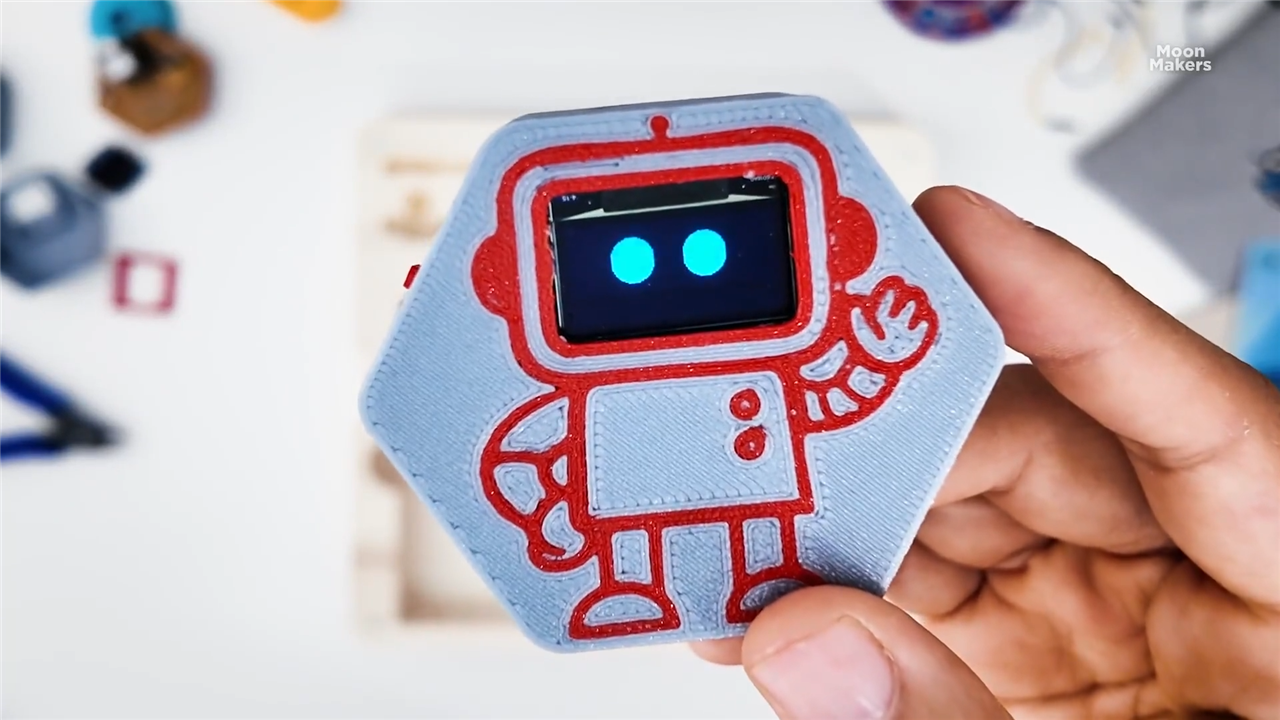
The 3D printed enclosure allows the microcontroller to plug into each page using a magnetic connector. (Image via Fabacademy)
The project leans heavily on embedded systems and fabrication, but also reveals her deep commitment to accessible learning design. Lopez designed Circuit Lab around an Xiao ESP32S3 microcontroller, ADXL335 or GY-521 accelerometer + gyroscope combo, OLED display and extra headers for connecting external modular sensor pages and an onboard battery. The hardware is housed inside a 3D printed enclosure with an adorable robot image on top (Fig. 2), along with a magnetic connector that allows the device to plug into the other pages.
When it came to the modularity and interconnectivity between pages, Lopez states that the mainboard design is key. “It connects seamlessly with each circuit page through a simple plug‑and‑play system. This design not only made the book modular but also allowed me to experiment with different page layouts and circuit types without redesigning the whole system. On the software side, I worked on the code to support this flexibility, so the book can continue to expand with new pages and activities in the future.”
Lopez chose to code her project using the Arduino IDE, which acts as the brain of the book for controlling interactions, display logic, page recognition, and BLE communication. But, as any engineer can attest, most projects come with challenges, and Circuit Lab is no exception. “The biggest challenge was the integration with the companion application,” said Lopez. “Making the book and the app work together turned Circuit Lab into a complete experience — not just physical interaction, but also digital exploration, and finally getting the app ready for the App Store was one of the most rewarding parts of the project because it really brought the concept to life.”
With that said, Circuit Lab is a powerful learning tool for educational settings. Its plug-and-learn format makes it ideal for young learners, students in underserved communities, or classrooms that want to merge theory with hands-on experimentation. It’s tactile, visual, and inviting, making it ideal for learning circuit design in a way that’s intuitive and engaging. It’s also designed for reuse and modular expansion, making it sustainable and adaptable for different skill levels.
When asked what the future has in store for the Circuit Lab project, Lopez explains, “I’m working on Circuit Lab 2.0, which will expand the number of pages, improve design, and further develop the digital side through the app. The goal is to make the experience even more immersive, and I want to make it possible for educators to customize the content to fit their classroom or workshop needs. I’m also exploring collaborations to make the book available soon.”
Have a story tip? Message me here at element14.