element14 Community
element14 Community
    Register Log In
  • Site
  • Search
  • Log In Register
  • Community Hub
    Community Hub
    • What's New on element14
    • Feedback and Support
    • Benefits of Membership
    • Personal Blogs
    • Members Area
    • Achievement Levels
  • Learn
    Learn
    • Ask an Expert
    • eBooks
    • element14 presents
    • Learning Center
    • Tech Spotlight
    • STEM Academy
    • Webinars, Training and Events
    • Learning Groups
  • Technologies
    Technologies
    • 3D Printing
    • FPGA
    • Industrial Automation
    • Internet of Things
    • Power & Energy
    • Sensors
    • Technology Groups
  • Challenges & Projects
    Challenges & Projects
    • Design Challenges
    • element14 presents Projects
    • Project14
    • Arduino Projects
    • Raspberry Pi Projects
    • Project Groups
  • Products
    Products
    • Arduino
    • Avnet & Tria Boards Community
    • Dev Tools
    • Manufacturers
    • Multicomp Pro
    • Product Groups
    • Raspberry Pi
    • RoadTests & Reviews
  • About Us
  • Store
    Store
    • Visit Your Store
    • Choose another store...
      • Europe
      •  Austria (German)
      •  Belgium (Dutch, French)
      •  Bulgaria (Bulgarian)
      •  Czech Republic (Czech)
      •  Denmark (Danish)
      •  Estonia (Estonian)
      •  Finland (Finnish)
      •  France (French)
      •  Germany (German)
      •  Hungary (Hungarian)
      •  Ireland
      •  Israel
      •  Italy (Italian)
      •  Latvia (Latvian)
      •  
      •  Lithuania (Lithuanian)
      •  Netherlands (Dutch)
      •  Norway (Norwegian)
      •  Poland (Polish)
      •  Portugal (Portuguese)
      •  Romania (Romanian)
      •  Russia (Russian)
      •  Slovakia (Slovak)
      •  Slovenia (Slovenian)
      •  Spain (Spanish)
      •  Sweden (Swedish)
      •  Switzerland(German, French)
      •  Turkey (Turkish)
      •  United Kingdom
      • Asia Pacific
      •  Australia
      •  China
      •  Hong Kong
      •  India
      • Japan
      •  Korea (Korean)
      •  Malaysia
      •  New Zealand
      •  Philippines
      •  Singapore
      •  Taiwan
      •  Thailand (Thai)
      • Vietnam
      • Americas
      •  Brazil (Portuguese)
      •  Canada
      •  Mexico (Spanish)
      •  United States
      Can't find the country/region you're looking for? Visit our export site or find a local distributor.
  • Translate
  • Profile
  • Settings
Business of Engineering
  • Technologies
  • More
Business of Engineering
Blog The new digital data storage is made of nanostructured glass
  • Blog
  • Forum
  • Documents
  • Quiz
  • Events
  • Polls
  • Files
  • Members
  • Mentions
  • Sub-Groups
  • Tags
  • More
  • Cancel
  • New
Join Business of Engineering to participate - click to join for free!
  • Share
  • More
  • Cancel
Group Actions
  • Group RSS
  • More
  • Cancel
Engagement
  • Author Author: Catwell
  • Date Created: 7 Apr 2020 7:19 PM Date Created
  • Views 1419 views
  • Likes 3 likes
  • Comments 1 comment
  • business of engineering
  • stem
  • on_campus
  • cabeatwell
  • data storage
  • university
  • data
  • business
  • innovation
Related
Recommended

The new digital data storage is made of nanostructured glass

Catwell
Catwell
7 Apr 2020

image

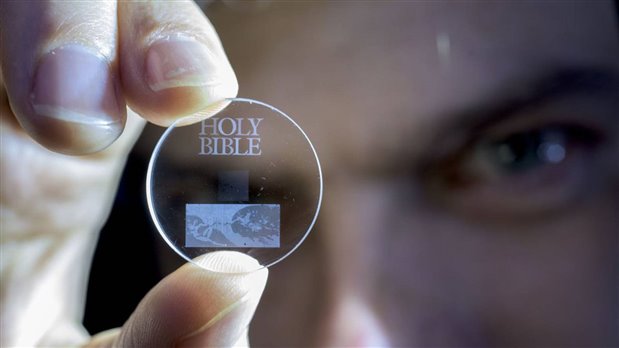
Now the entirety of human history can be stored onto a tiny silver of glass (Photo from ORC)


When the Notre Dame cathedral burnt down in 2019, a plethora of history was lost. It helped put in perspective just how precious these historical artifacts are and how they can disappear in an instant. Now, we may have a new solution to store the entirety of human history, thanks to scientists at the University of Southampton. The team recently developed the technique to store data digitally using laser light that has the capability of surviving for billions of years.


Scientists from the university’s Optoelectronics Research Centre (ORC) have developed the recording and gathering processes of five-dimensional (5D) digital data by using nanostructured glass and a process known as femtosecond laser writing. Documents are recorded using an ultrafast laser, which produces very short and intense pulses of light. The file is then written in three layers of nanostructured dots separated by five micrometers. The 5D storage is made up of the three dimensions of space responsible for describing the physical location of the dot, and two additional dimensions encoded by the polarity and intensity of the beam that makes the dot.


So how much can this thing store? 360 terabytes of information can fit on one sliver of nanostructured quartz with an estimated lifespan of 13.8 billion years – more than three times the age of Earth. On top of this, the storage can withstand temperatures up to 1000 C and will have an unlimited lifespan sitting at room temperature. It’s high stability and safety, makes it ideal for organizations with vast archives, such as museums and libraries.


This technology has come a long way since it was first demonstrated in 2013. Back then, it only had the capability to record a 300kb digital copy of a text file. Now, documents like the Universal Declaration of Human Rights (UDHR), the Magna Carta, and the King James Bible have been stored as digital copies using the technology. These documents were recently loaded onto the storage device and presented to the UN in February. 


Professor Peter Kazansky, from the ORC, says: “It is thrilling to think that we have created the technology to preserve documents and information and store it in space for future generations. This technology can secure the last evidence of our civilization: all we’ve learnt will not be forgotten.”


This groundbreaking research will have a significant impact on archiving. Not only does it have the capability of storing just about all of human history, it practically lasts forever. With this around, hopefully, we no longer have to worry about losing mass amounts of history due to unforeseen circumstances. And if there are other lifeforms out there, they’ll be able to access all of our archives well after we’re gone. You never know.


Have a story tip? Message me at: cabe(at)element14(dot)com

http://twitter.com/Cabe_Atwell

  • Sign in to reply
  • dubbie
    dubbie over 5 years ago

    Sounds good. I remember when microfiche (?) first started to be used in libraries and how much information could be condensed from books onto plastic films. Then we had magnetic storage, then CD-ROMs and now quartz. I wonder how much a 'reader' costs/


    Dubbie

    • Cancel
    • Vote Up 0 Vote Down
    • Sign in to reply
    • More
    • Cancel
element14 Community

element14 is the first online community specifically for engineers. Connect with your peers and get expert answers to your questions.

  • Members
  • Learn
  • Technologies
  • Challenges & Projects
  • Products
  • Store
  • About Us
  • Feedback & Support
  • FAQs
  • Terms of Use
  • Privacy Policy
  • Legal and Copyright Notices
  • Sitemap
  • Cookies

An Avnet Company © 2026 Premier Farnell Limited. All Rights Reserved.

Premier Farnell Ltd, registered in England and Wales (no 00876412), registered office: Farnell House, Forge Lane, Leeds LS12 2NE.

ICP 备案号 10220084.

Follow element14

  • X
  • Facebook
  • linkedin
  • YouTube