Octave is powerful programming language that lets you quickly prototype mathematical algorithms. Octave is very similar to MathWorks’ MATLAB.Everything is a MatrixWhen starting out with Octave it is best to think of everything as matrix, becaus...
IntroductionIn the previous tutorial, we talked about constants. By using a constant, you are letting everyone else know that a given value will not change. Constants can be applied to variables, function parameters and functions themselves.&nb...
IntroductionIn the previous tutorial, we talked about strings. Strings a way to store text in a C++ program. In this tutorial, we are going to talk about constants. The obvious application of constants is when you need to store a num...
IntroductionIn the previous tutorial, we talked about reading and writing binary data to a file. In this tutorial, we are going to talk about strings. Strings are a way of storing and manipulating text within C++.CodeLet’s jump right in an...
IntroductionIn the previous tutorial, we talked about inheritance which is a way to reuse variables and methods that are common to multiple classes. It also allows for a class hierarchy to be set up so that methods can work on the most generic class ...
IntroductionIn the previous tutorial, we saw how to use templates to make functions and classes more generic. This enables you to write a function or class that works with many different data types. In this tutorial, we are going to learn ...
IntroductionIn the previous tutorial, we used the STL (Standard Template Library) implementations of dynamic lists. More specifically, we looked at the forward_list, the list, and the vector. We showed how to use them and talked about whi...
Often times someone other than the firmware designer on a development team needs to program a TI MSP430 chip. An analog, apps, or test engineer, client; even an end user does not want to mess around with installing an entire IDE for a released ...
IntroductionIn the previous tutorial, we implemented some of the common functions that can be executed on a linked list. This is a great exercise to gain a deeper understanding of what is really going on. This is because lists are extremely com...
IntroductionIn this previous tutorial, we learned about linked lists. Linked list are a way to store data when you don’t know how many items you are going to have until you are done. A simple example would be finding all of the letters in a text file...
IntroductionIn the previous tutorial, we learned about dynamic memory which lets you create arrays which have a size that are only known at run time (and not when the program is written). One way that this occurs is if you have to read in an image.&n...
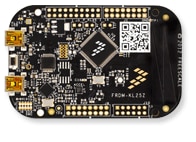
The Freescale Freedom platform is an ultra-low-cost development platform enabled by the Kinetis-L Series KL0x, KL1x and KL2x energy efficient microcontroller families built on ARM®︎ Cortex™︎-M0+ processors. Setting Up Your BoardFor this example I used ...
IntroductionIn the previous tutorial, we discussed pointers. Pointers are a way to store the address of a value in memory. We then used this to pass a value to a function by reference, so that we could modify it within the function. In thi...
IntroductionIn the previous tutorial, we discussed classes. Classes are a great way to group related variables and methods together. Also, they make for a logical division of code into multiple files, so that you don’t have thousands of l...
IntroductionIn the previous tutorial, we introduced structures, which allow you to store multiple, related values of different data types. In this tutorial, we are going to introduce classes which are a way to store related values of different ...
IntroductionIn the previous tutorial, we talked about arrays, which allow you to store many related values of the same data type. In this tutorial, we are going to talk about structures, which allow you to store related values of different data...
IntroductionIn the previous tutorial, we discussed the various data types available and when to use each one. In this tutorial, we are going to talk about arrays, which allow you store multiple variables of the same data type. We are going to use thi...
IntroductionIn the previous tutorial, we discussed how to use functions to make your code more modular and reusable. In this tutorial, we are going to talk about the different data types that exist in C++ and when to use each one.Integer Values...
IntroductionIn the previous tutorial, we learned how to make our code more robust by using while loops to screen out bad user input. In this tutorial, we are going to learn how to make our code more modular and reusable by utilizing functions.&...
IntroductionIn the previous tutorial, we learned how to make our code more concise and flexible by using for loops. In this tutorial, we will learn about another kind of loop: the while loop. We will use this loop to make our code more robust b...
The International Space Station (ISS) needs your help. (via NASA) ‘Houston, we have a problem.’ No, it’s not Apollo 13 that NASA’s having a problem with but rather the ISS (International Space Station). Actually, they’re having some issues with ...
IntroductionIn the previous tutorial, we learned how to make decisions based on the data that the user typed in and we wrote a guess my number game. The code for the game was very repetitive and could greatly be reduced and generalized by using...
IntroductionIn the previous tutorial, we learned how to read in numbers from the user. In this tutorial, we will learn how to make decisions based on data that you have stored in variables. This will allow us to create the childhood game ...
IntroductionIn the previous tutorial we learned how to compile a program and write a message to the screen. In this tutorial we are going to learn how to read in data that they user types in and store that information.CodeSo, let’s jump right i...