element14 Community
element14 Community
    Register Log In
  • Site
  • Search
  • Log In Register
  • Community Hub
    Community Hub
    • What's New on element14
    • Feedback and Support
    • Benefits of Membership
    • Personal Blogs
    • Members Area
    • Achievement Levels
  • Learn
    Learn
    • Ask an Expert
    • eBooks
    • element14 presents
    • Learning Center
    • Tech Spotlight
    • STEM Academy
    • Webinars, Training and Events
    • Learning Groups
  • Technologies
    Technologies
    • 3D Printing
    • FPGA
    • Industrial Automation
    • Internet of Things
    • Power & Energy
    • Sensors
    • Technology Groups
  • Challenges & Projects
    Challenges & Projects
    • Design Challenges
    • element14 presents Projects
    • Project14
    • Arduino Projects
    • Raspberry Pi Projects
    • Project Groups
  • Products
    Products
    • Arduino
    • Avnet & Tria Boards Community
    • Dev Tools
    • Manufacturers
    • Multicomp Pro
    • Product Groups
    • Raspberry Pi
    • RoadTests & Reviews
  • About Us
  • Store
    Store
    • Visit Your Store
    • Choose another store...
      • Europe
      •  Austria (German)
      •  Belgium (Dutch, French)
      •  Bulgaria (Bulgarian)
      •  Czech Republic (Czech)
      •  Denmark (Danish)
      •  Estonia (Estonian)
      •  Finland (Finnish)
      •  France (French)
      •  Germany (German)
      •  Hungary (Hungarian)
      •  Ireland
      •  Israel
      •  Italy (Italian)
      •  Latvia (Latvian)
      •  
      •  Lithuania (Lithuanian)
      •  Netherlands (Dutch)
      •  Norway (Norwegian)
      •  Poland (Polish)
      •  Portugal (Portuguese)
      •  Romania (Romanian)
      •  Russia (Russian)
      •  Slovakia (Slovak)
      •  Slovenia (Slovenian)
      •  Spain (Spanish)
      •  Sweden (Swedish)
      •  Switzerland(German, French)
      •  Turkey (Turkish)
      •  United Kingdom
      • Asia Pacific
      •  Australia
      •  China
      •  Hong Kong
      •  India
      • Japan
      •  Korea (Korean)
      •  Malaysia
      •  New Zealand
      •  Philippines
      •  Singapore
      •  Taiwan
      •  Thailand (Thai)
      • Vietnam
      • Americas
      •  Brazil (Portuguese)
      •  Canada
      •  Mexico (Spanish)
      •  United States
      Can't find the country/region you're looking for? Visit our export site or find a local distributor.
  • Translate
  • Profile
  • Settings
Embedded and Microcontrollers
  • Technologies
  • More
Embedded and Microcontrollers
Embedded Forum High Speed, High Current Op-amp
  • Blog
  • Forum
  • Documents
  • Quiz
  • Polls
  • Files
  • Members
  • Mentions
  • Sub-Groups
  • Tags
  • More
  • Cancel
  • New
Join Embedded and Microcontrollers to participate - click to join for free!
Actions
  • Share
  • More
  • Cancel
Forum Thread Details
  • State Suggested Answer
  • Replies 17 replies
  • Answers 3 answers
  • Subscribers 476 subscribers
  • Views 1498 views
  • Users 0 members are here
  • electronics.
Related

High Speed, High Current Op-amp

michaelwylie
michaelwylie over 9 years ago

I'm looking for high speed (slew rate), high current op-amps. I'm aware of the external typologies that can be added to op-amps to increase the output current capability, but the component count starts to become daunting for my application. I'm trying to design a circuit to produce up to a 1.5 Amp current pulse to an optical device. The pulse will vary in width from 100 ns to 1000 ns depending upon the application. Rise/Fall less than 10 ns. I've been googling for a bit, and it seems to be exclusive. You can get either the high current, or the high slew rate. Any options would be great.

  • Sign in to reply
  • Cancel

Top Replies

  • D_Hersey
    D_Hersey over 9 years ago +1 suggested
    Bi-FET reefers to amplifiers that use both bipolar and field-effect transistors in the same circuit. Early on, it was often a primitive mosfet driving a bipolar Q. This yielded a composite device that…
  • D_Hersey
    D_Hersey over 9 years ago +1
    The obvious superiority of a power mosfet over a power bipolar is saturation voltage. As a practical matter Si bipolars have a collector saturation of about half a volt. The mosfet conduction channel is…
  • D_Hersey
    D_Hersey over 9 years ago +1 suggested
    An emmiter-follower totempole at the gate of a power mosfet will work as well as a gate driver, at about a tenth of the cost.
  • peterjcs23
    0 peterjcs23 over 9 years ago

    Sounds like you need a switched driver rather than an op-amp to generate fast pulses at high current. Try searching for laser diode drivers.

    • Cancel
    • Vote Up 0 Vote Down
    • Sign in to reply
    • Verify Answer
    • Cancel
  • michaelkellett
    0 michaelkellett over 9 years ago

    Rise/fall in 10nS = slew rate 150A/uS and certainly no less than 200V/uS - I was about to say I didn't think you would find one when I remembered Apex:


    May be out of your price range but their  PA09 does 200v/us, 150 MHz bandiwdth - no pulse diagrams on the data sheet.


    They do lots of other parts so take a look: www.apexanalog.com


    How well do you need to control the current and pulse shape ?


    MK

    • Cancel
    • Vote Up 0 Vote Down
    • Sign in to reply
    • Verify Answer
    • Cancel
  • michaelwylie
    0 michaelwylie over 9 years ago in reply to peterjcs23

    I'm checking it out now.

    • Cancel
    • Vote Up 0 Vote Down
    • Sign in to reply
    • Verify Answer
    • Cancel
  • michaelwylie
    0 michaelwylie over 9 years ago in reply to michaelkellett

    Any ringing in the first 10 ns or so would be ok. A slight linear droop on the flat top would also be acceptable. Apex seems really expensive. I have been thinking about paralleling op amp outputs to reach 1.5 amps, have any experience with that?

    • Cancel
    • Vote Up 0 Vote Down
    • Sign in to reply
    • Verify Answer
    • Cancel
  • D_Hersey
    0 D_Hersey over 9 years ago

    Aw, c'mon, just hang a transistor outside the op-amp, maybe a nice, big Darlington.  They have the shut-off resistors built-in.  It is not like you need anything tricky, like push-pull.  National Semi has an old app note along the lines of 'CMOS Linear applications' where they show how to use UB-type silicon gate cmos in the feedback path of op-amps.  Useful technique.

    • Cancel
    • Vote Up 0 Vote Down
    • Sign in to reply
    • Verify Answer
    • Cancel
  • michaelwylie
    0 michaelwylie over 9 years ago in reply to D_Hersey

    I need the negative rail, so it would require push-pull.

    • Cancel
    • Vote Up 0 Vote Down
    • Sign in to reply
    • Verify Answer
    • Cancel
  • dougw
    0 dougw over 9 years ago

    As mentioned Apex PA107 and maybe PA119 might be adequate, but they will be pricey.

    • Cancel
    • Vote Up 0 Vote Down
    • Sign in to reply
    • Verify Answer
    • Cancel
  • michaelkellett
    0 michaelkellett over 9 years ago in reply to michaelwylie

    This'll be quite hard - up to 1.5A in 10ns and nice and clean - means short wires between load and power device, very low impedance supplies.


    Check out this (Linear technology APP Note 133)

    www.linear.com/docs/40550


    Jim Williams is only aiming for a much slower rise time and single quadrant drive but at higher current - note well the section "Layout Effects".


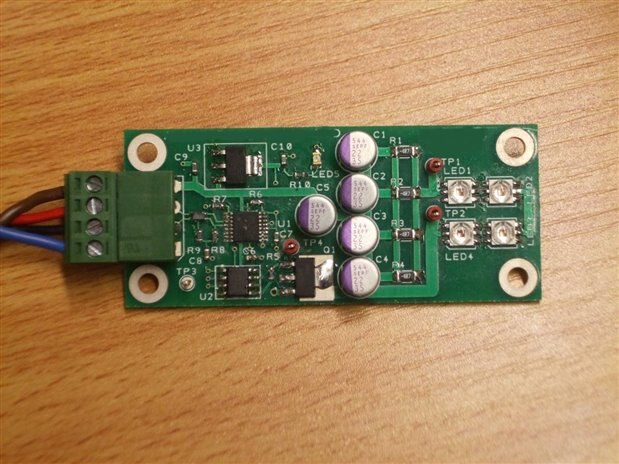
    About the simplest way to get close (which oddly I've just done for someone) is to uses a MOSFET with proper MOSFET driver and control the current by having some series resistance and an adjustable;e power supply. My circuit (in the picture) has 1.175R series resistance, 5 low ESR 22uF caps in parallel, and 10R in series with the MSOFET gate - rise time to 2A is about 35nS. I've got another one to build and test so if I get time I'll try without the 10R and take some scope pictures. It would probably work better with the MOSFET closer to the LEDs. I'd like to get the max current up to 5A.image

    This board is at the end of 3M of cable (single twisted pair with two additional power cores) and uses LVDS TX and RX chips to get the control pulses up the wire. The power regulator at the source end of the cable can do about 4-14V. The load is 4 red LEDs in series (it's a strobe light but I can't tell you what its for.)

    If I needed to get current out of the load fast I'd add another MOSFET (P) to short it the load out (and worry about how to stop them both being on at once !).


    MK

    • Cancel
    • Vote Up 0 Vote Down
    • Sign in to reply
    • Verify Answer
    • Reject Answer
    • Cancel
  • D_Hersey
    0 D_Hersey over 9 years ago

    If you need push-pull, sometimes you can get away with a cascode output stage.  This would be using a transistor for a pull-down and a CCS for the pull-up.  This topology gives us push-pull with only one control terminal, avoiding a 'dead zone' between the times the pull-up and the pull-down activate.


    Can you provide more detail about the nature of your load?

    • Cancel
    • Vote Up 0 Vote Down
    • Sign in to reply
    • Verify Answer
    • Cancel
  • michaelwylie
    0 michaelwylie over 9 years ago in reply to michaelkellett

    This is interesting because the first approach I took was to use a FET driver, but without the FET. I let the FET driver simply drive the load. I used a large wattage resistor to control the load current. But I've noticed the pulse, at least to my load, contains a linear decrease in amplitude from start to finish. It's significant too, like maybe 100 mV out of a 700 mV pulse peak. However, I have since discovered that negative bias on the output pulse waveform is also needed. This complicates the issue. I cannot disclose the nature of the load, but negative bias is necessary.


    To keep the circuitry simplified I may have to relax the load current specification.

    • Cancel
    • Vote Up 0 Vote Down
    • Sign in to reply
    • Verify Answer
    • Cancel
>
element14 Community

element14 is the first online community specifically for engineers. Connect with your peers and get expert answers to your questions.

  • Members
  • Learn
  • Technologies
  • Challenges & Projects
  • Products
  • Store
  • About Us
  • Feedback & Support
  • FAQs
  • Terms of Use
  • Privacy Policy
  • Legal and Copyright Notices
  • Sitemap
  • Cookies

An Avnet Company © 2025 Premier Farnell Limited. All Rights Reserved.

Premier Farnell Ltd, registered in England and Wales (no 00876412), registered office: Farnell House, Forge Lane, Leeds LS12 2NE.

ICP 备案号 10220084.

Follow element14

  • X
  • Facebook
  • linkedin
  • YouTube