


In a thread you stated that the only way to compare two resistors was to put them in a string, put a potential across said string and measure and compare the drops of the two loads. I won't go digging up the thread, because I am far too much of a gentleman for something as crass as that. Please take the essence of my rendition as accurate.

At the time I noted that you had overlooked the Norton alternative. But as my head hit the pillow tonight, the ghosts of ETs past implored me in both ears: SOMEONE IS WRONG ON THE INTERNET! Our doppelgänger del Norte, JWT! You are guilty of dissimulating John's degree of wrongness, Don! Get up and type!
Consider:
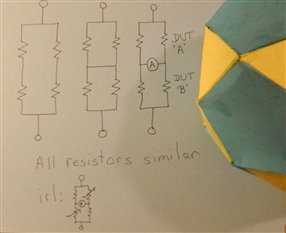
Imagine that the first two circuits have a dashed rectangles around them, sparing the terminals. They are 'black boxes.' For concreteness, let's imagine that each resistor is one ohm/Siemens. The black boxes would measure out to be one ohm/Siemens.
Pretend that the horizontal line in the second diagram is a jumper. How much current flows through this wire? None, ever. Whether the jumper is attached will be known only to the 'inside the box' community.
So, the (bipolar) ammeter in the third diagram reads zero if Ra=Rb. Else it will indicate which resistor is larger/smaller. Remember, the galvanic meter is highly sensitive, although passive. This circuit arrangement is called a "Whetstone Bridge."
Whetstone is a place in England where people like to balance things.
So there we have it, friend.

