element14 Community
element14 Community
    Register Log In
  • Site
  • Search
  • Log In Register
  • Community Hub
    Community Hub
    • What's New on element14
    • Feedback and Support
    • Benefits of Membership
    • Personal Blogs
    • Members Area
    • Achievement Levels
  • Learn
    Learn
    • Ask an Expert
    • eBooks
    • element14 presents
    • Learning Center
    • Tech Spotlight
    • STEM Academy
    • Webinars, Training and Events
    • Learning Groups
  • Technologies
    Technologies
    • 3D Printing
    • FPGA
    • Industrial Automation
    • Internet of Things
    • Power & Energy
    • Sensors
    • Technology Groups
  • Challenges & Projects
    Challenges & Projects
    • Design Challenges
    • element14 presents Projects
    • Project14
    • Arduino Projects
    • Raspberry Pi Projects
    • Project Groups
  • Products
    Products
    • Arduino
    • Avnet & Tria Boards Community
    • Dev Tools
    • Manufacturers
    • Multicomp Pro
    • Product Groups
    • Raspberry Pi
    • RoadTests & Reviews
  • About Us
  • Store
    Store
    • Visit Your Store
    • Choose another store...
      • Europe
      •  Austria (German)
      •  Belgium (Dutch, French)
      •  Bulgaria (Bulgarian)
      •  Czech Republic (Czech)
      •  Denmark (Danish)
      •  Estonia (Estonian)
      •  Finland (Finnish)
      •  France (French)
      •  Germany (German)
      •  Hungary (Hungarian)
      •  Ireland
      •  Israel
      •  Italy (Italian)
      •  Latvia (Latvian)
      •  
      •  Lithuania (Lithuanian)
      •  Netherlands (Dutch)
      •  Norway (Norwegian)
      •  Poland (Polish)
      •  Portugal (Portuguese)
      •  Romania (Romanian)
      •  Russia (Russian)
      •  Slovakia (Slovak)
      •  Slovenia (Slovenian)
      •  Spain (Spanish)
      •  Sweden (Swedish)
      •  Switzerland(German, French)
      •  Turkey (Turkish)
      •  United Kingdom
      • Asia Pacific
      •  Australia
      •  China
      •  Hong Kong
      •  India
      • Japan
      •  Korea (Korean)
      •  Malaysia
      •  New Zealand
      •  Philippines
      •  Singapore
      •  Taiwan
      •  Thailand (Thai)
      • Vietnam
      • Americas
      •  Brazil (Portuguese)
      •  Canada
      •  Mexico (Spanish)
      •  United States
      Can't find the country/region you're looking for? Visit our export site or find a local distributor.
  • Translate
  • Profile
  • Settings
Experts, Learning and Guidance
  • Technologies
  • More
Experts, Learning and Guidance
Ask an Expert Forum John Wiltrout, I was remiss in under-correcting you the other day!
  • Blog
  • Forum
  • Documents
  • Leaderboard
  • Files
  • Members
  • Mentions
  • Sub-Groups
  • Tags
  • More
  • Cancel
  • New
Join Experts, Learning and Guidance to participate - click to join for free!
Actions
  • Share
  • More
  • Cancel
Forum Thread Details
  • Replies 13 replies
  • Subscribers 303 subscribers
  • Views 1708 views
  • Users 0 members are here
  • resistors
Related
See a helpful answer?

Be sure to click 'more' and select 'suggest as answer'!

If you're the thread creator, be sure to click 'more' then 'Verify as Answer'!

John Wiltrout, I was remiss in under-correcting you the other day!

D_Hersey
D_Hersey over 10 years ago

In a thread you stated that the only way to compare two resistors was to put them in a string, put a potential across said string and measure and compare the drops of the two loads.  I won't go digging up the thread, because I am far too much of a gentleman for something as crass as that.  Please take the essence of my rendition as accurate.


image

At the time I noted that you had overlooked the Norton alternative.  But as my head hit the pillow tonight, the ghosts of ETs past implored me in both ears:  SOMEONE IS WRONG ON THE INTERNET!  Our doppelgänger del Norte, JWT!  You are guilty of dissimulating John's degree of wrongness, Don!  Get up and type!


Consider:
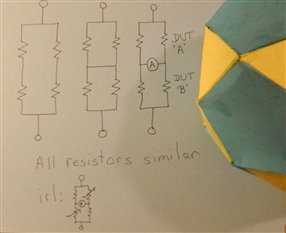
 

image

Imagine that the first two circuits have a dashed rectangles around them, sparing the terminals.  They are 'black boxes.'  For concreteness, let's imagine that each resistor is one ohm/Siemens.  The black boxes would measure out to be one ohm/Siemens.

Pretend that the horizontal line in the second diagram is a jumper.  How much current flows through this wire?  None, ever.  Whether the jumper is attached will be known only to the 'inside the box' community.

So, the (bipolar) ammeter in the third diagram reads zero if Ra=Rb.  Else it will indicate which resistor is larger/smaller.  Remember, the galvanic meter is highly sensitive, although passive.  This circuit arrangement is called a "Whetstone Bridge."


Whetstone is a place in England where people like to balance things.


So there we have it, friend.

  • Sign in to reply
  • Cancel
Parents
  • D_Hersey
    D_Hersey over 10 years ago

    Michael, I was kidding.  When I post in the middle of the night I am just giggling deliriously, not paying much attention.  Thank you for the correction, I was being a stinker.


    Keep it up John, you will one day realize that you have broken through to a level where you will fly freely through this stuff.  IIRC you made your alleged misstatement during a thread by a guy who wanted to detect the presence of metal in a slurry going down a tube.  I won't hold you to it and I certainly won't vouch for my ever-dimming powers of recall.


    Now to the chase:


    You could switch the two resistors into and out of the reference leg of an oscillator and compare frequencies.


    ==========


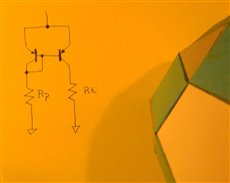
    You could use a Wilson mirror:


    image

    Current through Rp sets the B-E drops of both Qs.  If Rt is greater than Rp, the mirror will reach the limit of its compliance and Q2 will saturate.  If there is greater than a C-E drop across Q2, Rt is the smaller.

    • Cancel
    • Vote Up 0 Vote Down
    • Sign in to reply
    • Cancel
Reply
  • D_Hersey
    D_Hersey over 10 years ago

    Michael, I was kidding.  When I post in the middle of the night I am just giggling deliriously, not paying much attention.  Thank you for the correction, I was being a stinker.


    Keep it up John, you will one day realize that you have broken through to a level where you will fly freely through this stuff.  IIRC you made your alleged misstatement during a thread by a guy who wanted to detect the presence of metal in a slurry going down a tube.  I won't hold you to it and I certainly won't vouch for my ever-dimming powers of recall.


    Now to the chase:


    You could switch the two resistors into and out of the reference leg of an oscillator and compare frequencies.


    ==========


    You could use a Wilson mirror:


    image

    Current through Rp sets the B-E drops of both Qs.  If Rt is greater than Rp, the mirror will reach the limit of its compliance and Q2 will saturate.  If there is greater than a C-E drop across Q2, Rt is the smaller.

    • Cancel
    • Vote Up 0 Vote Down
    • Sign in to reply
    • Cancel
Children
No Data
element14 Community

element14 is the first online community specifically for engineers. Connect with your peers and get expert answers to your questions.

  • Members
  • Learn
  • Technologies
  • Challenges & Projects
  • Products
  • Store
  • About Us
  • Feedback & Support
  • FAQs
  • Terms of Use
  • Privacy Policy
  • Legal and Copyright Notices
  • Sitemap
  • Cookies

An Avnet Company © 2026 Premier Farnell Limited. All Rights Reserved.

Premier Farnell Ltd, registered in England and Wales (no 00876412), registered office: Farnell House, Forge Lane, Leeds LS12 2NE.

ICP 备案号 10220084.

Follow element14

  • X
  • Facebook
  • linkedin
  • YouTube