element14 Community
element14 Community
    Register Log In
  • Site
  • Search
  • Log In Register
  • Community Hub
    Community Hub
    • What's New on element14
    • Feedback and Support
    • Benefits of Membership
    • Personal Blogs
    • Members Area
    • Achievement Levels
  • Learn
    Learn
    • Ask an Expert
    • eBooks
    • element14 presents
    • Learning Center
    • Tech Spotlight
    • STEM Academy
    • Webinars, Training and Events
    • Learning Groups
  • Technologies
    Technologies
    • 3D Printing
    • FPGA
    • Industrial Automation
    • Internet of Things
    • Power & Energy
    • Sensors
    • Technology Groups
  • Challenges & Projects
    Challenges & Projects
    • Design Challenges
    • element14 presents Projects
    • Project14
    • Arduino Projects
    • Raspberry Pi Projects
    • Project Groups
  • Products
    Products
    • Arduino
    • Avnet & Tria Boards Community
    • Dev Tools
    • Manufacturers
    • Multicomp Pro
    • Product Groups
    • Raspberry Pi
    • RoadTests & Reviews
  • About Us
  • Store
    Store
    • Visit Your Store
    • Choose another store...
      • Europe
      •  Austria (German)
      •  Belgium (Dutch, French)
      •  Bulgaria (Bulgarian)
      •  Czech Republic (Czech)
      •  Denmark (Danish)
      •  Estonia (Estonian)
      •  Finland (Finnish)
      •  France (French)
      •  Germany (German)
      •  Hungary (Hungarian)
      •  Ireland
      •  Israel
      •  Italy (Italian)
      •  Latvia (Latvian)
      •  
      •  Lithuania (Lithuanian)
      •  Netherlands (Dutch)
      •  Norway (Norwegian)
      •  Poland (Polish)
      •  Portugal (Portuguese)
      •  Romania (Romanian)
      •  Russia (Russian)
      •  Slovakia (Slovak)
      •  Slovenia (Slovenian)
      •  Spain (Spanish)
      •  Sweden (Swedish)
      •  Switzerland(German, French)
      •  Turkey (Turkish)
      •  United Kingdom
      • Asia Pacific
      •  Australia
      •  China
      •  Hong Kong
      •  India
      • Japan
      •  Korea (Korean)
      •  Malaysia
      •  New Zealand
      •  Philippines
      •  Singapore
      •  Taiwan
      •  Thailand (Thai)
      • Vietnam
      • Americas
      •  Brazil (Portuguese)
      •  Canada
      •  Mexico (Spanish)
      •  United States
      Can't find the country/region you're looking for? Visit our export site or find a local distributor.
  • Translate
  • Profile
  • Settings
Experts, Learning and Guidance
  • Technologies
  • More
Experts, Learning and Guidance
Ask an Expert Forum Noise simulation with SPICE
  • Blog
  • Forum
  • Documents
  • Leaderboard
  • Files
  • Members
  • Mentions
  • Sub-Groups
  • Tags
  • More
  • Cancel
  • New
Join Experts, Learning and Guidance to participate - click to join for free!
Actions
  • Share
  • More
  • Cancel
Forum Thread Details
  • State Verified Answer
  • Replies 4 replies
  • Answers 1 answer
  • Subscribers 301 subscribers
  • Views 1466 views
  • Users 0 members are here
  • simulation
  • low noise
  • noise
  • spice
Related
See a helpful answer?

Be sure to click 'more' and select 'suggest as answer'!

If you're the thread creator, be sure to click 'more' then 'Verify as Answer'!

Noise simulation with SPICE

jc2048
jc2048 over 5 years ago

Does anyone have any experience of simulating noise performance with SPICE?


I'm playing around (in Tina-TI) with an old discrete audio preamp design that was originally intended for use with a pickup coil (moving-coil). If I ask for the input-referenced noise, it gives me this
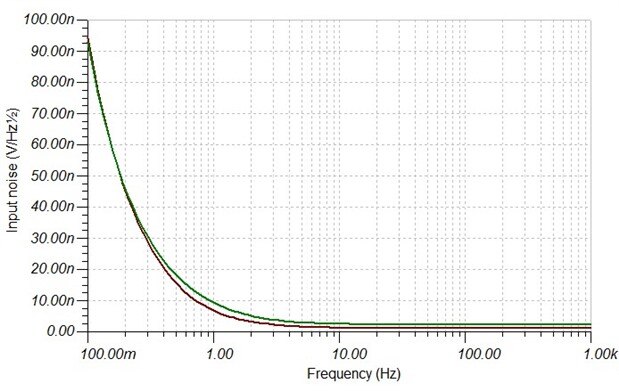
 

image


That looks quite plausible, with the 1/f noise in place and a sensible level for the white noise (1 or 2 nV/rtHz - higher than a very good bipolar low-noise op-amp, but still quite respectable). One thing I'm unsure of is the low corner frequency. An OP27 would be around 2.5Hz, and that's very, very good, so a third of a Hertz looks too good to be true, although this design does use a medium-power transistor in a common-base arrangement at the input, which is obviously something the chip people can't do.


Would it be reasonable to expect transistors to have sensible noise figures in their models?

  • Sign in to reply
  • Cancel

Top Replies

  • shabaz
    shabaz over 5 years ago +1 suggested
    Hi Jon, Interesting question, I don't know the answer, I've never looked closely at BJT SPICE files, and don't know if the models have stayed the same or have improved for newer devices. I came across…
  • michaelkellett
    michaelkellett over 5 years ago +1 verified
    If you have AOE (Art of Electronics) third edition there is a lot of good stuff about discrete device noise in there. If you plotted on a log scale I think the 1/f corner (3dB rise in noise) is nearer…
  • shabaz
    0 shabaz over 5 years ago

    Hi Jon,


    Interesting question, I don't know the answer, I've never looked closely at BJT SPICE files, and don't know if the models have stayed the same or have improved for newer devices.

    I came across this file, maybe you have already seen it: http://www.eng.auburn.edu/~wilambm/pap/2011/K10147_C011.pdf

    It mentions on page 8 that the corner frequency can be as low as tenths of Hz.

    This thread seems useful:

    https://groups.google.com/forum/#!topic/sci.electronics.cad/NMHuu4KdWUg

    And this SPICE document:

    https://class.ece.uw.edu/cadta/hspice/chapter_14.pdf

    on page 46 indicates the SPICE parameters related to noise (I'm thinking if the SPICE file is available, it could be checked to see if these parameters are present).

    • Cancel
    • Vote Up +1 Vote Down
    • Sign in to reply
    • Verify Answer
    • Reject Answer
    • Cancel
  • michaelkellett
    0 michaelkellett over 5 years ago

    If you have AOE (Art of Electronics) third edition there is a lot of good stuff about discrete device noise in there.


    If you plotted on a log scale I think the 1/f corner (3dB rise in noise) is nearer 3Hz than 0.33 Hz.


    1/f noise "definition" here:

    https://www.analog.com/en/analog-dialogue/articles/understanding-and-eliminating-1-f-noise.html


    Spice models are very variable, some good, some bad - no way of telling which you have, other than by comparison with reality.


    I've found discrete MOSFET and transistor models to be worse than IC models.


    My only real life use of small power transistors for low noise was very poor on 1/f corner - but OK for us at 10kHz.


    MK

    • Cancel
    • Vote Up +1 Vote Down
    • Sign in to reply
    • Verify Answer
    • Reject Answer
    • Cancel
  • jc2048
    0 jc2048 over 5 years ago in reply to michaelkellett

    Thanks Michael, that's just what I was after. I did wonder if maybe, because the transistor models

    are a part of SPICE, manufacturers might feel obliged to populate the various parameters

    accurately, but it's like all the rest of simulation: only as good as your models, so beware!


    The Tina help warns that op amp models may be simplified or not have any noise modelling at all,

    but so far I'm finding that models I get from manufacturer's do look to have reasonable modelling.


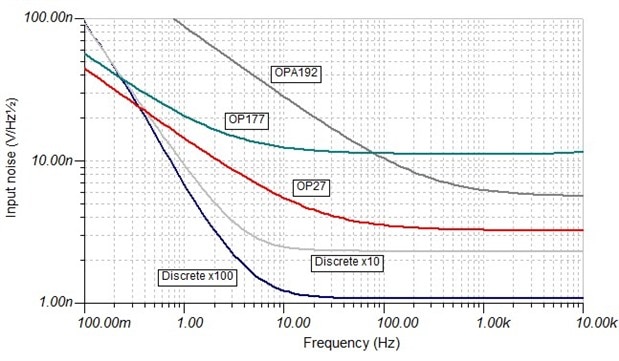
    Here's a selection, along with the discrete design I started with. [This time with a log scale. Why

    did I think I could judge a corner frequency from a linear scale and a constantly changing curve?]


    The OP27 is a bit off from the datasheet, but maybe the simulation model is biased more towards

    worst-case rather than the 'headline' typical figures they like to show on the datasheet. The CMOS

    OPA192 would be expected to have worse low frequency noise than the bipolar parts, but they've

    obviously done a lot of work to get a good wideband figure and the OP27 is a good bit better than

    an OP177 [which is fair enough, given what they're being pitched for and the price difference].


    image


    Even without knowing much about all this, I suspect the discrete design is a bit optimistic when

    you see it against an OP27.


    Although simulation might not always be that useful for actual design, it's very good for

    educational purposes. There are two curves for the discrete design because there's a switch to

    change the gain. That changes the resistance seen by the base of the transistor and that's the

    result. Ouch!


    I might try building the discrete circuit as it's so simple, and do some measurements on it. I

    don't have the test equipment to do that well, but I could make a stab at the low frequency noise.

    • Cancel
    • Vote Up 0 Vote Down
    • Sign in to reply
    • Verify Answer
    • Cancel
  • jc2048
    0 jc2048 over 5 years ago in reply to shabaz

    Thanks Shabaz, some good, helpful material there. Back to school for me!

    • Cancel
    • Vote Up 0 Vote Down
    • Sign in to reply
    • Verify Answer
    • Cancel
element14 Community

element14 is the first online community specifically for engineers. Connect with your peers and get expert answers to your questions.

  • Members
  • Learn
  • Technologies
  • Challenges & Projects
  • Products
  • Store
  • About Us
  • Feedback & Support
  • FAQs
  • Terms of Use
  • Privacy Policy
  • Legal and Copyright Notices
  • Sitemap
  • Cookies

An Avnet Company © 2025 Premier Farnell Limited. All Rights Reserved.

Premier Farnell Ltd, registered in England and Wales (no 00876412), registered office: Farnell House, Forge Lane, Leeds LS12 2NE.

ICP 备案号 10220084.

Follow element14

  • X
  • Facebook
  • linkedin
  • YouTube