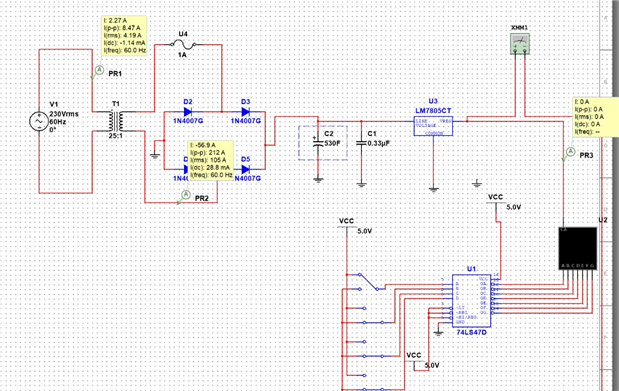
Every time I try to run the circuit the fuse breaks and the display turns off.
also I need the display to be supplied by the five voltage output from the power supply I designed
I attached the multisim file
Be sure to click 'more' and select 'suggest as answer'!
If you're the thread creator, be sure to click 'more' then 'Verify as Answer'!
Every time I try to run the circuit the fuse breaks and the display turns off.
also I need the display to be supplied by the five voltage output from the power supply I designed
I attached the multisim file
530F is a strange value for the capacitor - it's way, way too big (possibly a typo ?)
If the current charging it was 10A it would take 53 seconds to get only 1V across the capacitor - can't be charged through a 1A fuse.
You are using a simulator - so look at the current in the transformer secondary.
A sensible value for the capacitor would be 470uF (about 1 million times smaller). (Biggish electrolytic capacitors are made in a limted range of values - 220, 330, 470, 560 uF are common, I've never seen a 530uF capacitor).
Out of 22600 aluminium electrolytic caps Farnell offer 1410 at 470uF, 288 at 560uF, 40 at 510uF and none (0) at 530uF.
MK
530F is a strange value for the capacitor - it's way, way too big (possibly a typo ?)
If the current charging it was 10A it would take 53 seconds to get only 1V across the capacitor - can't be charged through a 1A fuse.
You are using a simulator - so look at the current in the transformer secondary.
A sensible value for the capacitor would be 470uF (about 1 million times smaller). (Biggish electrolytic capacitors are made in a limted range of values - 220, 330, 470, 560 uF are common, I've never seen a 530uF capacitor).
Out of 22600 aluminium electrolytic caps Farnell offer 1410 at 470uF, 288 at 560uF, 40 at 510uF and none (0) at 530uF.
MK