element14 Community
element14 Community
    Register Log In
  • Site
  • Search
  • Log In Register
  • Community Hub
    Community Hub
    • What's New on element14
    • Feedback and Support
    • Benefits of Membership
    • Personal Blogs
    • Members Area
    • Achievement Levels
  • Learn
    Learn
    • Ask an Expert
    • eBooks
    • element14 presents
    • Learning Center
    • Tech Spotlight
    • STEM Academy
    • Webinars, Training and Events
    • Learning Groups
  • Technologies
    Technologies
    • 3D Printing
    • FPGA
    • Industrial Automation
    • Internet of Things
    • Power & Energy
    • Sensors
    • Technology Groups
  • Challenges & Projects
    Challenges & Projects
    • Design Challenges
    • element14 presents Projects
    • Project14
    • Arduino Projects
    • Raspberry Pi Projects
    • Project Groups
  • Products
    Products
    • Arduino
    • Avnet & Tria Boards Community
    • Dev Tools
    • Manufacturers
    • Multicomp Pro
    • Product Groups
    • Raspberry Pi
    • RoadTests & Reviews
  • About Us
  • Store
    Store
    • Visit Your Store
    • Choose another store...
      • Europe
      •  Austria (German)
      •  Belgium (Dutch, French)
      •  Bulgaria (Bulgarian)
      •  Czech Republic (Czech)
      •  Denmark (Danish)
      •  Estonia (Estonian)
      •  Finland (Finnish)
      •  France (French)
      •  Germany (German)
      •  Hungary (Hungarian)
      •  Ireland
      •  Israel
      •  Italy (Italian)
      •  Latvia (Latvian)
      •  
      •  Lithuania (Lithuanian)
      •  Netherlands (Dutch)
      •  Norway (Norwegian)
      •  Poland (Polish)
      •  Portugal (Portuguese)
      •  Romania (Romanian)
      •  Russia (Russian)
      •  Slovakia (Slovak)
      •  Slovenia (Slovenian)
      •  Spain (Spanish)
      •  Sweden (Swedish)
      •  Switzerland(German, French)
      •  Turkey (Turkish)
      •  United Kingdom
      • Asia Pacific
      •  Australia
      •  China
      •  Hong Kong
      •  India
      • Japan
      •  Korea (Korean)
      •  Malaysia
      •  New Zealand
      •  Philippines
      •  Singapore
      •  Taiwan
      •  Thailand (Thai)
      • Vietnam
      • Americas
      •  Brazil (Portuguese)
      •  Canada
      •  Mexico (Spanish)
      •  United States
      Can't find the country/region you're looking for? Visit our export site or find a local distributor.
  • Translate
  • Profile
  • Settings
Experts, Learning and Guidance
  • Technologies
  • More
Experts, Learning and Guidance
Ask an Expert Forum Excited abput getting startes in electronics with a simple project :D
  • Blog
  • Forum
  • Documents
  • Leaderboard
  • Files
  • Members
  • Mentions
  • Sub-Groups
  • Tags
  • More
  • Cancel
  • New
Join Experts, Learning and Guidance to participate - click to join for free!
Actions
  • Share
  • More
  • Cancel
Forum Thread Details
  • State Suggested Answer
  • Replies 7 replies
  • Answers 2 answers
  • Subscribers 302 subscribers
  • Views 740 views
  • Users 0 members are here
Related
See a helpful answer?

Be sure to click 'more' and select 'suggest as answer'!

If you're the thread creator, be sure to click 'more' then 'Verify as Answer'!

Excited abput getting startes in electronics with a simple project :D

Former Member
Former Member over 11 years ago

Hello world. I'm new here and I would like to start learning about electronics. It's something that fascinates me, but I know close to nothing about it.

Last week I installed an alarm on my car by myself and I got it to work perfectly.

Now, what I'd like to do is to install a cellphone in the car, take the signal from the lights that flash when the alarm is triggered and use it to dial my phone number by using the speed dial function on the phone that will be in the car.

So far I have the following:

- firstly, the signal from the alarm is a 12V DC current that is intermintent. It is on 1 second and off 1 second. There, I figured I could use a reservoir capacitor in order to have a (almost) constant signal.

- that signal would operate a relay that will make a connection between the two contacts on a number key in the cellphone, so that after 3 or 4 seconds, the speed dial would call my number.

(* I could use a separate relay that uses the wires that feed a relay to disconnect the energy from the spark plugs when the alarm is triggered, to avoid the phone calling when I connect or disconnect the alarm, since lights flash in that moment.)

- What I'd need is that the relay that closes the circuit on the phone (i.e. dial the number through speeddial) work for no more than 5 seconds (about the time it takes for the speed dial to activate)

- After that, I'd like for the circuit to wait for about 1 or 2 minutes and start over (so as to no call me again as soon as I hang up) to remind me after 1 or 2 minutes that the alarm is still ringing if I didn't catch it the first time.


I've attached a very crude diagram (the only imaging SW I know how to use is AutoCAD, but I don't have it installed, so I used Paint) of how I think it might work. But that will only keep the cellphone button pressed for as long as the alarm is ringing.

All of this should be while the alarm is triggered, which is to say that the intermitent pulse from the lights flashed by the alarm should be ignored for 1 or 2 minutes.

I've read something about a 555 IC that would be usefull to get the timing (the 5 sec on and 1 minute off) but i hace no idea how to use it and where to put it.


The end result would be:

the car alarm is triggered and the car lights will flash (one second on, one second off) continuosly. Once the lights start flashing, helped by the capacitor (and enabled by the second relay, which only activates when the alarm is triggered and not when the alarm is armed or disarmed) the main relay will hold a number key in the phone's keypad, which will make it call me using the speed dial feature in the car's phone.

After that, the relay will disconnect (the key in the phone will no longer be pressed); it will wait a minute and call me again (as long as the alarm is still active).


Would you be so kind to help me?

I'm very excited about this project. It should seem very simple and basic to the members of the community, but it would be HUGE for me and it would encourage me to undertake more ambitous projects and to learn more about electronics.

Thanks!!!


P.S.: Since I'm new here, I'm not sure if this thread goes in this forum. If not, could you be so kind to move it where it should go? or at least tell me where I should post it.

P.S.2: Ben Heck rules!!!

Attachments:
image
  • Sign in to reply
  • Cancel
Parents
  • dougw
    0 dougw over 11 years ago

    Hi Ferderico,

    One side of the capacitor should be connected to ground (the way it is shown, it will prevent current from flowing).

    There needs to be a diode in front of the capacitor to prevent discharge when the input signal goes low.

    The relays should be replaced by FET transistors because relays will likely take too much current to run.

    If you get that far, we can then extend the functionality to include the periodic activation you want.

    Doug

    • Cancel
    • Vote Up 0 Vote Down
    • Sign in to reply
    • Verify Answer
    • Reject Answer
    • Cancel
Reply
  • dougw
    0 dougw over 11 years ago

    Hi Ferderico,

    One side of the capacitor should be connected to ground (the way it is shown, it will prevent current from flowing).

    There needs to be a diode in front of the capacitor to prevent discharge when the input signal goes low.

    The relays should be replaced by FET transistors because relays will likely take too much current to run.

    If you get that far, we can then extend the functionality to include the periodic activation you want.

    Doug

    • Cancel
    • Vote Up 0 Vote Down
    • Sign in to reply
    • Verify Answer
    • Reject Answer
    • Cancel
Children
  • Former Member
    0 Former Member over 11 years ago in reply to dougw

    Hi, Douglas. Thanks for the reply.

    Fullscreen contentimage_176461.html Download
    <html><head><title>Jive SBS</title></head>
    <body><font face="arial,helvetica,sans-serif">
    <b>Error</b><br><font size="-1">
    An general error occurred while processing your request.
    </font></font></body></html>
    

    So far, I bought 2 JQC-3F-1C-12VDC relays and a 1200 μF and I got it working. The guy at the store explained to me how to connect the capacitor image and it worked.

    I realized that my alarm doesn't have an engine kill switch (I also realized that IF IT DID HAVE a kill switch, I wouldn't need the intermitent light. I would just use that continous signal from there image).

    Anyway, by hooking the intermitent signal to the capacitor I could smooth the signal enough as to get the relay to stay closed for as long as there is signal. So far, so good.

    So, at this point, when the alarm is triggered I have a constant 12 VDC signal. I read something about the 555 and, with my limited understanding, I understood that it supports a 12 V signal (perhaps with the capacitor alone the 555 could work and I could get rid of RELAY 1).

    I also learned something about "duty cycle". I can use the IC 555 to get a 95% of the time on and 5% off (it really doesn't matter if it's 95% on and 5% off or the other way around, since I can connect the phone's button to the normally closed or to the normally open prong on the RELAY 2).

    So what I need to know is how to connect the IC 555 to get a 5% duty cycle (or 95%).

    I noticed what you say about the diode, because I noticed that as soon as the current is cut, the voltage drops dramatically, although it was enough to get the relay closed.

    Also, I have no idea what a FET is or how to connect it.

    In the image attached everything is working so far. Could you help me with the IC 555 duty cycle, and, if you think the FET transistors would be better suited for this, tell me how to connect them?


    Thank you very much!!!

    • Cancel
    • Vote Up 0 Vote Down
    • Sign in to reply
    • Verify Answer
    • Cancel
  • dougw
    0 dougw over 11 years ago in reply to Former Member

    Hi Frederico

    A 555 might not be able to create a 2 minute delay reliably - the capacitor would be charging so slowly that it would be susceptible to noise triggering for a quite a while before it finally completed its pulse.

    Here is a circuit that should work - it counts the alarm pulses to create a long delay between switch closures.

    The 3 chips are CMOS logic chips. The 4040 is a 12 bit counter. The 4013 is an SR latch. The 4538 is a oneshot (like the 555).

    The 2N7000 is an N channel FET.

    The circuit is powered entirely by the alarm signal, so it does not drain the battery when no alarm exists. (the 12V in this circuit is not connected to the battery)

    I think this circuit will generate a switch closure when the alarm first starts, but I am not sure - the 4538 power-up conditions are not well described in the datasheet.

    It should generate a switch closure every couple of minutes after the alarm activates.


    Fullscreen 7870.contentimage_176462.html Download
    <html><head><title>Jive SBS</title></head>
    <body><font face="arial,helvetica,sans-serif">
    <b>Error</b><br><font size="-1">
    An general error occurred while processing your request.
    </font></font></body></html>
    

    • Cancel
    • Vote Up 0 Vote Down
    • Sign in to reply
    • Verify Answer
    • Reject Answer
    • Cancel
  • Former Member
    0 Former Member over 11 years ago in reply to dougw

    Thank you very much image

    Actually, the 2 minutes delay is not strict at all. It can be 1 or two minutes. It's meant as a reminder. The most important part is that the switch closure last around 3 to 5 secs (also, no so precisely).

    I will try to set it up and tell you how it went.


    Thanks!!

    • Cancel
    • Vote Up 0 Vote Down
    • Sign in to reply
    • Verify Answer
    • Cancel
  • Former Member
    0 Former Member over 11 years ago in reply to dougw

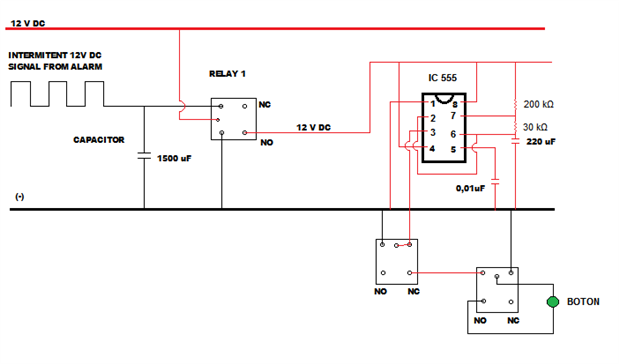
    Hey, Douglas. What do you think about this?


    image

    According to some calculators I found online this will give me a 35 seconds ON and 5 seconds OFF output. Then I use a relay on the NC prong to invert it to 5 secs on and 35 secs off, which holds the button pressed for 5 secs and releases it for 35 secs. (BTW, "boton" means button in spanish image)

    Your circuit looks way better than mine, but it's too complicated for me. Besides, button press and release times may vary and it doesn't matter very much, since it's just a reminder. I can also fine tune it by changing the resistors of by using rheostats or potentiometers (i never understood the difference between those two) instead.


    Do you think this will work?

    Thanks!!!

    • Cancel
    • Vote Up 0 Vote Down
    • Sign in to reply
    • Verify Answer
    • Cancel
  • dougw
    0 dougw over 11 years ago in reply to Former Member

    Hi Frederico,

    I is worth a try.

    The relays need to be low enough power such that the 555 can drive both at the same time.

    They should also have a snubber diode across their coils to protect the 555 from large voltage spikes when the coils turn off.

    Doug

    • Cancel
    • Vote Up 0 Vote Down
    • Sign in to reply
    • Verify Answer
    • Cancel
element14 Community

element14 is the first online community specifically for engineers. Connect with your peers and get expert answers to your questions.

  • Members
  • Learn
  • Technologies
  • Challenges & Projects
  • Products
  • Store
  • About Us
  • Feedback & Support
  • FAQs
  • Terms of Use
  • Privacy Policy
  • Legal and Copyright Notices
  • Sitemap
  • Cookies

An Avnet Company © 2025 Premier Farnell Limited. All Rights Reserved.

Premier Farnell Ltd, registered in England and Wales (no 00876412), registered office: Farnell House, Forge Lane, Leeds LS12 2NE.

ICP 备案号 10220084.

Follow element14

  • X
  • Facebook
  • linkedin
  • YouTube