element14 Community
element14 Community
    Register Log In
  • Site
  • Search
  • Log In Register
  • Community Hub
    Community Hub
    • What's New on element14
    • Feedback and Support
    • Benefits of Membership
    • Personal Blogs
    • Members Area
    • Achievement Levels
  • Learn
    Learn
    • Ask an Expert
    • eBooks
    • element14 presents
    • Learning Center
    • Tech Spotlight
    • STEM Academy
    • Webinars, Training and Events
    • Learning Groups
  • Technologies
    Technologies
    • 3D Printing
    • FPGA
    • Industrial Automation
    • Internet of Things
    • Power & Energy
    • Sensors
    • Technology Groups
  • Challenges & Projects
    Challenges & Projects
    • Design Challenges
    • element14 presents Projects
    • Project14
    • Arduino Projects
    • Raspberry Pi Projects
    • Project Groups
  • Products
    Products
    • Arduino
    • Avnet & Tria Boards Community
    • Dev Tools
    • Manufacturers
    • Multicomp Pro
    • Product Groups
    • Raspberry Pi
    • RoadTests & Reviews
  • About Us
  • Store
    Store
    • Visit Your Store
    • Choose another store...
      • Europe
      •  Austria (German)
      •  Belgium (Dutch, French)
      •  Bulgaria (Bulgarian)
      •  Czech Republic (Czech)
      •  Denmark (Danish)
      •  Estonia (Estonian)
      •  Finland (Finnish)
      •  France (French)
      •  Germany (German)
      •  Hungary (Hungarian)
      •  Ireland
      •  Israel
      •  Italy (Italian)
      •  Latvia (Latvian)
      •  
      •  Lithuania (Lithuanian)
      •  Netherlands (Dutch)
      •  Norway (Norwegian)
      •  Poland (Polish)
      •  Portugal (Portuguese)
      •  Romania (Romanian)
      •  Russia (Russian)
      •  Slovakia (Slovak)
      •  Slovenia (Slovenian)
      •  Spain (Spanish)
      •  Sweden (Swedish)
      •  Switzerland(German, French)
      •  Turkey (Turkish)
      •  United Kingdom
      • Asia Pacific
      •  Australia
      •  China
      •  Hong Kong
      •  India
      • Japan
      •  Korea (Korean)
      •  Malaysia
      •  New Zealand
      •  Philippines
      •  Singapore
      •  Taiwan
      •  Thailand (Thai)
      • Vietnam
      • Americas
      •  Brazil (Portuguese)
      •  Canada
      •  Mexico (Spanish)
      •  United States
      Can't find the country/region you're looking for? Visit our export site or find a local distributor.
  • Translate
  • Profile
  • Settings
Experts, Learning and Guidance
  • Technologies
  • More
Experts, Learning and Guidance
Ask an Expert Forum Experiment 11 in Make: Electronics (2nd edition)
  • Blog
  • Forum
  • Documents
  • Leaderboard
  • Files
  • Members
  • Mentions
  • Sub-Groups
  • Tags
  • More
  • Cancel
  • New
Join Experts, Learning and Guidance to participate - click to join for free!
Actions
  • Share
  • More
  • Cancel
Forum Thread Details
  • State Verified Answer
  • Replies 9 replies
  • Answers 3 answers
  • Subscribers 303 subscribers
  • Views 1712 views
  • Users 0 members are here
  • make: electronics
Related
See a helpful answer?

Be sure to click 'more' and select 'suggest as answer'!

If you're the thread creator, be sure to click 'more' then 'Verify as Answer'!

Experiment 11 in Make: Electronics (2nd edition)

os·cil·la·tor
os·cil·la·tor over 8 years ago

Hello,


I am having difficulty with Experiment 11 in the second edition of Make: Electronics.


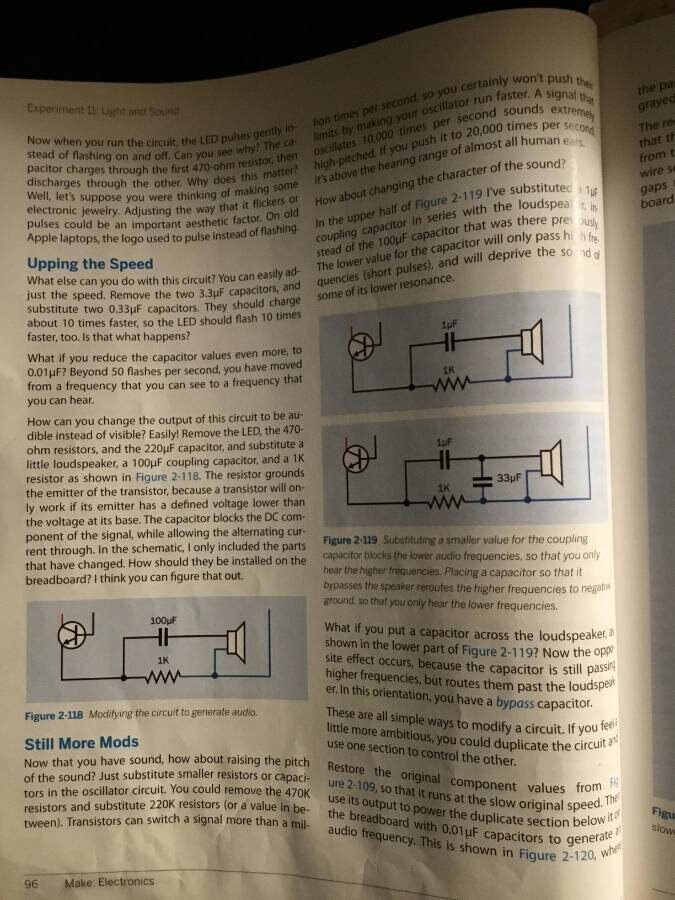
Specifically I am having trouble figuring out where to connect the components in Figure 2-118 to the breadboard.  They are meant to replace the 4 color components at the lower right of Figure 2-116 / 2-117. 


I am able to generate sound by guessing where to connect the speaker, 100uF capacitor, and 1K resistor, but the capacitor and resistor have no bearing on the sound..... it makes the buzz whether those components are attached or not.  Also, replacing the 100uF capacitor with a 1uF capacitor as the upper portion of Figure 2-119 instructs does not change the character of the sound, so clearly I am not putting things in their proper places.


Obviously this is an issue of being able to translate schematics to functional design, but as a complete beginner on page 96 of an introductory electronics book, I find this very difficult.


Could someone please help me figure out Figure 2-118?   I also foresee difficulty with the lower portion of Figure 2-119.


Thank you for your assistance!


image


image

image


image

  • Sign in to reply
  • Cancel

Top Replies

  • jc2048
    jc2048 over 8 years ago +3 verified
    Here are possible layouts for the first circuit with a speaker and then the third one with the bypass capacitor. I'm assuming you can manage the second one where you just substitute a 1uF cap for the 100uF…
  • beacon_dave
    beacon_dave over 8 years ago in reply to jc2048 +2 suggested
    The book says "Speaker (small)" which is not very helpful, however the kit option would appear to include a "Small 8-ohm loudspeaker". http://www.plattkits.com/kits/ Does the book give you a specification…
  • jw0752
    jw0752 over 8 years ago +1
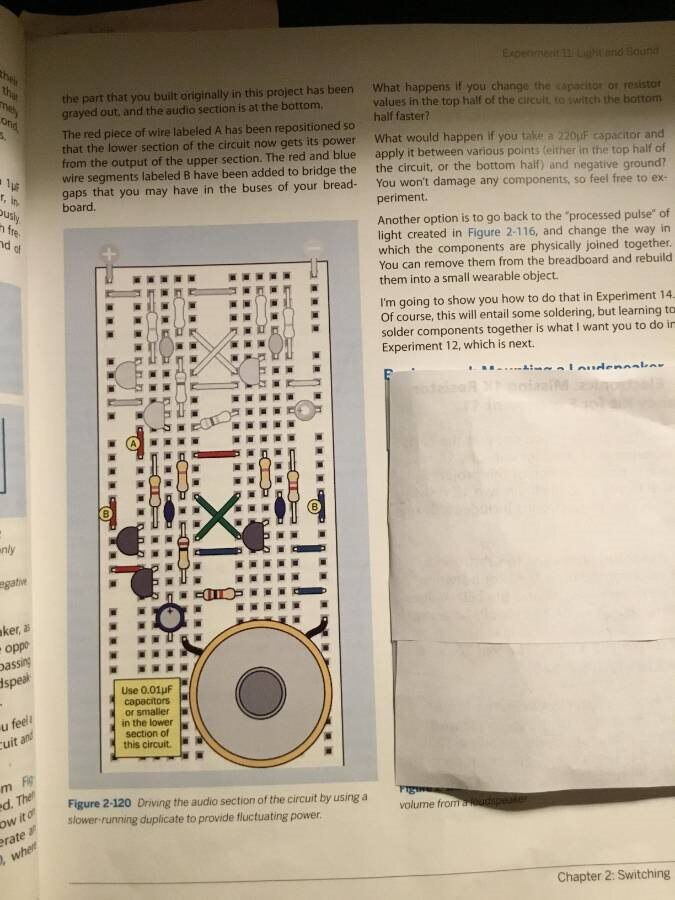
    Hi, You are doing OK. The layout in 2-120 is exactly what is being called for in figure 2-119. I drew it out on a piece of paper but what I drew is the same as figure 2-120. Keep in mind that the 2 vertical…
Parents
  • jw0752
    0 jw0752 over 8 years ago

    Hi,


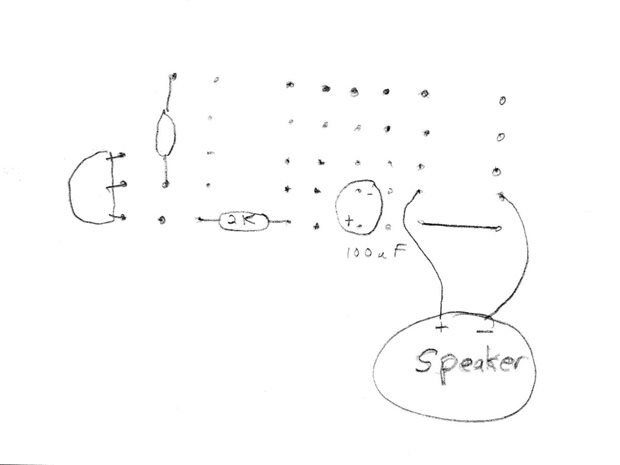
    You are doing OK. The layout in 2-120 is exactly what is being called for in figure 2-119. I drew it out on a piece of paper but what I drew is the same as figure 2-120.


    image


    Keep in mind that the 2 vertical lines of holes associated with the red and blue lines are all connected together and the horizontal groups of five holes on either side of the middle grove are also hooked together. They serve as wires with multiple connection points. Compare my drawing to the figure 2-120 and see if you can see how they are really equivalent. Getting comfortable with the new protocols of a new course of study is always a challenge but also worth it. The book you are using to learn is an excellent one. Keep up the good work.


    John

    • Cancel
    • Vote Up +1 Vote Down
    • Sign in to reply
    • Verify Answer
    • Cancel
Reply
  • jw0752
    0 jw0752 over 8 years ago

    Hi,


    You are doing OK. The layout in 2-120 is exactly what is being called for in figure 2-119. I drew it out on a piece of paper but what I drew is the same as figure 2-120.


    image


    Keep in mind that the 2 vertical lines of holes associated with the red and blue lines are all connected together and the horizontal groups of five holes on either side of the middle grove are also hooked together. They serve as wires with multiple connection points. Compare my drawing to the figure 2-120 and see if you can see how they are really equivalent. Getting comfortable with the new protocols of a new course of study is always a challenge but also worth it. The book you are using to learn is an excellent one. Keep up the good work.


    John

    • Cancel
    • Vote Up +1 Vote Down
    • Sign in to reply
    • Verify Answer
    • Cancel
Children
  • jc2048
    0 jc2048 over 8 years ago in reply to jw0752

    I don't think it is the same. The capacitor + needs to go to the emitter, not the ground end of the resistor.


    Having said that, some additional resistance in series with the speaker would be a good idea - at the moment the dissipation is high, even with a 32 or 40 ohm speaker (if it's running from 9V or something of that order). With an 8 ohm speaker it would probably damage the output transistor.

    • Cancel
    • Vote Up +1 Vote Down
    • Sign in to reply
    • Verify Answer
    • Reject Answer
    • Cancel
  • jw0752
    0 jw0752 over 8 years ago in reply to jc2048

    Hi Jon,


    I think you are absolutely correct. (Senior Moment). Please disregard my previous post s it was wrong.


    John

    • Cancel
    • Vote Up +1 Vote Down
    • Sign in to reply
    • Verify Answer
    • Cancel
  • jc2048
    0 jc2048 over 8 years ago in reply to jw0752

    Don't worry - I once made a mistake, too. [Now I'm trying to think who it was I stole that joke from...]


    I'm partly wrong as well. I assumed that an 8 ohm speaker would be too much of a load for the emitter-follower but, if you look in detail at what the circuit does, it ends up with a fair bit of voltage being dropped by the coupling capacitor and a 2N2222A would probably just about manage because it's got quite a good collector current rating.


    If you simulate it, you'll see it's a horrible way to drive a speaker. You can immediately understand why they quickly went to push-pull output stages on the early transistor radios.

    • Cancel
    • Vote Up 0 Vote Down
    • Sign in to reply
    • Verify Answer
    • Reject Answer
    • Cancel
  • os·cil·la·tor
    0 os·cil·la·tor over 8 years ago in reply to jw0752

    Hi John,


    Thank you for your response!  It is definitely helpful to remember that the breadboard is connected in horizontal rows.  Moving things left and right (up to the middle divide) seems to be ok (at least in these simple circuits), but moving a component up or down breaks the connection.   This actually came in useful on this circuit, as I will mention below.  Thanks so much for your encouragement!

    • Cancel
    • Vote Up +1 Vote Down
    • Sign in to reply
    • Verify Answer
    • Cancel
element14 Community

element14 is the first online community specifically for engineers. Connect with your peers and get expert answers to your questions.

  • Members
  • Learn
  • Technologies
  • Challenges & Projects
  • Products
  • Store
  • About Us
  • Feedback & Support
  • FAQs
  • Terms of Use
  • Privacy Policy
  • Legal and Copyright Notices
  • Sitemap
  • Cookies

An Avnet Company © 2025 Premier Farnell Limited. All Rights Reserved.

Premier Farnell Ltd, registered in England and Wales (no 00876412), registered office: Farnell House, Forge Lane, Leeds LS12 2NE.

ICP 备案号 10220084.

Follow element14

  • X
  • Facebook
  • linkedin
  • YouTube