element14 Community
element14 Community
    Register Log In
  • Site
  • Search
  • Log In Register
  • Community Hub
    Community Hub
    • What's New on element14
    • Feedback and Support
    • Benefits of Membership
    • Personal Blogs
    • Members Area
    • Achievement Levels
  • Learn
    Learn
    • Ask an Expert
    • eBooks
    • element14 presents
    • Learning Center
    • Tech Spotlight
    • STEM Academy
    • Webinars, Training and Events
    • Learning Groups
  • Technologies
    Technologies
    • 3D Printing
    • FPGA
    • Industrial Automation
    • Internet of Things
    • Power & Energy
    • Sensors
    • Technology Groups
  • Challenges & Projects
    Challenges & Projects
    • Design Challenges
    • element14 presents Projects
    • Project14
    • Arduino Projects
    • Raspberry Pi Projects
    • Project Groups
  • Products
    Products
    • Arduino
    • Avnet & Tria Boards Community
    • Dev Tools
    • Manufacturers
    • Multicomp Pro
    • Product Groups
    • Raspberry Pi
    • RoadTests & Reviews
  • About Us
  • Store
    Store
    • Visit Your Store
    • Choose another store...
      • Europe
      •  Austria (German)
      •  Belgium (Dutch, French)
      •  Bulgaria (Bulgarian)
      •  Czech Republic (Czech)
      •  Denmark (Danish)
      •  Estonia (Estonian)
      •  Finland (Finnish)
      •  France (French)
      •  Germany (German)
      •  Hungary (Hungarian)
      •  Ireland
      •  Israel
      •  Italy (Italian)
      •  Latvia (Latvian)
      •  
      •  Lithuania (Lithuanian)
      •  Netherlands (Dutch)
      •  Norway (Norwegian)
      •  Poland (Polish)
      •  Portugal (Portuguese)
      •  Romania (Romanian)
      •  Russia (Russian)
      •  Slovakia (Slovak)
      •  Slovenia (Slovenian)
      •  Spain (Spanish)
      •  Sweden (Swedish)
      •  Switzerland(German, French)
      •  Turkey (Turkish)
      •  United Kingdom
      • Asia Pacific
      •  Australia
      •  China
      •  Hong Kong
      •  India
      • Japan
      •  Korea (Korean)
      •  Malaysia
      •  New Zealand
      •  Philippines
      •  Singapore
      •  Taiwan
      •  Thailand (Thai)
      • Vietnam
      • Americas
      •  Brazil (Portuguese)
      •  Canada
      •  Mexico (Spanish)
      •  United States
      Can't find the country/region you're looking for? Visit our export site or find a local distributor.
  • Translate
  • Profile
  • Settings
Experts, Learning and Guidance
  • Technologies
  • More
Experts, Learning and Guidance
Ask an Expert Forum Philips GA-212 Turntable LDR Voltage
  • Blog
  • Forum
  • Documents
  • Leaderboard
  • Files
  • Members
  • Mentions
  • Sub-Groups
  • Tags
  • More
  • Cancel
  • New
Join Experts, Learning and Guidance to participate - click to join for free!
Actions
  • Share
  • More
  • Cancel
Forum Thread Details
  • State Not Answered
  • Replies 16 replies
  • Subscribers 303 subscribers
  • Views 5285 views
  • Users 0 members are here
Related
See a helpful answer?

Be sure to click 'more' and select 'suggest as answer'!

If you're the thread creator, be sure to click 'more' then 'Verify as Answer'!

Philips GA-212 Turntable LDR Voltage

Graeme
Graeme over 3 years ago

Hello

I have a Philips GA-212 Turntable. I have serviced it and set all the voltages etc. The speeds are now correct and it's sounding great. However, no matter how hard I try the voltage across the LDR is between 6.3V and 8.3V depending on the setting of the pot.  have checked the surrounding components and it's a 4.7K Pot. The main voltage is -9V. I have replaced the 2 x electrolytics. I am measuring the voltages with the TT is the stop position and the arm in it's holder. The turnable stops if I move the arm quite quickly to the centre but not if slowly on a record no matter what setting the pot is at. I can never get anywhere near 0.75V

Any thought out there please?

Kind regards

Graeme

  • Sign in to reply
  • Cancel

Top Replies

  • Jan Cumps
    Jan Cumps over 3 years ago +3
    I fixed this on the same model: Service my Philips 212 Turntable - Part 2: initial measurements Philips have changed that circuit. In the post I linked above, you 'll find the LCR schematics for both…
  • Jan Cumps
    0 Jan Cumps over 3 years ago

    I fixed this on the same model: Service my Philips 212 Turntable - Part 2: initial measurements

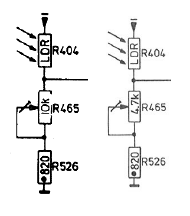
    Philips have changed that circuit. In the post I linked above, you 'll find the LCR schematics for both versions (section Auto Switch-Off LDR).
    In my case, I believe the reason was that someone serviced the turntable with the incorrect version of the manual an tried to replace (and put back wrongly) the potentiometer. While the defect in my table was somewhere else in the power supply.
    So after I fixed the supply, and resoldered the LCR regulator, a 4K7 one, and could get the voltage to 0.75 V (see meter LCD screen below)

    image

    • Cancel
    • Vote Up +3 Vote Down
    • Sign in to reply
    • Verify Answer
    • Cancel
  • Graeme
    0 Graeme over 3 years ago in reply to Jan Cumps

    Hi Jan

    Many thanks for your reply. I had, in fact, followed your excellent advice before tackling my own TT. I'll have another go 'though it's not a critical aspect as the TT is working and sounding fab. With the original and excellent Philips 401 Cartridge too! I think this TT is very well made overall but it's just a shame the arm looks and feels like it's come from 'Toys r Us' ;-)

    Cheers

    Graeme

    • Cancel
    • Vote Up 0 Vote Down
    • Sign in to reply
    • Verify Answer
    • Cancel
  • Jan Cumps
    0 Jan Cumps over 3 years ago in reply to Graeme

    Ultra light tonearms mounted fixed on the subchassis are specific for Philips.

    • Cancel
    • Vote Up 0 Vote Down
    • Sign in to reply
    • Verify Answer
    • Cancel
  • Graeme
    0 Graeme over 3 years ago in reply to Jan Cumps

    Hello again

    A few thoughts re the LDR voltage please? Whilst the TT is working and sounding great, I cannot get the LDR voltage anywhere near 0.75V. It varies between 6.5 and 8.5 depending on the setting of R465. The supply voltage is exactly 9V

    I have thoroughly checked the LDR, R465 and R526

    R526 measure 820ohm. R465 measures between 0 and 4.45Kohm (a 4.7K pot) and the LDR (wires disconnected from board) 6.5Mohm (dark) and 9Kohm with the bulb ON. The measurement of 0.75V should be when the light is on, in the stop position and the arm at the rest position.

    Using a voltage divider calculator https://ohmslawcalculator.com/voltage-divider-calculator shows that i could never reach 0.75V

    As such i believe i have an incorrect/faulty LDR? I know they are avail with many different resistance settings. This one appears original.

    I have a fair amount of electronic knowledge gained over many years but this one stumps me. Perhaps i cannot see the wood for the trees. Any thoughts please?

    As said before, this is in no way critical but it would be nice to sort it.

     - On another note, what voltage do you have across the main motor when on 33/45? I don't find the motor that strong and the current/voltage cannot be that high as it's being fed via a simple BC338

    Cheers

    Graeme

    • Cancel
    • Vote Up 0 Vote Down
    • Sign in to reply
    • Verify Answer
    • Cancel
  • Jan Cumps
    0 Jan Cumps over 3 years ago in reply to Graeme

    On the 1st note:

    If that's what the LDR measures, you'll indeed never get at the - 0.75 V.
    To be sure, I checked with both versions of the schematic:

    image

    But in both cases, the LDR has to drop to under the 1 K. 
    500 Ohm if the pot = 10 K, 980 Ohm if it's a 4.7 K one. 
    The 9 K that you measure is an order of magnitude too high for either configuration.

    • Cancel
    • Vote Up 0 Vote Down
    • Sign in to reply
    • Verify Answer
    • Cancel
  • Jan Cumps
    0 Jan Cumps over 3 years ago in reply to Graeme

     - On another note, what voltage do you have across the main motor when on 33/45? I don't find the motor that strong and the current/voltage cannot be that high as it's being fed via a simple BC338

    I'll have to pass on that. To get access to the inside I'd have to empty a wall size book case and move it away from the wall. I've given the table its final place.

    • Cancel
    • Vote Up 0 Vote Down
    • Sign in to reply
    • Verify Answer
    • Cancel
  • Graeme
    0 Graeme over 3 years ago in reply to Jan Cumps

    Haha. No need to dismantle your house!

    I'm wondering if increasing R526 to around 100K or so could 'force' the circuit to work with the current LDR?

    • Cancel
    • Vote Up 0 Vote Down
    • Sign in to reply
    • Verify Answer
    • Cancel
  • Jan Cumps
    0 Jan Cumps over 3 years ago in reply to Graeme

    I'd see a few issues with that:

    • the divider would get rather weak. It's now much lower than the input impedance of the transistor circuit.
      guidelines (from Art of Electronics) is that the impedance of a voltage divider should be at least 10 x lower than the impedance of its load.
    • With a 100 K resistor, the trimmer will have almost no range to alter. It'd need to get increased too. And then it adds to the 1st point's problem.
    • There are other circuits attached to the output node of the divider.
      image
      Although the LCR circuit is AC coupled (via C726 and C727), you may have to change R532, R542 or fiddle with the settings of  R466 and R467.

    The motor isn't very strong, but on the other side, not weak either. On my table, with a 12" record on the table, it reaches its 33 RPM speed, from stop position, in 2 seconds.

    • Cancel
    • Vote Up 0 Vote Down
    • Sign in to reply
    • Verify Answer
    • Cancel
  • Graeme
    0 Graeme over 3 years ago in reply to Jan Cumps

    Good points thank you. Checking on line the only ones I can find have the following resistance...do you think any of them might be suitable?

    Re the motor. Mine also starts up quickly but occasionally the pitch varies (wow) for a few seconds....not really a huge issue as 99% of the times all is good. I did oil the bearing and motor. New belt and cleaned the pulley etc with ISO alcohol.

    Otherwise it sounds great. Very low noise floor indeed.

    Thanks for your continued help :-)

    Resistance: @10 Lux
    GL5506 2-5Kohm
    GL5516 5-10kohm
    GL5528 8-20Kohm
    GL5537 18-50Kohm
    GL5539 30-90Kohm
    GL5549 45-100Kohm
    Dark Resistance:
    GL5506 0.2Mohm
    GL5516 0.5Mohn
    GL5528 1Mohm
    GL5537 2Mohm
    GL5539 5Mohm
    GL5549 10Mohm
    • Cancel
    • Vote Up 0 Vote Down
    • Sign in to reply
    • Verify Answer
    • Cancel
  • Jan Cumps
    0 Jan Cumps over 3 years ago in reply to Graeme
    Graeme said:
    Re the motor. Mine also starts up quickly but occasionally the pitch varies (wow) for a few seconds

    Most likely not a motor issue. There are a few players that can influence it:

    • stability of the power supply. 

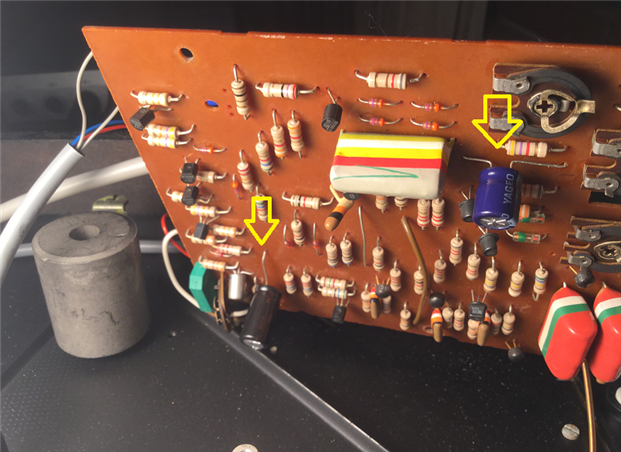
    image

    If not done yet, replace the capacitors on the locations I've flagged with the yellow arrows.
    The photo shows the after state. The original ones are blue Philips electrolytes.
    If they are still there, replace. If you have an LCR meter, you can see for yourself that they are out of spec. If not, just assume they are bad.
    Electrolytes have polarity. Replace with same value, (at least) same voltage and in the right direction.

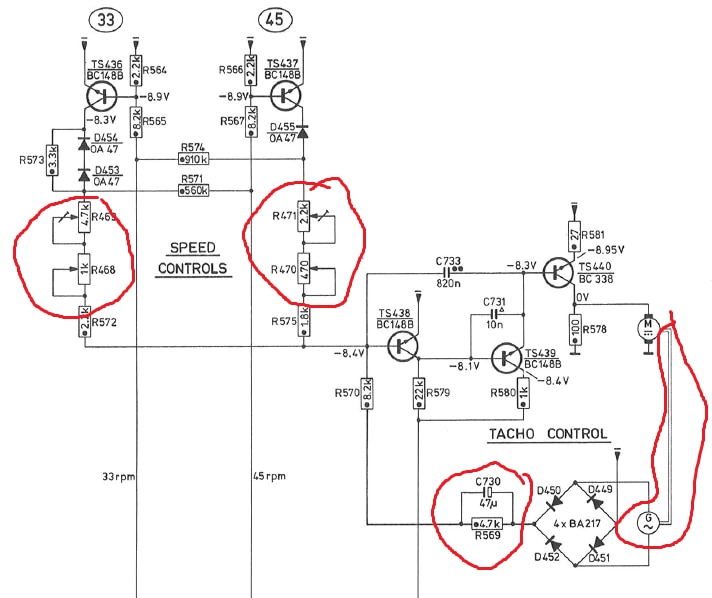
    • check the contacts of the potentiometers and trimmers that influence the speed, and the feedback circuit
      image
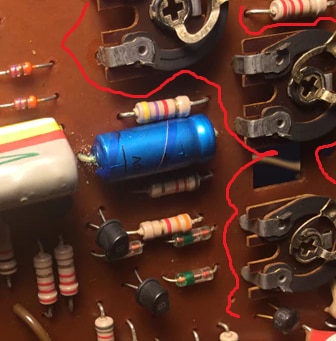
      the two upper circles are the pots and trimmers. Maybe they need a contact clean. They are all sitting on the PCB and look like this
      image
      (in this photo you can also see one of the old electrolytes that need to be replaced, in bright blue. It's C730 that has impact on speed stability)

      Check the tacho cable from motor to PCB. Bad contacts?
      Check the value of C730, or better, replace it. It's one of the two electrolytes.
    • Cancel
    • Vote Up 0 Vote Down
    • Sign in to reply
    • Verify Answer
    • Cancel
>
element14 Community

element14 is the first online community specifically for engineers. Connect with your peers and get expert answers to your questions.

  • Members
  • Learn
  • Technologies
  • Challenges & Projects
  • Products
  • Store
  • About Us
  • Feedback & Support
  • FAQs
  • Terms of Use
  • Privacy Policy
  • Legal and Copyright Notices
  • Sitemap
  • Cookies

An Avnet Company © 2025 Premier Farnell Limited. All Rights Reserved.

Premier Farnell Ltd, registered in England and Wales (no 00876412), registered office: Farnell House, Forge Lane, Leeds LS12 2NE.

ICP 备案号 10220084.

Follow element14

  • X
  • Facebook
  • linkedin
  • YouTube