element14 Community
element14 Community
    Register Log In
  • Site
  • Search
  • Log In Register
  • Community Hub
    Community Hub
    • What's New on element14
    • Feedback and Support
    • Benefits of Membership
    • Personal Blogs
    • Members Area
    • Achievement Levels
  • Learn
    Learn
    • Ask an Expert
    • eBooks
    • element14 presents
    • Learning Center
    • Tech Spotlight
    • STEM Academy
    • Webinars, Training and Events
    • Learning Groups
  • Technologies
    Technologies
    • 3D Printing
    • FPGA
    • Industrial Automation
    • Internet of Things
    • Power & Energy
    • Sensors
    • Technology Groups
  • Challenges & Projects
    Challenges & Projects
    • Design Challenges
    • element14 presents Projects
    • Project14
    • Arduino Projects
    • Raspberry Pi Projects
    • Project Groups
  • Products
    Products
    • Arduino
    • Avnet & Tria Boards Community
    • Dev Tools
    • Manufacturers
    • Multicomp Pro
    • Product Groups
    • Raspberry Pi
    • RoadTests & Reviews
  • About Us
    About the element14 Community
  • Store
    Store
    • Visit Your Store
    • Choose another store...
      • Europe
      •  Austria (German)
      •  Belgium (Dutch, French)
      •  Bulgaria (Bulgarian)
      •  Czech Republic (Czech)
      •  Denmark (Danish)
      •  Estonia (Estonian)
      •  Finland (Finnish)
      •  France (French)
      •  Germany (German)
      •  Hungary (Hungarian)
      •  Ireland
      •  Israel
      •  Italy (Italian)
      •  Latvia (Latvian)
      •  
      •  Lithuania (Lithuanian)
      •  Netherlands (Dutch)
      •  Norway (Norwegian)
      •  Poland (Polish)
      •  Portugal (Portuguese)
      •  Romania (Romanian)
      •  Russia (Russian)
      •  Slovakia (Slovak)
      •  Slovenia (Slovenian)
      •  Spain (Spanish)
      •  Sweden (Swedish)
      •  Switzerland(German, French)
      •  Turkey (Turkish)
      •  United Kingdom
      • Asia Pacific
      •  Australia
      •  China
      •  Hong Kong
      •  India
      •  Japan
      •  Korea (Korean)
      •  Malaysia
      •  New Zealand
      •  Philippines
      •  Singapore
      •  Taiwan
      •  Thailand (Thai)
      •  Vietnam
      • Americas
      •  Brazil (Portuguese)
      •  Canada
      •  Mexico (Spanish)
      •  United States
      Can't find the country/region you're looking for? Visit our export site or find a local distributor.
  • Translate
  • Profile
  • Settings
Experts, Learning and Guidance
  • Technologies
  • More
Experts, Learning and Guidance
Ask an Expert Forum Best way to disconnect a SOIC-8 pin?
  • Blog
  • Forum
  • Documents
  • Leaderboard
  • Files
  • Members
  • Mentions
  • Sub-Groups
  • Tags
  • More
  • Cancel
  • New
Join Experts, Learning and Guidance to participate - click to join for free!
Actions
  • Share
  • More
  • Cancel
Forum Thread Details
  • State Verified Answer
  • Replies 22 replies
  • Subscribers 337 subscribers
  • Views 7907 views
  • Users 0 members are here
Related
See a helpful answer?

Be sure to click 'more' and select 'suggest as answer'!

If you're the thread creator, be sure to click 'more' then 'Verify as Answer'!

Best way to disconnect a SOIC-8 pin?

Andrew J
Andrew J over 3 years ago

I've accidentally connected a pin to GND and it should have been left unconnected.  It's pin 5 of an 8-pin SOIC so reasonably accessible but what would be the best way to actually disconnect it without stressing other pins?  Note that the track that connects it to GND is very short and actually under the IC so isn't accessible.  I don't really want to de-solder the chip so all I can think of is to try and wick up the solder from that pad and then gently bend the pin up.  I've found that trying to wick it up is quite difficult because there's always some that remains under the pin.

  • Sign in to reply
  • Cancel

Top Replies

  • scottiebabe
    scottiebabe over 3 years ago +6
    Go big! lol
  • baldengineer
    baldengineer over 3 years ago +4 verified
    I would heat up the pin, lift it, and then wick any solder left making a connection. In fact, you may find adding some solder first helps to make lifting it easier.
  • michaelkellett
    michaelkellett over 3 years ago +3
    I would cut the pin, I do have a nice pair of rather expensive micro cutters for this purpose. Works well on SOIC, less good on 0.5mm pitch pins. You can (with care) use a scalpel with a nice new blade…
  • Andrew J
    0 Andrew J over 3 years ago in reply to scottiebabe

    Is that for real (I can't be bothered to look it up, I'm lazy and it's christmas)?  Surely they'd just go for a NC on that pin.  

    • Cancel
    • Vote Up 0 Vote Down
    • Sign in to reply
    • Verify Answer
    • Cancel
  • scottiebabe
    0 scottiebabe over 3 years ago in reply to Andrew J

    lol its a 700 V rated pin so they omitted the adjacent pin for clearance and creepage 

    image

    You could blame the manufacturer for leaving the pins on a no connect pin lol

    • Cancel
    • Vote Up +1 Vote Down
    • Sign in to reply
    • Verify Answer
    • Cancel
  • baldengineer
    0 baldengineer over 3 years ago in reply to scottiebabe

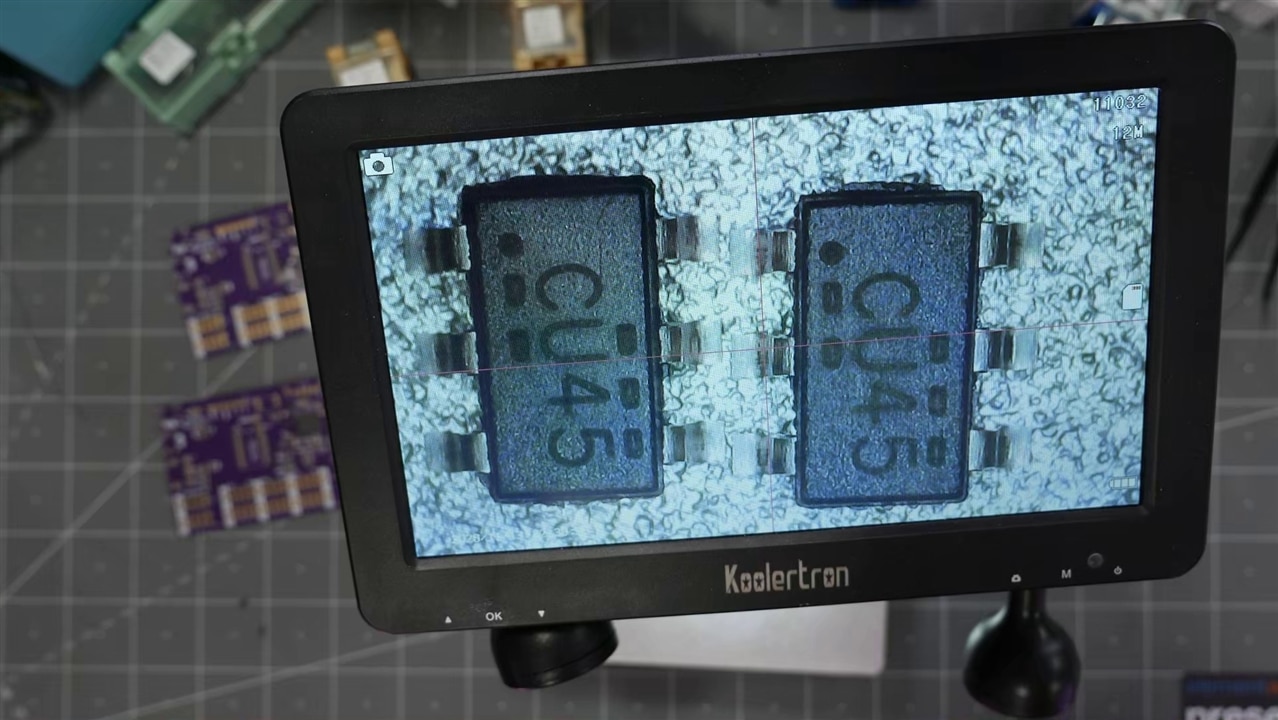
    image

    Without a microscope, it was almost impossible to tell the difference between pins 1 and 5.

    • Cancel
    • Vote Up +1 Vote Down
    • Sign in to reply
    • Verify Answer
    • Cancel
  • scottiebabe
    0 scottiebabe over 3 years ago in reply to baldengineer

    LOL! Is that a genuine 74LVC2GU04 ? Yikes!

    • Cancel
    • Vote Up +2 Vote Down
    • Sign in to reply
    • Verify Answer
    • Cancel
  • baldengineer
    0 baldengineer over 3 years ago in reply to scottiebabe

    Yeah. I used them as a buffer / logic converter for 3.3 and 5 volt logic.

    • Cancel
    • Vote Up +1 Vote Down
    • Sign in to reply
    • Verify Answer
    • Cancel
  • dougw
    0 dougw over 3 years ago

    I like lifting the pin as described above, but it may cause less stress to cut the pin as mentioned by scottiebabe and remove the soldered part with an iron. This also prevents the pin from getting bent later and causing a short.

    • Cancel
    • Vote Up +2 Vote Down
    • Sign in to reply
    • Verify Answer
    • Cancel
  • michaelkellett
    0 michaelkellett over 3 years ago

    I would cut the pin, I do have a nice pair of rather expensive micro cutters for this purpose. Works well on SOIC, less good on 0.5mm pitch pins.

    You can (with care) use a scalpel with a nice new blade. Then clean up with fine tip iron and flux. I've removed 144 pin TQFPs like this. It takes a while and you have to saw away patiently for a long time but I must have done a couple of dozen of them in the last few years and I haven't lost  a pad yet. Trying to save a £1000+ board helps one to keep focused.

    MK

    • Cancel
    • Vote Up +3 Vote Down
    • Sign in to reply
    • Verify Answer
    • Cancel
  • Andrew J
    0 Andrew J over 3 years ago

    I snipped and cleaned up in the end.  I just couldn't get leverage with tweezers and the soldering iron tip on the pin at the same time and I didn't want to stress the chip.  I was 100% certain that pin was the problem so there were going to be no @£$%! moments.

    And as Scottiebabe shows, no one will notice Grinning

    It's good to see that I'm not the only one who does stupid things though as I'm guessing these responses came from bitter experience.

    • Cancel
    • Vote Up +3 Vote Down
    • Sign in to reply
    • Verify Answer
    • Cancel
  • Fred27
    0 Fred27 over 3 years ago

    Nuke it from orbit. It's the only way to be sure.

    • Cancel
    • Vote Up +3 Vote Down
    • Sign in to reply
    • Verify Answer
    • Cancel
  • baldengineer
    0 baldengineer over 3 years ago in reply to Fred27

    Your lab has different equipment from mine …

    • Cancel
    • Vote Up 0 Vote Down
    • Sign in to reply
    • Verify Answer
    • Cancel
<>
element14 Community

element14 is the first online community specifically for engineers. Connect with your peers and get expert answers to your questions.

  • Members
  • Learn
  • Technologies
  • Challenges & Projects
  • Products
  • Store
  • About Us
  • Feedback & Support
  • FAQs
  • Terms of Use
  • Privacy Policy
  • Legal and Copyright Notices
  • Sitemap
  • Cookies

An Avnet Company © 2026 Premier Farnell Limited. All Rights Reserved.

Premier Farnell Ltd, registered in England and Wales (no 00876412), registered office: Farnell House, Forge Lane, Leeds LS12 2NE.

Follow element14

  • X
  • Facebook
  • linkedin
  • YouTube