element14 Community
element14 Community
    Register Log In
  • Site
  • Search
  • Log In Register
  • Community Hub
    Community Hub
    • What's New on element14
    • Feedback and Support
    • Benefits of Membership
    • Personal Blogs
    • Members Area
    • Achievement Levels
  • Learn
    Learn
    • Ask an Expert
    • eBooks
    • element14 presents
    • Learning Center
    • Tech Spotlight
    • STEM Academy
    • Webinars, Training and Events
    • Learning Groups
  • Technologies
    Technologies
    • 3D Printing
    • FPGA
    • Industrial Automation
    • Internet of Things
    • Power & Energy
    • Sensors
    • Technology Groups
  • Challenges & Projects
    Challenges & Projects
    • Design Challenges
    • element14 presents Projects
    • Project14
    • Arduino Projects
    • Raspberry Pi Projects
    • Project Groups
  • Products
    Products
    • Arduino
    • Avnet & Tria Boards Community
    • Dev Tools
    • Manufacturers
    • Multicomp Pro
    • Product Groups
    • Raspberry Pi
    • RoadTests & Reviews
  • About Us
  • Store
    Store
    • Visit Your Store
    • Choose another store...
      • Europe
      •  Austria (German)
      •  Belgium (Dutch, French)
      •  Bulgaria (Bulgarian)
      •  Czech Republic (Czech)
      •  Denmark (Danish)
      •  Estonia (Estonian)
      •  Finland (Finnish)
      •  France (French)
      •  Germany (German)
      •  Hungary (Hungarian)
      •  Ireland
      •  Israel
      •  Italy (Italian)
      •  Latvia (Latvian)
      •  
      •  Lithuania (Lithuanian)
      •  Netherlands (Dutch)
      •  Norway (Norwegian)
      •  Poland (Polish)
      •  Portugal (Portuguese)
      •  Romania (Romanian)
      •  Russia (Russian)
      •  Slovakia (Slovak)
      •  Slovenia (Slovenian)
      •  Spain (Spanish)
      •  Sweden (Swedish)
      •  Switzerland(German, French)
      •  Turkey (Turkish)
      •  United Kingdom
      • Asia Pacific
      •  Australia
      •  China
      •  Hong Kong
      •  India
      • Japan
      •  Korea (Korean)
      •  Malaysia
      •  New Zealand
      •  Philippines
      •  Singapore
      •  Taiwan
      •  Thailand (Thai)
      • Vietnam
      • Americas
      •  Brazil (Portuguese)
      •  Canada
      •  Mexico (Spanish)
      •  United States
      Can't find the country/region you're looking for? Visit our export site or find a local distributor.
  • Translate
  • Profile
  • Settings
Experts, Learning and Guidance
  • Technologies
  • More
Experts, Learning and Guidance
Ask an Expert Forum Using TVS Diode P6KE across relay coil but then also relay coil is getting damaged.
  • Blog
  • Forum
  • Documents
  • Leaderboard
  • Files
  • Members
  • Mentions
  • Sub-Groups
  • Tags
  • More
  • Cancel
  • New
Join Experts, Learning and Guidance to participate - click to join for free!
Actions
  • Share
  • More
  • Cancel
Forum Thread Details
  • Replies 21 replies
  • Subscribers 307 subscribers
  • Views 3579 views
  • Users 0 members are here
Related
See a helpful answer?

Be sure to click 'more' and select 'suggest as answer'!

If you're the thread creator, be sure to click 'more' then 'Verify as Answer'!

Using TVS Diode P6KE across relay coil but then also relay coil is getting damaged.

Former Member
Former Member over 10 years ago

We are using TVS diode across 24V DC-100AMPs relay for automotive application but my relay coil is getting damaged.

  • Sign in to reply
  • Cancel

Top Replies

  • mcb1
    mcb1 over 10 years ago in reply to Former Member +1
    Unfortunately the schematic shows a relay and not what is connected on the load side, or how the 24v DC is sourced (ie switchmode supply, battery, etc). What is on the end of the 100A contacts.? ie a simple…
  • mcb1
    mcb1 over 10 years ago in reply to Former Member +1
    That image helps.... There is no heating apparent from the contact as it seems to be a nice copper colour. The coil wire appears to have fused. For any inductive circuit the In-rush/ON current is very…
  • mcb1
    mcb1 over 10 years ago in reply to Former Member +1
    We are trying to help.... If you can't provide a circuit then I'm afraid my anwers are limited to guessing ... Mark
Parents
  • jw0752
    jw0752 over 10 years ago

    Hi Amol,

    The diode is not usually there to protect the coil but to protect other semiconductor components from the voltage spike caused by the coil when it is de-energized. Usually the only way to damage a coil is to put voltage on it that is outside its specifications. Also you might check to see that the relay is designed for AC or DC volts. Using a relay rated for 24 volts AC would get excessively hot if used on 24 volts DC. It would also help to diagnose your problem if you would include a diagram of your circuit and how you have the diode connected in the circuit. Also if you can explain how the coil is being damaged. (heat damage?, shorted?, open?)

    John

    • Cancel
    • Vote Up 0 Vote Down
    • Sign in to reply
    • Cancel
  • Former Member
    Former Member over 10 years ago in reply to jw0752

    HI John,


    Coil is getting open in between.It is getting damaged near the soldered points.

    Not sure but its a burn out, coil has burn between that.

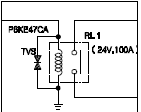
    Bidirectional TVS is connected across coil.

    I am using 24V DC ,contact rating of 100 Amps.

    Connection are as follow,

    One end connected to +24V DC through a relay followed by switch and second end directly connected to ground.

    • Cancel
    • Vote Up 0 Vote Down
    • Sign in to reply
    • Cancel
  • Former Member
    Former Member over 10 years ago in reply to Former Member

    Pls refer daigram

    image

    • Cancel
    • Vote Up 0 Vote Down
    • Sign in to reply
    • Cancel
  • mcb1
    mcb1 over 10 years ago in reply to Former Member

    Unfortunately the schematic shows a relay and not what is connected on the load side, or how the 24v DC is sourced (ie switchmode supply, battery, etc).

    What is on the end of the 100A contacts.? ie a simple resistive load, or a motor.


    What is the relay that controls the coil being driven by.

    Is that chattering?, or a clean ON or OFF.


    How long before the relay is damaged.?


    Are you sure the damage isn't being caused by the contacts of the relay.?


    Placing the diode across the coil slows down the release time to approx 5 times the relay spec.

    This means there may be an arc when the relay opens which will cause large amounts of heating.


    I'd suggest carefully pulling apart the relay and examining what is damaged.

    You might want to include some high resolution photos of the damage and teardown.


    Mark

    • Cancel
    • Vote Up +1 Vote Down
    • Sign in to reply
    • Cancel
Reply
  • mcb1
    mcb1 over 10 years ago in reply to Former Member

    Unfortunately the schematic shows a relay and not what is connected on the load side, or how the 24v DC is sourced (ie switchmode supply, battery, etc).

    What is on the end of the 100A contacts.? ie a simple resistive load, or a motor.


    What is the relay that controls the coil being driven by.

    Is that chattering?, or a clean ON or OFF.


    How long before the relay is damaged.?


    Are you sure the damage isn't being caused by the contacts of the relay.?


    Placing the diode across the coil slows down the release time to approx 5 times the relay spec.

    This means there may be an arc when the relay opens which will cause large amounts of heating.


    I'd suggest carefully pulling apart the relay and examining what is damaged.

    You might want to include some high resolution photos of the damage and teardown.


    Mark

    • Cancel
    • Vote Up +1 Vote Down
    • Sign in to reply
    • Cancel
Children
  • Former Member
    Former Member over 10 years ago in reply to mcb1

    It is connected to 24V 150Ah battery.

    It is clean ON OFF
    It damaged after 3 hours of operation

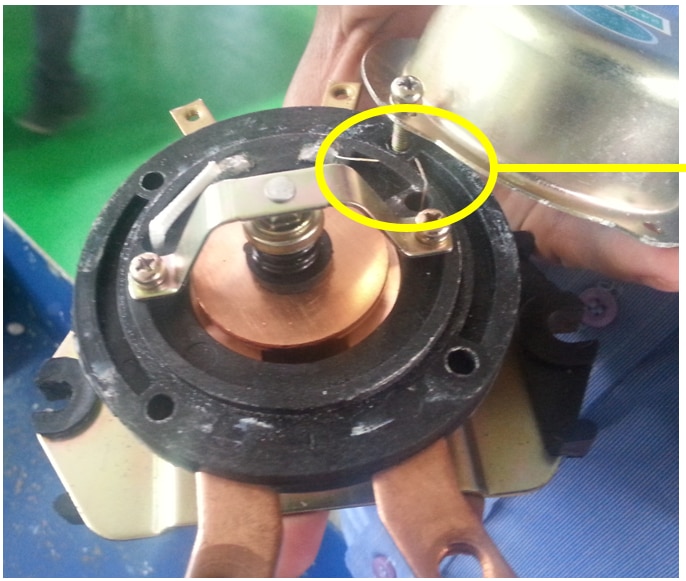
    The damaged can be also due to contact,the contacts are connected to alternator.

    image

    • Cancel
    • Vote Up 0 Vote Down
    • Sign in to reply
    • Cancel
  • mcb1
    mcb1 over 10 years ago in reply to Former Member

    That image helps....

    There is no heating apparent from the contact as it seems to be a nice copper colour.


    The coil wire appears to have fused.

    For any inductive circuit the In-rush/ON current is very high.

    You haven't included the model of relay or the coil specs, but whatever it is normally, you can expect 3-5 (or more) times the "at rest" current as it switches on.

    Most of these relays have a very high mechanical force, which will add to the ON current.


    Unfortunately without the circuit, it is not possible to tell if there is a secondary path that is adding to the problem.

    If you have a relay and switch controlling this relay, then I'm not sure why you need the diode across the coil.


    It is clean ON OFF

    How do you know ... have you bypassed it, or put something across it to check.??


    There is obviously something causing it ( as evidenced by the damaged coil wire) so it is a process of eliminating each part to isolate it.

    Second guessing and assumptions will not fix it, so you/we need to assume the design isn't working as it's intended.


    Include the relay spec sheet, or part number and more importantly the source you are getting them from.


    If you simply wire the relay across the 24v without any connection to the alternator, or the other means of controlling the coil, will it last more than 3 hrs.?

    This will prove the relay can actually operate in a continuous mode ...


    Mark

    • Cancel
    • Vote Up +1 Vote Down
    • Sign in to reply
    • Cancel
  • Former Member
    Former Member over 10 years ago in reply to mcb1

    Relay operates for more then 3 hours without any connections.

    Actually relay operates in continuous mode without any problems.

    And this relay is used to turn on several motors at one time.

    The source is alternator ,does alternator output damages the coil.

    • Cancel
    • Vote Up 0 Vote Down
    • Sign in to reply
    • Cancel
  • Former Member
    Former Member over 10 years ago in reply to Former Member

    Relay coil is energised through feedback from starter switch.

    • Cancel
    • Vote Up 0 Vote Down
    • Sign in to reply
    • Cancel
  • Former Member
    Former Member over 10 years ago in reply to Former Member

    If the coil is being energised by the alternator without any dc rectification then yep it'll generate a lot more heat and fail more rapidly

    • Cancel
    • Vote Up 0 Vote Down
    • Sign in to reply
    • Cancel
  • jw0752
    jw0752 over 10 years ago in reply to Former Member

    Hi Amol,

    My experience with situations like this indicate that the coil is getting too much current during energization. mcb1 is right in his assesment. Each time this over current occurs the wire that you show in the photo "heats up" as it is exposed in the air and the weakest link. The repeated heating of the wire causes it to change its temper and resistance and become more and more susceptible to failure. I would put a low resistance, perhaps 5 ohms, in series with the the circuit that feeds the coil. If the coil won't pull in with 5 ohms try 3 ohms. This will limit the energizing current and should prevent the failure you are seeing.

    John

    • Cancel
    • Vote Up +1 Vote Down
    • Sign in to reply
    • Cancel
  • jw0752
    jw0752 over 10 years ago in reply to Former Member

    Hi Amol,

    I thought of one other possibility for the cause of this problem. If for some reason the solenoid relay coil is not properly secured to the armature it will move during the actuation. This can cause a mechanical stress or a bending of the leads. Just like bending a wire back and forth will break it, repeated actuation with a loose coil will also break the leads.

    John

    • Cancel
    • Vote Up 0 Vote Down
    • Sign in to reply
    • Cancel
  • Former Member
    Former Member over 9 years ago in reply to jw0752

    Thank You ,we just reduced the diode breakdown current.

    • Cancel
    • Vote Up 0 Vote Down
    • Sign in to reply
    • Cancel
element14 Community

element14 is the first online community specifically for engineers. Connect with your peers and get expert answers to your questions.

  • Members
  • Learn
  • Technologies
  • Challenges & Projects
  • Products
  • Store
  • About Us
  • Feedback & Support
  • FAQs
  • Terms of Use
  • Privacy Policy
  • Legal and Copyright Notices
  • Sitemap
  • Cookies

An Avnet Company © 2026 Premier Farnell Limited. All Rights Reserved.

Premier Farnell Ltd, registered in England and Wales (no 00876412), registered office: Farnell House, Forge Lane, Leeds LS12 2NE.

ICP 备案号 10220084.

Follow element14

  • X
  • Facebook
  • linkedin
  • YouTube