element14 Community
element14 Community
    Register Log In
  • Site
  • Search
  • Log In Register
  • Community Hub
    Community Hub
    • What's New on element14
    • Feedback and Support
    • Benefits of Membership
    • Personal Blogs
    • Members Area
    • Achievement Levels
  • Learn
    Learn
    • Ask an Expert
    • eBooks
    • element14 presents
    • Learning Center
    • Tech Spotlight
    • STEM Academy
    • Webinars, Training and Events
    • Learning Groups
  • Technologies
    Technologies
    • 3D Printing
    • FPGA
    • Industrial Automation
    • Internet of Things
    • Power & Energy
    • Sensors
    • Technology Groups
  • Challenges & Projects
    Challenges & Projects
    • Design Challenges
    • element14 presents Projects
    • Project14
    • Arduino Projects
    • Raspberry Pi Projects
    • Project Groups
  • Products
    Products
    • Arduino
    • Avnet & Tria Boards Community
    • Dev Tools
    • Manufacturers
    • Multicomp Pro
    • Product Groups
    • Raspberry Pi
    • RoadTests & Reviews
  • About Us
  • Store
    Store
    • Visit Your Store
    • Choose another store...
      • Europe
      •  Austria (German)
      •  Belgium (Dutch, French)
      •  Bulgaria (Bulgarian)
      •  Czech Republic (Czech)
      •  Denmark (Danish)
      •  Estonia (Estonian)
      •  Finland (Finnish)
      •  France (French)
      •  Germany (German)
      •  Hungary (Hungarian)
      •  Ireland
      •  Israel
      •  Italy (Italian)
      •  Latvia (Latvian)
      •  
      •  Lithuania (Lithuanian)
      •  Netherlands (Dutch)
      •  Norway (Norwegian)
      •  Poland (Polish)
      •  Portugal (Portuguese)
      •  Romania (Romanian)
      •  Russia (Russian)
      •  Slovakia (Slovak)
      •  Slovenia (Slovenian)
      •  Spain (Spanish)
      •  Sweden (Swedish)
      •  Switzerland(German, French)
      •  Turkey (Turkish)
      •  United Kingdom
      • Asia Pacific
      •  Australia
      •  China
      •  Hong Kong
      •  India
      • Japan
      •  Korea (Korean)
      •  Malaysia
      •  New Zealand
      •  Philippines
      •  Singapore
      •  Taiwan
      •  Thailand (Thai)
      • Vietnam
      • Americas
      •  Brazil (Portuguese)
      •  Canada
      •  Mexico (Spanish)
      •  United States
      Can't find the country/region you're looking for? Visit our export site or find a local distributor.
  • Translate
  • Profile
  • Settings
Experts, Learning and Guidance
  • Technologies
  • More
Experts, Learning and Guidance
Ask an Expert Forum MC1377P video circuit drops to almost 0 when terminated with 75 ohm. Any ideas?
  • Blog
  • Forum
  • Documents
  • Leaderboard
  • Files
  • Members
  • Mentions
  • Sub-Groups
  • Tags
  • More
  • Cancel
  • New
Join Experts, Learning and Guidance to participate - click to join for free!
Actions
  • Share
  • More
  • Cancel
Forum Thread Details
  • Replies 12 replies
  • Subscribers 303 subscribers
  • Views 1124 views
  • Users 0 members are here
  • mc1377p
Related
See a helpful answer?

Be sure to click 'more' and select 'suggest as answer'!

If you're the thread creator, be sure to click 'more' then 'Verify as Answer'!

MC1377P video circuit drops to almost 0 when terminated with 75 ohm. Any ideas?

baldengineer
baldengineer over 4 years ago

A project I've been working on for several months, or years depending on how you count, is build a Mini Apple IIe. (Originally it was a portable, now its just a mini.) The key to the project is the MEGA-II ASIC from the Apple IIgs. It contains all of the support logic found in old Apple II computers. (Approximately 80 7400-series chips!).


Since no one has ever used the MEGA-II in this way, I decided to build a couple of prototype boards to test three key sections: 6502, MEGA-II, and VGC. Turns out, we have the 65c02 and MEGA-II to be seemingly working. It even attempts to boot the Apple IIe ROM. (And then it appears to panic.)


So, I moved our attention to the video board. There are two basic sections on the board: the digital side and the analog side. The digital side consists of the VGC (video graphics controller) ASIC and three 4-bit DACs for RGB. Long story short, the MEGA-II generates the classic Apple II video bitstream, the VGC+DAC section converts it to analog R,G,B.


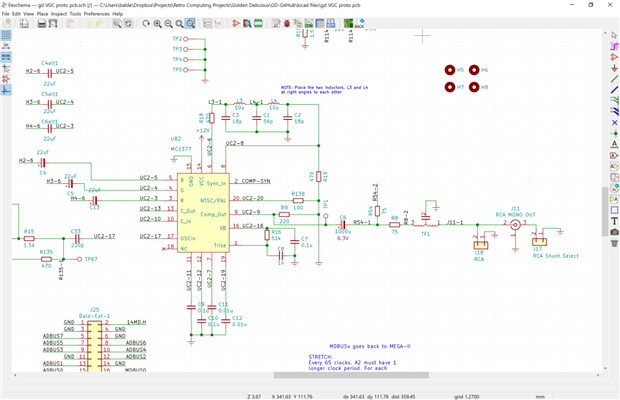
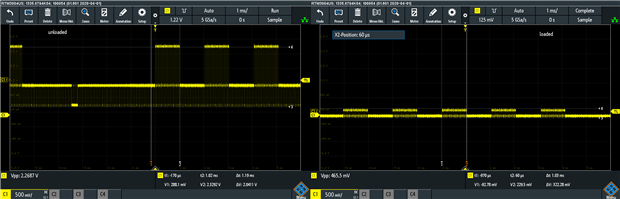
The analog part of the video circuit is based on an MC1377 RGB-to-NTSC encoder. That is the part of the circuit giving me trouble. In this iteration of the project, I just copied the circuit from the Apple IIgs. (My final project won't have composite.) The problem is that when I attach a video receiver or terminate the MC1377's output with 75-ohms, its output drops from 2.6 Vpp to 300 mVpp. A bit too small.


Here's the circuit:
image

The Full KiCad file is available here.


Here's the comparison of output:
image

In both cases I am, effectively, probing at J18's signal. On the right, I terminate that node with a 75 ohm resistor. (Same behavior with an actual composite receiver.)


A bunch more waveforms and link to MC1377P datasheet here: https://www.baldengineer.com/mc1377-measurements-on-mini-apple-iie-prototype-video-board.html .


Any ideas why the output is clamping so hard?

  • Sign in to reply
  • Cancel
Parents
  • baldengineer
    baldengineer over 4 years ago

    Here's the hardware that generated that screen.


    image


    There are three boards. The top left with the huge 84-pin PLCC is the MEGA-II from an Apple IIgs. It contains all Memory, IOU, Clocks, and GLU circuits from an Apple IIe. It has four 4167 DRAMs on it. To the right is a board for the Video Controller Chip (VGC) from an Apple IIgs. As I described above, half the chip is digital, the other half generates the analog video signals. Under the MEGA-II board is a (modern) 65c02 based board with an EPROM. Currently, the EPROM is programmed with the Apple IIe Unenhanced CD and EF ROMs.


    The Apple IIe used two ROM chips while the IIc used a single ROM chip. The MEGA-II is somewhat of a hybrid of IIe and IIc logic. So I may end up with the IIc ROM.


    Seeing a screen of seemingly garbage characters has made my day. There's a lot of things working (and probably a lot that isn't.)


    I've been streaming this entire project on Twitch. Last night was the 24th stream related to the project. On average, they last 3 hours.


    P.S. Shout-out to OSHPark. They donated the prototype boards. Because I broke out almost every pin and knew I'd have a ton of flying wires, I went four-layer. One inner layer is (mostly) 5V, the other is GND. Copper pours on top and bottom are also GND.


    And to answer a common question, a new thing I've been doing is the exposed ground planes around the edges. Makes it much easier to attach scope probes.

    • Cancel
    • Vote Up 0 Vote Down
    • Sign in to reply
    • Cancel
Reply
  • baldengineer
    baldengineer over 4 years ago

    Here's the hardware that generated that screen.


    image


    There are three boards. The top left with the huge 84-pin PLCC is the MEGA-II from an Apple IIgs. It contains all Memory, IOU, Clocks, and GLU circuits from an Apple IIe. It has four 4167 DRAMs on it. To the right is a board for the Video Controller Chip (VGC) from an Apple IIgs. As I described above, half the chip is digital, the other half generates the analog video signals. Under the MEGA-II board is a (modern) 65c02 based board with an EPROM. Currently, the EPROM is programmed with the Apple IIe Unenhanced CD and EF ROMs.


    The Apple IIe used two ROM chips while the IIc used a single ROM chip. The MEGA-II is somewhat of a hybrid of IIe and IIc logic. So I may end up with the IIc ROM.


    Seeing a screen of seemingly garbage characters has made my day. There's a lot of things working (and probably a lot that isn't.)


    I've been streaming this entire project on Twitch. Last night was the 24th stream related to the project. On average, they last 3 hours.


    P.S. Shout-out to OSHPark. They donated the prototype boards. Because I broke out almost every pin and knew I'd have a ton of flying wires, I went four-layer. One inner layer is (mostly) 5V, the other is GND. Copper pours on top and bottom are also GND.


    And to answer a common question, a new thing I've been doing is the exposed ground planes around the edges. Makes it much easier to attach scope probes.

    • Cancel
    • Vote Up 0 Vote Down
    • Sign in to reply
    • Cancel
Children
No Data
element14 Community

element14 is the first online community specifically for engineers. Connect with your peers and get expert answers to your questions.

  • Members
  • Learn
  • Technologies
  • Challenges & Projects
  • Products
  • Store
  • About Us
  • Feedback & Support
  • FAQs
  • Terms of Use
  • Privacy Policy
  • Legal and Copyright Notices
  • Sitemap
  • Cookies

An Avnet Company © 2026 Premier Farnell Limited. All Rights Reserved.

Premier Farnell Ltd, registered in England and Wales (no 00876412), registered office: Farnell House, Forge Lane, Leeds LS12 2NE.

ICP 备案号 10220084.

Follow element14

  • X
  • Facebook
  • linkedin
  • YouTube