element14 Community
element14 Community
    Register Log In
  • Site
  • Search
  • Log In Register
  • Community Hub
    Community Hub
    • What's New on element14
    • Feedback and Support
    • Benefits of Membership
    • Personal Blogs
    • Members Area
    • Achievement Levels
  • Learn
    Learn
    • Ask an Expert
    • eBooks
    • element14 presents
    • Learning Center
    • Tech Spotlight
    • STEM Academy
    • Webinars, Training and Events
    • Learning Groups
  • Technologies
    Technologies
    • 3D Printing
    • FPGA
    • Industrial Automation
    • Internet of Things
    • Power & Energy
    • Sensors
    • Technology Groups
  • Challenges & Projects
    Challenges & Projects
    • Design Challenges
    • element14 presents Projects
    • Project14
    • Arduino Projects
    • Raspberry Pi Projects
    • Project Groups
  • Products
    Products
    • Arduino
    • Avnet & Tria Boards Community
    • Dev Tools
    • Manufacturers
    • Multicomp Pro
    • Product Groups
    • Raspberry Pi
    • RoadTests & Reviews
  • About Us
  • Store
    Store
    • Visit Your Store
    • Choose another store...
      • Europe
      •  Austria (German)
      •  Belgium (Dutch, French)
      •  Bulgaria (Bulgarian)
      •  Czech Republic (Czech)
      •  Denmark (Danish)
      •  Estonia (Estonian)
      •  Finland (Finnish)
      •  France (French)
      •  Germany (German)
      •  Hungary (Hungarian)
      •  Ireland
      •  Israel
      •  Italy (Italian)
      •  Latvia (Latvian)
      •  
      •  Lithuania (Lithuanian)
      •  Netherlands (Dutch)
      •  Norway (Norwegian)
      •  Poland (Polish)
      •  Portugal (Portuguese)
      •  Romania (Romanian)
      •  Russia (Russian)
      •  Slovakia (Slovak)
      •  Slovenia (Slovenian)
      •  Spain (Spanish)
      •  Sweden (Swedish)
      •  Switzerland(German, French)
      •  Turkey (Turkish)
      •  United Kingdom
      • Asia Pacific
      •  Australia
      •  China
      •  Hong Kong
      •  India
      • Japan
      •  Korea (Korean)
      •  Malaysia
      •  New Zealand
      •  Philippines
      •  Singapore
      •  Taiwan
      •  Thailand (Thai)
      • Vietnam
      • Americas
      •  Brazil (Portuguese)
      •  Canada
      •  Mexico (Spanish)
      •  United States
      Can't find the country/region you're looking for? Visit our export site or find a local distributor.
  • Translate
  • Profile
  • Settings
Experts, Learning and Guidance
  • Technologies
  • More
Experts, Learning and Guidance
Ask an Expert Forum Need help to replace a resistor
  • Blog
  • Forum
  • Documents
  • Leaderboard
  • Files
  • Members
  • Mentions
  • Sub-Groups
  • Tags
  • More
  • Cancel
  • New
Join Experts, Learning and Guidance to participate - click to join for free!
Actions
  • Share
  • More
  • Cancel
Forum Thread Details
  • Replies 27 replies
  • Subscribers 299 subscribers
  • Views 7380 views
  • Users 0 members are here
Related
See a helpful answer?

Be sure to click 'more' and select 'suggest as answer'!

If you're the thread creator, be sure to click 'more' then 'Verify as Answer'!

Need help to replace a resistor

ldarby
ldarby over 2 years ago

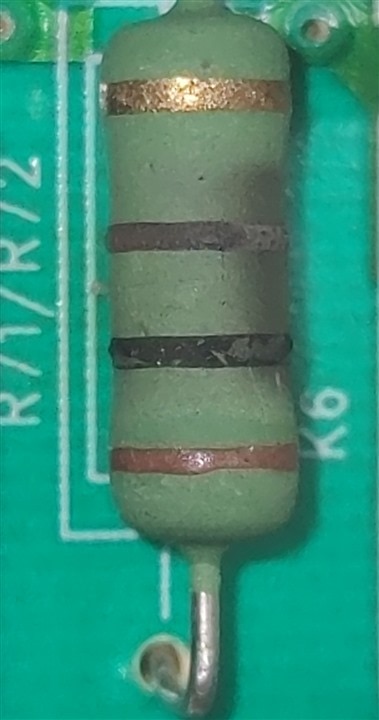
Hopefully this isn't a dumb question but this resistor is cracked and slightly burnt.  I measured it, it's open circuit.   It's from my bosch washing machine which is about 12 years old.  I think it's brown, black, silver, gold which is 0.1 Ohm (can't be grey, that's 1 giga ohm), but I've found several other photos showing this resistor on this pcb is brown black brown, 100 ohm, and people saying it's 100 ohm as well, and no one saying it's 0.1 ohm.  It's 'Ako 731799-06 BSH 9000449412'  if you would like search yourself.  Could it really be 100 ohm, and the burn slowly chared ring 3 to look grey/silver over time?  If it's supposed to be 100 ohm, and I replace it with 0.1, I'm sure it'll blow up...

Next question, since this failure seems to be very common, would it make sense to replace it with a higher power resistor e.g. 5W or 10W?

Thanks.

image

  • Sign in to reply
  • Cancel

Top Replies

  • shabaz
    shabaz over 2 years ago in reply to ldarby +4
    Unfortunately not enough detail from the photos, the connection snakes off from the top side of the board, but I can't see where due to angle. Anyway, it's a resistor directly off the Live connection…
  • ldarby
    ldarby over 2 years ago in reply to anniel747 +2
    Yeah, oops, maybe was possible. There was a much larger crack (not shown in above photos), I tried opening up that crack but that made the whole shell pop off and took all the wire with it... lesson l…
  • ldarby
    ldarby over 2 years ago in reply to shabaz +2
    Thanks very much for that, the chip left of center is a full bridge rectifier, it connects to that, then the cap is 10uF, 400V, and that connects to the D (Drain) pin. I couldn't see any inductors though…
Parents
  • shabaz
    shabaz over 2 years ago

    Hi,

    If you can share a high-res photo of the surrounding circuitry, on both sides of the board, then it is possible to make a better guess. It's very feasible that discoloration could have occurred. It also seems unlikely to be a 0.1 ohm resistor, but it's speculation unless more detail is provided.

    • Cancel
    • Vote Up +1 Vote Down
    • Sign in to reply
    • Cancel
  • ldarby
    ldarby over 2 years ago in reply to shabaz

    Thanks shabaz, here are the images:

    imageimage image

    I've circled where it's connected to, which connects to the main power switch on the front panel.  Earlier I measured 3V AC, 0V DC  on that when it was connected to mains and powered off, and 0V AV, 0V DC when switched on, hope this helps?

    Also robogary yes in 2nd pic I've circled a chip that probably also failed, the conformal coating had bubbles in it, it's a LNK304GN.  In fact these 2 components fail so often they're sold together: https://www.aliexpress.com/i/1005001758260213.html (which shows 100R).

    • Cancel
    • Vote Up 0 Vote Down
    • Sign in to reply
    • Cancel
  • shabaz
    shabaz over 2 years ago in reply to ldarby

    Unfortunately not enough detail from the photos, the connection snakes off from the top side of the board, but I can't see where due to angle.

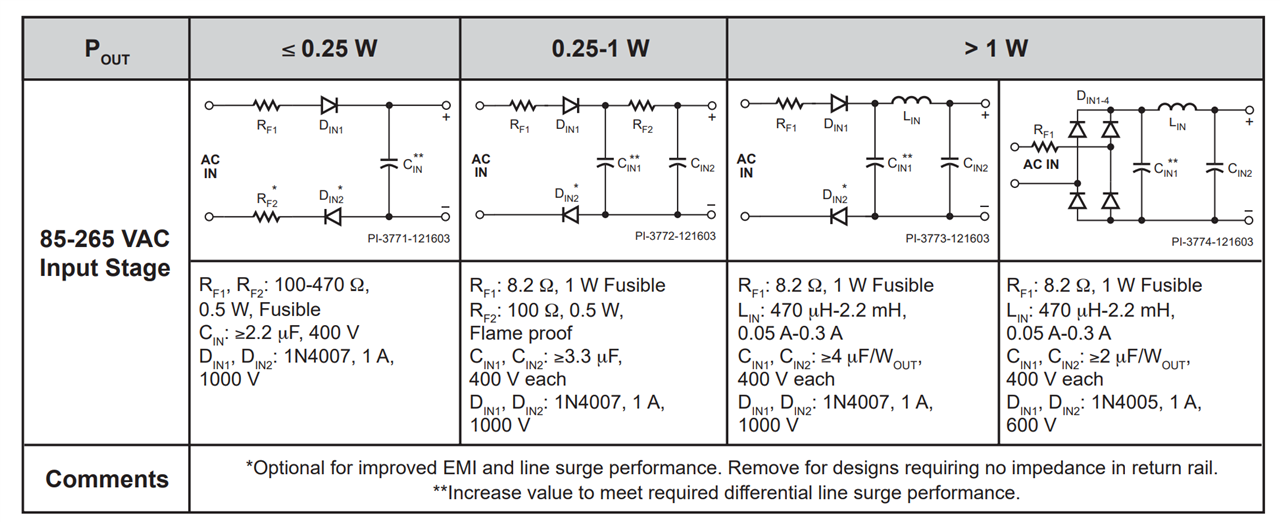
    Anyway, it's a resistor directly off the Live connection, it is highly unlikely to be 0.1 ohm. Since you mention the LNK chip might have failed, then there's a good chance it is related, since the LNK circuit uses a fusible resistor connected to Live. 

    See here (from LNK design guide PDF):

    image

    There's a high chance it could have been 100 ohm, or 10 ohm, but certainly not 0.1 ohm. 

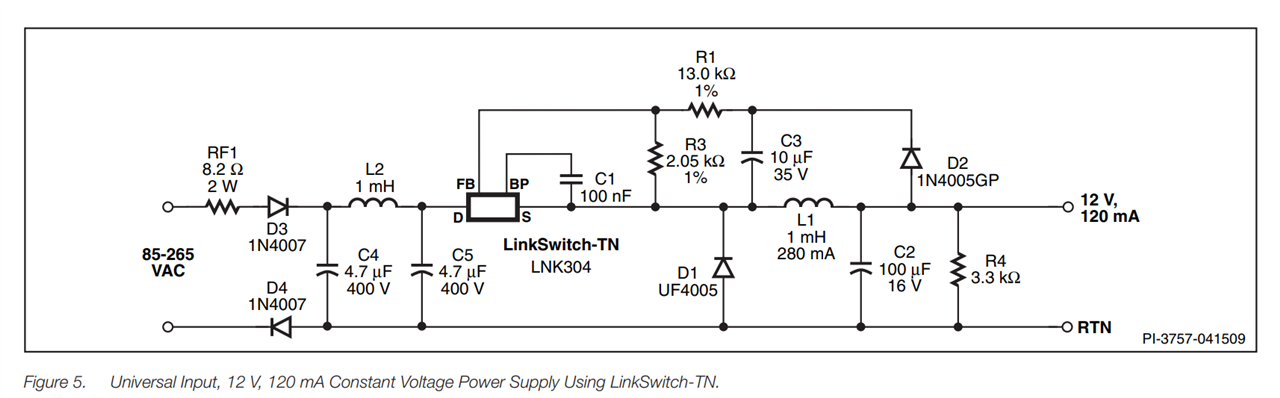
    You could check with a multimeter on the _unpowered_ board with _capacitors_discharged_first_ that the trace from the resistor goes to a diode and onward to an inductor and then to the LNK chip as shown in the LNK datasheet PDF:

    image

    If so, then you know that resistor has to be 100 ohm or 10 ohm. You could just try 100 ohm, and see if it works If it doesn't, then try 10 ohm.

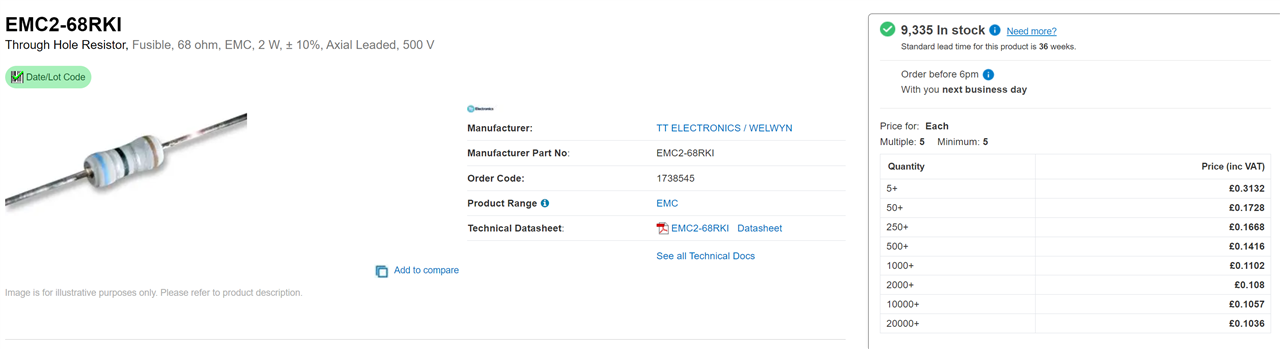
    I couldn't find a 100 ohm fusible resistor but if it is being used in that topology you could use a 68 ohm resistor, but don't blame me if it all goes up in flames or worse - I'm not providing advice here.

    image

    Here is a 10 ohm fusible resistor:

    image

    • Cancel
    • Vote Up +4 Vote Down
    • Sign in to reply
    • Cancel
Reply
  • shabaz
    shabaz over 2 years ago in reply to ldarby

    Unfortunately not enough detail from the photos, the connection snakes off from the top side of the board, but I can't see where due to angle.

    Anyway, it's a resistor directly off the Live connection, it is highly unlikely to be 0.1 ohm. Since you mention the LNK chip might have failed, then there's a good chance it is related, since the LNK circuit uses a fusible resistor connected to Live. 

    See here (from LNK design guide PDF):

    image

    There's a high chance it could have been 100 ohm, or 10 ohm, but certainly not 0.1 ohm. 

    You could check with a multimeter on the _unpowered_ board with _capacitors_discharged_first_ that the trace from the resistor goes to a diode and onward to an inductor and then to the LNK chip as shown in the LNK datasheet PDF:

    image

    If so, then you know that resistor has to be 100 ohm or 10 ohm. You could just try 100 ohm, and see if it works If it doesn't, then try 10 ohm.

    I couldn't find a 100 ohm fusible resistor but if it is being used in that topology you could use a 68 ohm resistor, but don't blame me if it all goes up in flames or worse - I'm not providing advice here.

    image

    Here is a 10 ohm fusible resistor:

    image

    • Cancel
    • Vote Up +4 Vote Down
    • Sign in to reply
    • Cancel
Children
  • ldarby
    ldarby over 2 years ago in reply to shabaz

    Thanks very much for that, the chip left of center is a full bridge rectifier, it connects to that, then the cap is 10uF, 400V, and that connects to the D (Drain) pin.  I couldn't see any inductors though apart from the large one near the mains.

    And that  design guide confirms it's used as a fuse, so will get a 100R 2W flame proof one (and not a 10W one...).  (I'm sure it was 100R based on measuring the bits of wire, see below).

    • Cancel
    • Vote Up +2 Vote Down
    • Sign in to reply
    • Cancel
element14 Community

element14 is the first online community specifically for engineers. Connect with your peers and get expert answers to your questions.

  • Members
  • Learn
  • Technologies
  • Challenges & Projects
  • Products
  • Store
  • About Us
  • Feedback & Support
  • FAQs
  • Terms of Use
  • Privacy Policy
  • Legal and Copyright Notices
  • Sitemap
  • Cookies

An Avnet Company © 2025 Premier Farnell Limited. All Rights Reserved.

Premier Farnell Ltd, registered in England and Wales (no 00876412), registered office: Farnell House, Forge Lane, Leeds LS12 2NE.

ICP 备案号 10220084.

Follow element14

  • X
  • Facebook
  • linkedin
  • YouTube