element14 Community
element14 Community
    Register Log In
  • Site
  • Search
  • Log In Register
  • Community Hub
    Community Hub
    • What's New on element14
    • Feedback and Support
    • Benefits of Membership
    • Personal Blogs
    • Members Area
    • Achievement Levels
  • Learn
    Learn
    • Ask an Expert
    • eBooks
    • element14 presents
    • Learning Center
    • Tech Spotlight
    • STEM Academy
    • Webinars, Training and Events
    • Learning Groups
  • Technologies
    Technologies
    • 3D Printing
    • FPGA
    • Industrial Automation
    • Internet of Things
    • Power & Energy
    • Sensors
    • Technology Groups
  • Challenges & Projects
    Challenges & Projects
    • Design Challenges
    • element14 presents Projects
    • Project14
    • Arduino Projects
    • Raspberry Pi Projects
    • Project Groups
  • Products
    Products
    • Arduino
    • Avnet & Tria Boards Community
    • Dev Tools
    • Manufacturers
    • Multicomp Pro
    • Product Groups
    • Raspberry Pi
    • RoadTests & Reviews
  • About Us
  • Store
    Store
    • Visit Your Store
    • Choose another store...
      • Europe
      •  Austria (German)
      •  Belgium (Dutch, French)
      •  Bulgaria (Bulgarian)
      •  Czech Republic (Czech)
      •  Denmark (Danish)
      •  Estonia (Estonian)
      •  Finland (Finnish)
      •  France (French)
      •  Germany (German)
      •  Hungary (Hungarian)
      •  Ireland
      •  Israel
      •  Italy (Italian)
      •  Latvia (Latvian)
      •  
      •  Lithuania (Lithuanian)
      •  Netherlands (Dutch)
      •  Norway (Norwegian)
      •  Poland (Polish)
      •  Portugal (Portuguese)
      •  Romania (Romanian)
      •  Russia (Russian)
      •  Slovakia (Slovak)
      •  Slovenia (Slovenian)
      •  Spain (Spanish)
      •  Sweden (Swedish)
      •  Switzerland(German, French)
      •  Turkey (Turkish)
      •  United Kingdom
      • Asia Pacific
      •  Australia
      •  China
      •  Hong Kong
      •  India
      • Japan
      •  Korea (Korean)
      •  Malaysia
      •  New Zealand
      •  Philippines
      •  Singapore
      •  Taiwan
      •  Thailand (Thai)
      • Vietnam
      • Americas
      •  Brazil (Portuguese)
      •  Canada
      •  Mexico (Spanish)
      •  United States
      Can't find the country/region you're looking for? Visit our export site or find a local distributor.
  • Translate
  • Profile
  • Settings
Experts, Learning and Guidance
  • Technologies
  • More
Experts, Learning and Guidance
Ask an Expert Forum ohms law
  • Blog
  • Forum
  • Documents
  • Leaderboard
  • Files
  • Members
  • Mentions
  • Sub-Groups
  • Tags
  • More
  • Cancel
  • New
Join Experts, Learning and Guidance to participate - click to join for free!
Actions
  • Share
  • More
  • Cancel
Forum Thread Details
  • State Not Answered
  • Replies 17 replies
  • Subscribers 295 subscribers
  • Views 2722 views
  • Users 0 members are here
  • ask_an_expert
Related
See a helpful answer?

Be sure to click 'more' and select 'suggest as answer'!

If you're the thread creator, be sure to click 'more' then 'Verify as Answer'!

ohms law

Akans
Akans over 1 year ago

how did i use ohms low to choose a resistor for my circuit when the current of the voltage is unknown. like i have a 10 volt resistor and i need 5volt out from the 10volt what will i do to get the current so that i can use it to divide the voltage to get my resistor for the circuit as ohms low states

  • Sign in to reply
  • Cancel

Top Replies

  • shabaz
    shabaz over 1 year ago +5
    You should get a basic multimeter, and a small pack of resistors, and just try it. Take measurements, observe if anything gets hot, and compare with your expectations. What's the worst that will happen…
  • JWx
    JWx over 1 year ago in reply to Akans +4
    for driving a LED you need three values: power supply voltage, diode forward voltage and diode current. Diode current can usually be in the range of about 2-20mA Diode voltage depend on the color and…
  • shabaz
    shabaz over 1 year ago in reply to shabaz +4
    I decided to eat own dogfood and check out the link.. The Learning Circuit is excellent, part 5 discusses the LED example. Ohm's Law with Breadboard Circuits -- The Learning Circuit 05 https://youtu…
  • baldengineer
    0 baldengineer over 1 year ago

    What are you trying to accomplish? It sounds like you need a voltage regulator, not a voltage divider.

    • Cancel
    • Vote Up +1 Vote Down
    • Sign in to reply
    • Verify Answer
    • Cancel
  • JWx
    0 JWx over 1 year ago

    do you want do create voltage divider to get 5V  from 10V?  What level of current are you going to draw? As baldengineer have stated, using divider would be really wasteful - regulator would be better choice

    • Cancel
    • Vote Up +1 Vote Down
    • Sign in to reply
    • Verify Answer
    • Cancel
  • JWx
    0 JWx over 1 year ago in reply to JWx

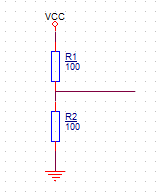
    image

    using circuit as above, with two resistors of the same value, you can get half of voltage in the middle point - if you draw only a small current (if you draw more, voltage across R2 drops)

    • Cancel
    • Vote Up +2 Vote Down
    • Sign in to reply
    • Verify Answer
    • Cancel
  • Akans
    0 Akans over 1 year ago in reply to JWx

    what i am trying to say is how to choose a resistor for a led all tutorial i have watch seams they get their current from datasheet and they use ohms low to work out and get the suitable voltage for the led and i have been founding it difficult choose a resistor for my circuit because using ohms low is voltage divide by current and i am using batter so what should i do

    • Cancel
    • Vote Up 0 Vote Down
    • Sign in to reply
    • Verify Answer
    • Cancel
  • javagoza
    0 javagoza over 1 year ago in reply to JWx

    This is a community created online calculator.

    Voltage divider calculator for real E-series resistors (douxchamps.net)

    • Cancel
    • Vote Up +3 Vote Down
    • Sign in to reply
    • Verify Answer
    • Cancel
  • JWx
    0 JWx over 1 year ago in reply to Akans

    for driving a LED you need three values: power supply voltage, diode forward voltage and diode current.

    Diode current can usually be in the range of about 2-20mA

    Diode voltage depend on the color and is standard for that color - for example, yellow LED has forward voltage of about 2.1V

    then, all the remaining voltage should be across the resistor - so (for example, using 9V battery and 5mA)

    9V - 2.1V (diode forward voltage) = 6.9V (voltage drop across resistor)

    6.9V/5mA = 1380 Ohm

    this is not a standard value, but you can use - for example - 1.3kOhm (1300Ohm)

    • Cancel
    • Vote Up +4 Vote Down
    • Sign in to reply
    • Verify Answer
    • Cancel
  • Akans
    0 Akans over 1 year ago in reply to JWx

    what about if i want to drive a 12volt motor and i have a voltage supply to be 18v what should i do

    • Cancel
    • Vote Up 0 Vote Down
    • Sign in to reply
    • Verify Answer
    • Cancel
  • shabaz
    0 shabaz over 1 year ago

    You should get a basic multimeter, and a small pack of resistors, and just try it. Take measurements, observe if anything gets hot, and compare with your expectations. What's the worst that will happen? Combined with some reading, I guarantee you'll learn more that way than the mistakes you make.

    Ohm's law is fundamental, and will be covered in many books, but there are excellent recommendations here:

     I Want to Do Electronics!  Where do I start?

    • Cancel
    • Vote Up +5 Vote Down
    • Sign in to reply
    • Verify Answer
    • Cancel
  • JWx
    0 JWx over 1 year ago in reply to Akans

    install a voltage regulator - switching one if possible to limit power loss.

    Motor has a different characteristics - it consumes different current depending on the load. You can probably limit the current using resistor but it would be wasteful - if you calculate the resistor for idle current, any load increase would increase voltage across resistor, decreasing voltage across motor and limiting power. And if you calculate resistor for loaded motor, you will get overvoltage when motor is idle.

    Anyway - if you can tell what current   will be drawn during operation (for example - steady load), the method is the same - all the excess voltage should be across resistor.

    for example - motor consumes 2A during operation, and voltage difference is 18V-12V = 6V

    6V/2A = 3 Ohm

    and power dissipated would be 6V*2A = 12W

    and of course - if motor is stalled, most of the input voltage would be across the resistor, resulting in 18V * 18V/3Ohm = 108W of power

    • Cancel
    • Vote Up +1 Vote Down
    • Sign in to reply
    • Verify Answer
    • Cancel
  • dougw
    0 dougw over 1 year ago

    The question is not clear to me.
    Assuming you have a resistor with 10 volts, connecting an identical resistor from that resistor to ground will drop the voltage to 5 volts.

    • Cancel
    • Vote Up +3 Vote Down
    • Sign in to reply
    • Verify Answer
    • Cancel
>
element14 Community

element14 is the first online community specifically for engineers. Connect with your peers and get expert answers to your questions.

  • Members
  • Learn
  • Technologies
  • Challenges & Projects
  • Products
  • Store
  • About Us
  • Feedback & Support
  • FAQs
  • Terms of Use
  • Privacy Policy
  • Legal and Copyright Notices
  • Sitemap
  • Cookies

An Avnet Company © 2025 Premier Farnell Limited. All Rights Reserved.

Premier Farnell Ltd, registered in England and Wales (no 00876412), registered office: Farnell House, Forge Lane, Leeds LS12 2NE.

ICP 备案号 10220084.

Follow element14

  • X
  • Facebook
  • linkedin
  • YouTube