element14 Community
element14 Community
    Register Log In
  • Site
  • Search
  • Log In Register
  • Community Hub
    Community Hub
    • What's New on element14
    • Feedback and Support
    • Benefits of Membership
    • Personal Blogs
    • Members Area
    • Achievement Levels
  • Learn
    Learn
    • Ask an Expert
    • eBooks
    • element14 presents
    • Learning Center
    • Tech Spotlight
    • STEM Academy
    • Webinars, Training and Events
    • Learning Groups
  • Technologies
    Technologies
    • 3D Printing
    • FPGA
    • Industrial Automation
    • Internet of Things
    • Power & Energy
    • Sensors
    • Technology Groups
  • Challenges & Projects
    Challenges & Projects
    • Design Challenges
    • element14 presents Projects
    • Project14
    • Arduino Projects
    • Raspberry Pi Projects
    • Project Groups
  • Products
    Products
    • Arduino
    • Avnet & Tria Boards Community
    • Dev Tools
    • Manufacturers
    • Multicomp Pro
    • Product Groups
    • Raspberry Pi
    • RoadTests & Reviews
  • About Us
  • Store
    Store
    • Visit Your Store
    • Choose another store...
      • Europe
      •  Austria (German)
      •  Belgium (Dutch, French)
      •  Bulgaria (Bulgarian)
      •  Czech Republic (Czech)
      •  Denmark (Danish)
      •  Estonia (Estonian)
      •  Finland (Finnish)
      •  France (French)
      •  Germany (German)
      •  Hungary (Hungarian)
      •  Ireland
      •  Israel
      •  Italy (Italian)
      •  Latvia (Latvian)
      •  
      •  Lithuania (Lithuanian)
      •  Netherlands (Dutch)
      •  Norway (Norwegian)
      •  Poland (Polish)
      •  Portugal (Portuguese)
      •  Romania (Romanian)
      •  Russia (Russian)
      •  Slovakia (Slovak)
      •  Slovenia (Slovenian)
      •  Spain (Spanish)
      •  Sweden (Swedish)
      •  Switzerland(German, French)
      •  Turkey (Turkish)
      •  United Kingdom
      • Asia Pacific
      •  Australia
      •  China
      •  Hong Kong
      •  India
      • Japan
      •  Korea (Korean)
      •  Malaysia
      •  New Zealand
      •  Philippines
      •  Singapore
      •  Taiwan
      •  Thailand (Thai)
      • Vietnam
      • Americas
      •  Brazil (Portuguese)
      •  Canada
      •  Mexico (Spanish)
      •  United States
      Can't find the country/region you're looking for? Visit our export site or find a local distributor.
  • Translate
  • Profile
  • Settings
Experts, Learning and Guidance
  • Technologies
  • More
Experts, Learning and Guidance
Ask an Expert Forum Anyone have experience repairing an HP3325B synthesized generator?
  • Blog
  • Forum
  • Documents
  • Leaderboard
  • Files
  • Members
  • Mentions
  • Sub-Groups
  • Tags
  • More
  • Cancel
  • New
Join Experts, Learning and Guidance to participate - click to join for free!
Actions
  • Share
  • More
  • Cancel
Forum Thread Details
  • State Not Answered
  • Replies 12 replies
  • Subscribers 298 subscribers
  • Views 2114 views
  • Users 0 members are here
Related
See a helpful answer?

Be sure to click 'more' and select 'suggest as answer'!

If you're the thread creator, be sure to click 'more' then 'Verify as Answer'!

Anyone have experience repairing an HP3325B synthesized generator?

davebullockmbe
davebullockmbe over 1 year ago

Hi HP Experts,
I have just repaired my HP3325B Synthesised signal generator and found what appears to be a 3V memory backup battery in there.
It still measures 3.08V but has most likely been in there since the 1970's.
So I wondered just what it is backing up and should I replace it?
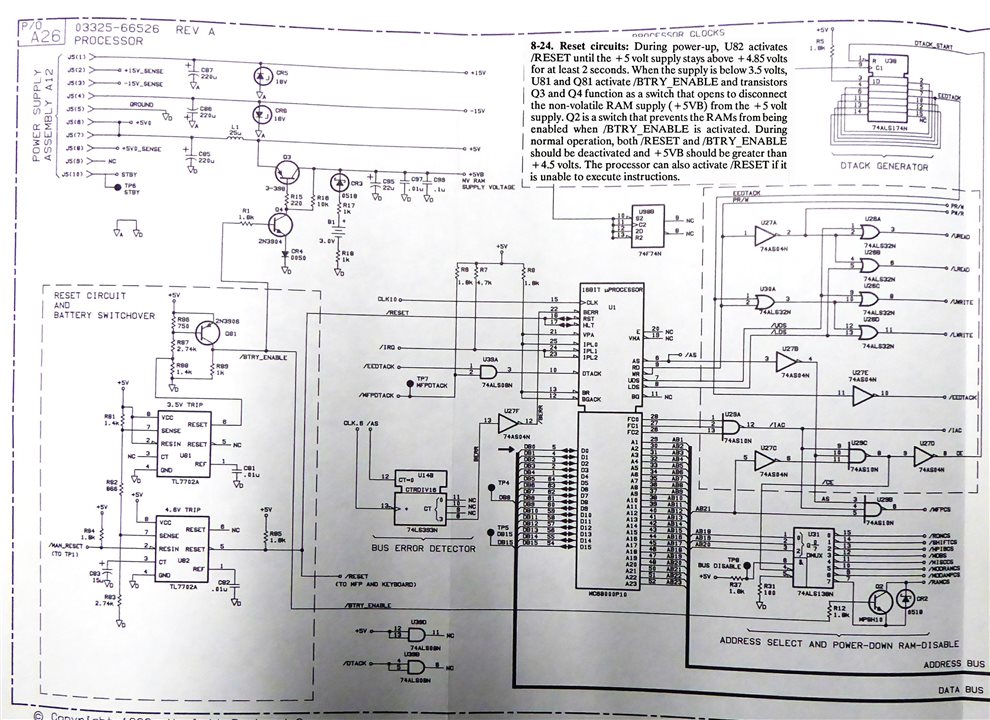
I looked at the attached schematic expecting it to be retaining vital calibration data.
I have scoured the service manual for any mention of this lithium battery's purpose and the only reference to it is a tiny section entitled RESET CIRCUITS. (I have pasted this as a window at the top of the attached schematic).

So what is the battery backing up?
The schematic shows it feeding a supply line called "+5B NV RAM SUPPLY VOLTAGE". However a closer look at the diagram shows it powering a pair of SRAM chips which are of course Volatile memory.
Does anyone know if these two memory IC's are holding vital calibration data or are they used to simply store user's operational data whilst the generator is switched on and operating.

I can't find this vital nugget of information in the service manual (well I can't spot it!) and DO NOT want to accidentally lose the calibration by foolishly disconnecting the battery without mitigation.

Please enlighten me if you know the answer.
Thanks in anticipation..........
Daveimage
  • Sign in to reply
  • Cancel

Top Replies

  • beacon_dave
    beacon_dave over 1 year ago +3
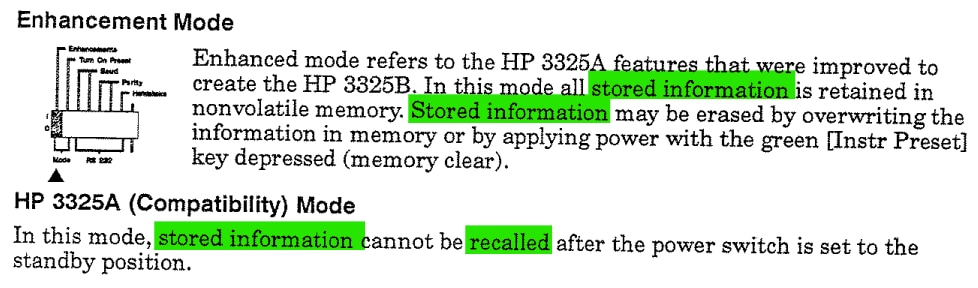
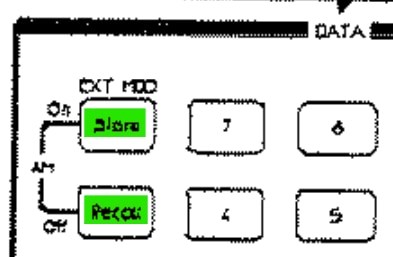
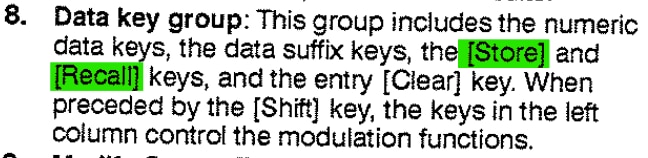
    Looks like the data entry values as the manual refers to storing and recalling information.
  • davebullockmbe
    davebullockmbe over 1 year ago in reply to beacon_dave +2
    Lol...been there ... got the missing knuckles :-)
  • dougw
    dougw over 1 year ago +1
    I can't say what data is being retained in the SRAM, however the SRAM power looks like it is fed from the regular 5V supply when the system is powered up, and the battery only kicks in when 5V disappears…
  • michaelkellett
    0 michaelkellett over 1 year ago

    I thought I might help you until I realised that mine is a 3325A.

    I suggest you ask on

    https://groups.io/g/HP-Agilent-Keysight-equipment

    You'll need to join (free) but its well worthwhile if you play with old HP stuff.

    There is a a good deal more "attitude" there than on E14 but also some very helpful and knowledgeable people.

    MK

    • Cancel
    • Vote Up 0 Vote Down
    • Sign in to reply
    • Verify Answer
    • Cancel
  • phoenixcomm
    0 phoenixcomm over 1 year ago

     davebullockmbe I think as I am not sure but I grabbed the service manual (waist) and could not find the part number. My best guess is they are using sort of a regulator. ie if the drive V is too high from Q3, 84 the output will go to zero, ~~ Cris

    • Cancel
    • Vote Up 0 Vote Down
    • Sign in to reply
    • Verify Answer
    • Cancel
  • dougw
    0 dougw over 1 year ago

    I can't say what data is being retained in the SRAM, however the SRAM power looks like it is fed from the regular 5V supply when the system is powered up, and the battery only kicks in when 5V disappears. It looks like you can (carefully) replace the battery while the system is powered up without ever losing power to the SRAM..

    • Cancel
    • Vote Up +1 Vote Down
    • Sign in to reply
    • Verify Answer
    • Cancel
  • electronicbiker
    0 electronicbiker over 1 year ago

    I don't know the answer either. My best guess is that it could be some sort of memory that retains the settings of all the knobs and switches during a power-down and that those values are used on the next power-up so that all the knobs and switches will be set to deliver the same values as when it was switched off. This would suggest that the knobs and switches rotate continuously and generate square waves, like the two pulse-generating wheels inside an old-fashioned mouse. The extra bits and pieces may be a hold-off system whereby the voltages applied to the delicate parts have to reach and remain at a certain voltage level and for a certain length of time before being applied to the rest of the circuit. After all, if the 5 volt peak-to-peak maximum input socket on the equipment that is being calibrated is still connected after a power-down, you wouldn't want to be suppying hundreds of volts to it during power-up. It might also do a similar job on power-down, as the voltages will be all over the place as the power fades away.

    I had difficulty viewing the circuit diagram as it is blurred in places and very blurred in others. Can you do it again with the camera on a tripod and the shutter release operated remotely? I have found a desktop music stand to be very useful when standing manuals and diagrams etc nearly upright. The dark part (bottom centre) doesn't help either. Other useful info would be an approximate date of manufacture and the part numbers of some of the other devices especially the two big ones shown end-to-end in the dark area. Also, are there any crystals, and if so what is their resonant frequency? It is just possible that there is a phase-locked-loop in there somewhere.

    Final thought - "NV RAM" could be a very early version of "EEPROM", especially if it is written to on power-down and read on power-up. If that is the case then both power-up and power-down might take slightly longer than expected.

    • Cancel
    • Vote Up 0 Vote Down
    • Sign in to reply
    • Verify Answer
    • Cancel
  • electronicbiker
    0 electronicbiker over 1 year ago in reply to electronicbiker

    Blast! Just had another thought! Always the same, I press the Log Out button and immediately think of something else.

    The model number HP3325B might be part of the mystery. Assuming there is a HP3325A, C, D, etc, then different fixed parameters could be stored in the NV RAM for different models. In which case don't take the battery out just yet!

    • Cancel
    • Vote Up 0 Vote Down
    • Sign in to reply
    • Verify Answer
    • Cancel
  • beacon_dave
    0 beacon_dave over 1 year ago

    Looks like the data entry values as the manual refers to storing and recalling information.

    image

    image

    image

    • Cancel
    • Vote Up +3 Vote Down
    • Sign in to reply
    • Verify Answer
    • Cancel
  • davebullockmbe
    0 davebullockmbe over 1 year ago in reply to beacon_dave

    HI everyone, wow what a great response thank you.

    So does this look like it's 'user's setup' data that's stored and can be recalled to continue a particular test regime, as opposed to "factory" calibration that would be a disaster if lost?

    beacon-dave where did you find this? is it in the service or operators manual?
    I need to see a description of just what sort of data HP are calling  "Stored data".

    Great stuff, thanks everyone

    Dave

    • Cancel
    • Vote Up 0 Vote Down
    • Sign in to reply
    • Verify Answer
    • Cancel
  • beacon_dave
    0 beacon_dave over 1 year ago in reply to davebullockmbe
    davebullockmbe said:
    beacon-dave where did you find this?

    That was from the Operating Manual dated 1997.

    Perhaps check the service manual for the model A to verify that there is no battery backup to the SRAM there.

    • The NV RAM is listed as one of the model B enhancements over the previous model A.
    • If you switch the model B into model A 'compatibility mode' then you would appear to lose the NV backup functionality of the SRAM during standby/power cycle.
    • If the model A doesn't have a battery, then if any factory calibration data was being stored there, then presumably the model A would have lost it immediately after it was powered off at the factory.
    davebullockmbe said:
    as opposed to "factory" calibration that would be a disaster if lost

    After ≈25 years, then it may be out of factory calibration by now anyway. Scream

    Note that there is also an Installation Manual for the HP3325B which gives you the factory inspection check list but at a glance I didn't see any reference to the NV RAM or store / recall functionality.

    • Cancel
    • Vote Up 0 Vote Down
    • Sign in to reply
    • Verify Answer
    • Cancel
  • davebullockmbe
    0 davebullockmbe over 1 year ago in reply to beacon_dave

    Thanks, yes it's always frustrating when the specific information you need is either glossed over of missing from a manual.

    It's the well known Car maintenance manual problem isn't it?

    eg. "To remove the water pump first locate the 'throggle pin' and with the special spanner loosen the 'cratchitt collar and withdraw the pin". No indication of where either mystery part is,  or what the special spanner looks like in the subsequent text or diagrams...lol! 

    I am thinking that it's looking like the SRAM is just storing operational data rather than vital calibration data then.
    Yes these signal generators were pulled from 19" racks in an audiology laboratory and look like new, amazingly.
    I haven't found any real issues with the calibration but I now only use them in less exacting situations.

    The fault I was initially repairing I traced to 'granulated' solder joints where there was a ring of grey cracking around the soldered pins on the three flat ribbon cable connectors half way down A26 leading through the 'deck' to the lower section. I wasn't expecting such a 'dry joint' issue with gold plated HP boards so lesson learned!

    Dave

    • Cancel
    • Vote Up +1 Vote Down
    • Sign in to reply
    • Verify Answer
    • Cancel
  • beacon_dave
    0 beacon_dave over 1 year ago in reply to davebullockmbe
    davebullockmbe said:
    it's always frustrating when the specific information you need is either glossed over of missing from a manual

    Perhaps be thankful that there were at least three such manuals available. These days you are lucky if you get a generic 'pamphlet' that even remotely matches the operation of your equipment.

    davebullockmbe said:
    or what the special spanner looks like

    Or that with the engine/body in place, even with the 'special spanner', it is less than an eighth of a turn between engine block and bulkhead and it is the world's longest bolt that is 'tight all the way'... Disappointed

    • Cancel
    • Vote Up +1 Vote Down
    • Sign in to reply
    • Verify Answer
    • Cancel
>
element14 Community

element14 is the first online community specifically for engineers. Connect with your peers and get expert answers to your questions.

  • Members
  • Learn
  • Technologies
  • Challenges & Projects
  • Products
  • Store
  • About Us
  • Feedback & Support
  • FAQs
  • Terms of Use
  • Privacy Policy
  • Legal and Copyright Notices
  • Sitemap
  • Cookies

An Avnet Company © 2026 Premier Farnell Limited. All Rights Reserved.

Premier Farnell Ltd, registered in England and Wales (no 00876412), registered office: Farnell House, Forge Lane, Leeds LS12 2NE.

ICP 备案号 10220084.

Follow element14

  • X
  • Facebook
  • linkedin
  • YouTube