element14 Community
element14 Community
    Register Log In
  • Site
  • Search
  • Log In Register
  • Community Hub
    Community Hub
    • What's New on element14
    • Feedback and Support
    • Benefits of Membership
    • Personal Blogs
    • Members Area
    • Achievement Levels
  • Learn
    Learn
    • Ask an Expert
    • eBooks
    • element14 presents
    • Learning Center
    • Tech Spotlight
    • STEM Academy
    • Webinars, Training and Events
    • Learning Groups
  • Technologies
    Technologies
    • 3D Printing
    • FPGA
    • Industrial Automation
    • Internet of Things
    • Power & Energy
    • Sensors
    • Technology Groups
  • Challenges & Projects
    Challenges & Projects
    • Design Challenges
    • element14 presents Projects
    • Project14
    • Arduino Projects
    • Raspberry Pi Projects
    • Project Groups
  • Products
    Products
    • Arduino
    • Avnet & Tria Boards Community
    • Dev Tools
    • Manufacturers
    • Multicomp Pro
    • Product Groups
    • Raspberry Pi
    • RoadTests & Reviews
  • About Us
  • Store
    Store
    • Visit Your Store
    • Choose another store...
      • Europe
      •  Austria (German)
      •  Belgium (Dutch, French)
      •  Bulgaria (Bulgarian)
      •  Czech Republic (Czech)
      •  Denmark (Danish)
      •  Estonia (Estonian)
      •  Finland (Finnish)
      •  France (French)
      •  Germany (German)
      •  Hungary (Hungarian)
      •  Ireland
      •  Israel
      •  Italy (Italian)
      •  Latvia (Latvian)
      •  
      •  Lithuania (Lithuanian)
      •  Netherlands (Dutch)
      •  Norway (Norwegian)
      •  Poland (Polish)
      •  Portugal (Portuguese)
      •  Romania (Romanian)
      •  Russia (Russian)
      •  Slovakia (Slovak)
      •  Slovenia (Slovenian)
      •  Spain (Spanish)
      •  Sweden (Swedish)
      •  Switzerland(German, French)
      •  Turkey (Turkish)
      •  United Kingdom
      • Asia Pacific
      •  Australia
      •  China
      •  Hong Kong
      •  India
      • Japan
      •  Korea (Korean)
      •  Malaysia
      •  New Zealand
      •  Philippines
      •  Singapore
      •  Taiwan
      •  Thailand (Thai)
      • Vietnam
      • Americas
      •  Brazil (Portuguese)
      •  Canada
      •  Mexico (Spanish)
      •  United States
      Can't find the country/region you're looking for? Visit our export site or find a local distributor.
  • Translate
  • Profile
  • Settings
Experts, Learning and Guidance
  • Technologies
  • More
Experts, Learning and Guidance
Ask an Expert Forum How does 569 relate to 5.6pF on an MLCC through hole capacitor, I understand 101 or 104 but why 569?
  • Blog
  • Forum
  • Documents
  • Leaderboard
  • Files
  • Members
  • Mentions
  • Sub-Groups
  • Tags
  • More
  • Cancel
  • New
Join Experts, Learning and Guidance to participate - click to join for free!
Actions
  • Share
  • More
  • Cancel
Forum Thread Details
  • State Verified Answer
  • Replies 12 replies
  • Answers 1 answer
  • Subscribers 301 subscribers
  • Views 1511 views
  • Users 0 members are here
Related
See a helpful answer?

Be sure to click 'more' and select 'suggest as answer'!

If you're the thread creator, be sure to click 'more' then 'Verify as Answer'!

How does 569 relate to 5.6pF on an MLCC through hole capacitor, I understand 101 or 104 but why 569?

davebullockmbe
davebullockmbe 9 months ago

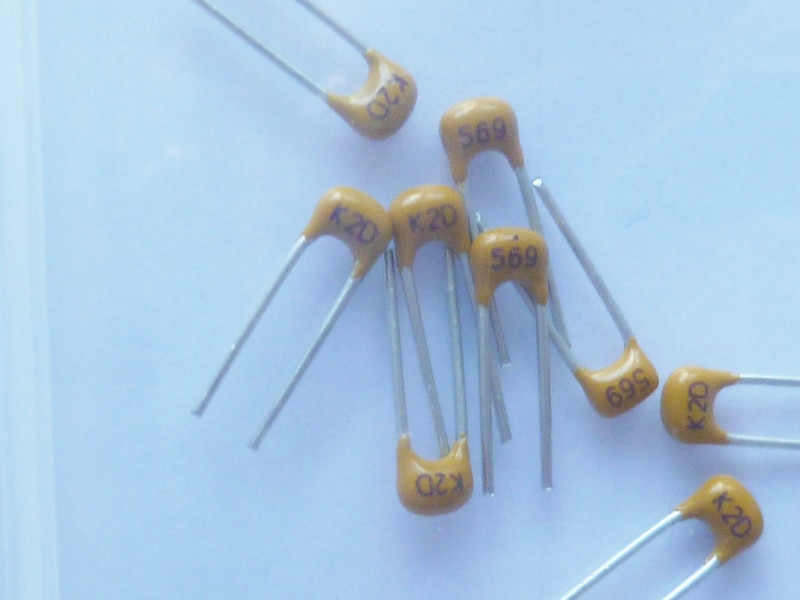
Hi I just received what purport to be some through hole 5.6pF MLCC's marked 569, how does this relate to the value?

I understand MLCC's marked 101, 102, 473 as the last number is the multiplier (how many zeroes) but xx9?

Whilst an internet can decipher the value it offers no explanation of the value numbering origin for such low value MLCC's

Please explain.

Thanks

Dave

  • Sign in to reply
  • Cancel

Top Replies

  • davebullockmbe
    davebullockmbe 9 months ago in reply to michaelkellett +3
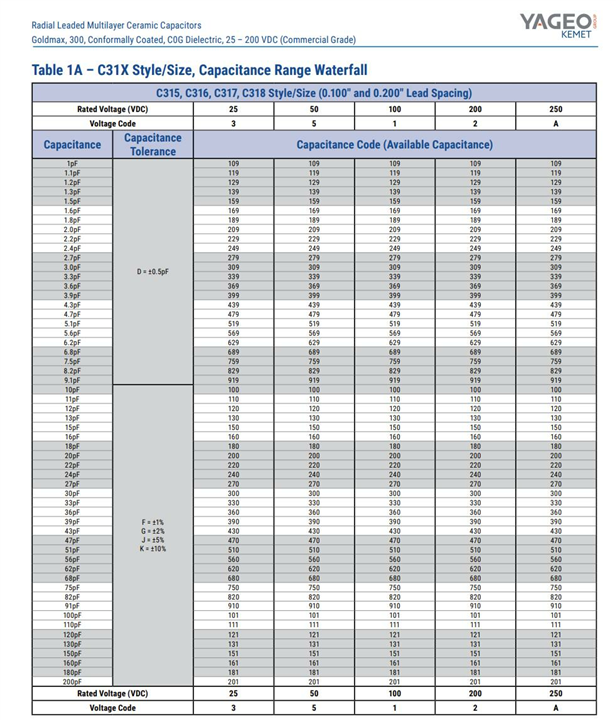
    Ha! Mystery solved...the xx9 (9) means there is NO multiplier and infers that the value is BELOW 10pF. I just found this chart (below) Once the value increases above 9.1pF the familiar 100 appears…
  • anniel747
    anniel747 9 months ago in reply to davebullockmbe +2 verified
    davebullockmbe Capacitance Code (pF): Two significant digits and number of zeros. Use 9 for 1.0 – 9.9 pF. Use 8 for 0.5 – .99 pF. ex. 2.2 pF = 229 ex. 0.5 pF = 508
  • davebullockmbe
    davebullockmbe 9 months ago in reply to anniel747 +2 verified
    Interesting thanks :-)
  • shabaz
    0 shabaz 9 months ago

    Are these from ebay/aliexpress? Maybe it's a typo, the operator hit the 9 key instead of zero, for their printing operation (and mistakenly typed that instead of 056 too! If they have to type three digits). Could be anything if its from such a source..

    • Cancel
    • Vote Up 0 Vote Down
    • Sign in to reply
    • Verify Answer
    • Cancel
  • davebullockmbe
    0 davebullockmbe 9 months ago in reply to shabaz

    No it doesn't appear to be a 'typo' as this is the text on the actual capacitors (attached) see below. They were from a well known UK supplier although will have originated from China as does everything these days?

    I can't imagine what the 9 stands for..... it can't be a multiplier.....mysterious!

    Dave

    image

    • Cancel
    • Vote Up 0 Vote Down
    • Sign in to reply
    • Verify Answer
    • Cancel
  • shabaz
    0 shabaz 9 months ago in reply to davebullockmbe

    What's the brand/manufacturer part code? I'm wondering if the datasheet explains the labeling. Are these from a small hobby store reseller or a larger distributor?

    • Cancel
    • Vote Up 0 Vote Down
    • Sign in to reply
    • Verify Answer
    • Cancel
  • davebullockmbe
    0 davebullockmbe 9 months ago in reply to shabaz

    Well clearly it's a recognised numbering format because if you type "569 mlcc" into google the first 'hit' (AI overview) you get explains that it's a 5.6pF MLCC capacitor

    C0402C569D5GACAUTO and C0603C569C5GACTU are part numbers for 5.6 pF, 50 V multilayer ceramic capacitors (MLCCs). These capacitors are made by KEMET

    So I assume it's an established nomenclature?

    However I have never seen this before in my 50 years of industrial electronics.
    Dave

    • Cancel
    • Vote Up 0 Vote Down
    • Sign in to reply
    • Verify Answer
    • Cancel
  • michaelkellett
    0 michaelkellett 9 months ago

    Have you measured them - perhaps they are 56nF Slight smile

    Not really - I just saw your bit about looking them up.

    MK

    • Cancel
    • Vote Up 0 Vote Down
    • Sign in to reply
    • Verify Answer
    • Cancel
  • davebullockmbe
    0 davebullockmbe 9 months ago in reply to michaelkellett

    Ha!

    Mystery solved...the xx9 (9) means there is NO multiplier and infers that the value is BELOW 10pF.

    I just found this chart (below)

    Once the value increases above 9.1pF the familiar 100 appears to operate.
    I guess I never used MLCC's below 10pF before...amazing!

    Dave

    image

    • Cancel
    • Vote Up +3 Vote Down
    • Sign in to reply
    • Verify Answer
    • Cancel
  • shabaz
    0 shabaz 9 months ago in reply to davebullockmbe

    No, it's a manufacturer convention. Hence why the part code matters if there's any ambiguity.

    For instance, Murata MLCCs use a decimal identifier 'R' for these small values. And it's very common for older ceramic discs (i.e. not MLCC) to just directly print the value when below 10pF.

    • Cancel
    • Vote Up 0 Vote Down
    • Sign in to reply
    • Verify Answer
    • Cancel
  • anniel747
    0 anniel747 9 months ago in reply to davebullockmbe

    davebullockmbe 

    Capacitance Code (pF): Two significant digits and number of zeros. Use 9 for 1.0 – 9.9 pF. Use 8 for 0.5 – .99 pF. ex. 2.2 pF = 229 ex. 0.5 pF = 508

    • Cancel
    • Vote Up +2 Vote Down
    • Sign in to reply
    • Reject Answer
    • Cancel
  • davebullockmbe
    +1 davebullockmbe 9 months ago in reply to anniel747

    Interesting thanks :-)

    • Cancel
    • Vote Up +2 Vote Down
    • Sign in to reply
    • Reject Answer
    • Cancel
  • anniel747
    0 anniel747 9 months ago in reply to davebullockmbe

    davebullockmbe Taken from the datasheet.

    • Cancel
    • Vote Up 0 Vote Down
    • Sign in to reply
    • Verify Answer
    • Reject Answer
    • Cancel
>
element14 Community

element14 is the first online community specifically for engineers. Connect with your peers and get expert answers to your questions.

  • Members
  • Learn
  • Technologies
  • Challenges & Projects
  • Products
  • Store
  • About Us
  • Feedback & Support
  • FAQs
  • Terms of Use
  • Privacy Policy
  • Legal and Copyright Notices
  • Sitemap
  • Cookies

An Avnet Company © 2026 Premier Farnell Limited. All Rights Reserved.

Premier Farnell Ltd, registered in England and Wales (no 00876412), registered office: Farnell House, Forge Lane, Leeds LS12 2NE.

ICP 备案号 10220084.

Follow element14

  • X
  • Facebook
  • linkedin
  • YouTube