element14 Community
element14 Community
    Register Log In
  • Site
  • Search
  • Log In Register
  • Community Hub
    Community Hub
    • What's New on element14
    • Feedback and Support
    • Benefits of Membership
    • Personal Blogs
    • Members Area
    • Achievement Levels
  • Learn
    Learn
    • Ask an Expert
    • eBooks
    • element14 presents
    • Learning Center
    • Tech Spotlight
    • STEM Academy
    • Webinars, Training and Events
    • Learning Groups
  • Technologies
    Technologies
    • 3D Printing
    • FPGA
    • Industrial Automation
    • Internet of Things
    • Power & Energy
    • Sensors
    • Technology Groups
  • Challenges & Projects
    Challenges & Projects
    • Design Challenges
    • element14 presents Projects
    • Project14
    • Arduino Projects
    • Raspberry Pi Projects
    • Project Groups
  • Products
    Products
    • Arduino
    • Avnet & Tria Boards Community
    • Dev Tools
    • Manufacturers
    • Multicomp Pro
    • Product Groups
    • Raspberry Pi
    • RoadTests & Reviews
  • About Us
  • Store
    Store
    • Visit Your Store
    • Choose another store...
      • Europe
      •  Austria (German)
      •  Belgium (Dutch, French)
      •  Bulgaria (Bulgarian)
      •  Czech Republic (Czech)
      •  Denmark (Danish)
      •  Estonia (Estonian)
      •  Finland (Finnish)
      •  France (French)
      •  Germany (German)
      •  Hungary (Hungarian)
      •  Ireland
      •  Israel
      •  Italy (Italian)
      •  Latvia (Latvian)
      •  
      •  Lithuania (Lithuanian)
      •  Netherlands (Dutch)
      •  Norway (Norwegian)
      •  Poland (Polish)
      •  Portugal (Portuguese)
      •  Romania (Romanian)
      •  Russia (Russian)
      •  Slovakia (Slovak)
      •  Slovenia (Slovenian)
      •  Spain (Spanish)
      •  Sweden (Swedish)
      •  Switzerland(German, French)
      •  Turkey (Turkish)
      •  United Kingdom
      • Asia Pacific
      •  Australia
      •  China
      •  Hong Kong
      •  India
      • Japan
      •  Korea (Korean)
      •  Malaysia
      •  New Zealand
      •  Philippines
      •  Singapore
      •  Taiwan
      •  Thailand (Thai)
      • Vietnam
      • Americas
      •  Brazil (Portuguese)
      •  Canada
      •  Mexico (Spanish)
      •  United States
      Can't find the country/region you're looking for? Visit our export site or find a local distributor.
  • Translate
  • Profile
  • Settings
Experts, Learning and Guidance
  • Technologies
  • More
Experts, Learning and Guidance
Ask an Expert Forum Multiple charger ICs on the same battery?
  • Blog
  • Forum
  • Documents
  • Leaderboard
  • Files
  • Members
  • Mentions
  • Sub-Groups
  • Tags
  • More
  • Cancel
  • New
Join Experts, Learning and Guidance to participate - click to join for free!
Actions
  • Share
  • More
  • Cancel
Forum Thread Details
  • State Not Answered
  • Replies 8 replies
  • Subscribers 300 subscribers
  • Views 47 views
  • Users 0 members are here
  • battery charging
  • lipo
Related
See a helpful answer?

Be sure to click 'more' and select 'suggest as answer'!

If you're the thread creator, be sure to click 'more' then 'Verify as Answer'!

Multiple charger ICs on the same battery?

obones
obones 1 day ago

Hello,

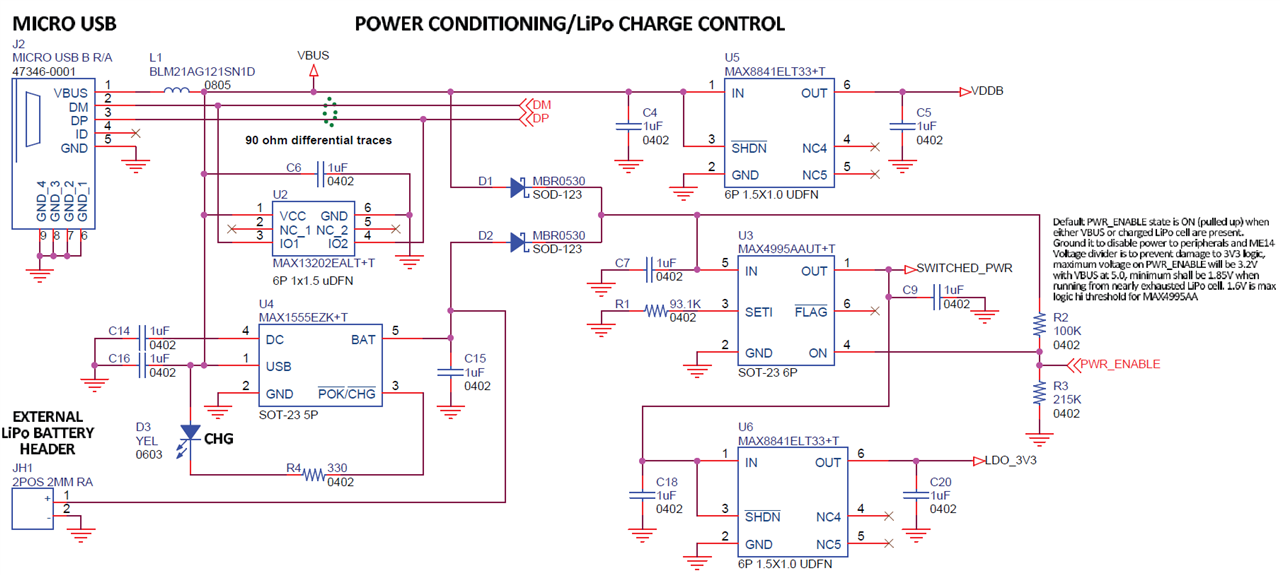
I have a MAX32666FTHR board that embeds a MAX1555 IC to handle charging a LiPo battery, as seen on this diagram:
image

In the circuit I'm building around that board, I'm using a display made of 64 WS2812B LEDs that is powered with +5V and consumes around 1A when fully lit.
To generate that +5V from the battery, I can use a boost DC DC converter quite easily, I just need to take into account the fact that it consumes a lot of current, and so the battery cannot be small if I want it to work for more than a few minutes. As such, I'm looking at 5000 to 10000mAh batteries.

Thing is, the MAX1555 used here is only consuming 100mA at most while charging, meaning that it would take anywhere between 2 to 4 days to fully charge the selected battery.

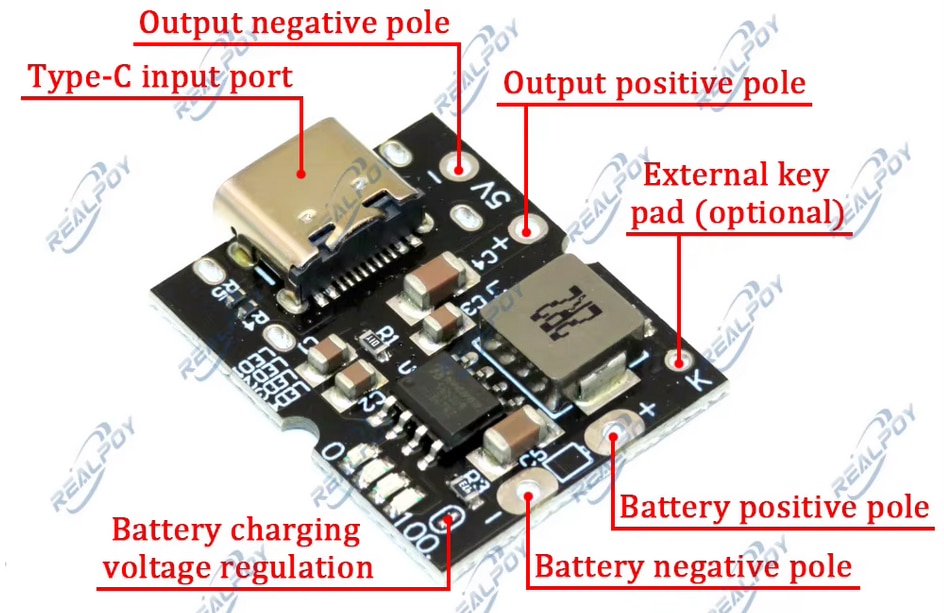
So, to speed up things quite a bit, I'm considering this kind of module:
image

It's specifications tell me that it can charge a 2A, thus getting around 2.5 to 5 hours charge time. And it is also capable of outputting 5V at 2A, way more than what I need in my project.

So far so good, but I'm wondering how to connect all this together, preserving functionality as much as possible, with as little user manipulation as possible.

At first, I thought about desoldering the VBUS pin on J2 and connecting VBUS to the module output. But this makes the VDDB signal always present which tricks the MAX32666 into thinking it is connected to a USB host when it is not actually so. And I'd really like to be able to continue using the available USB stack implementation in my project.

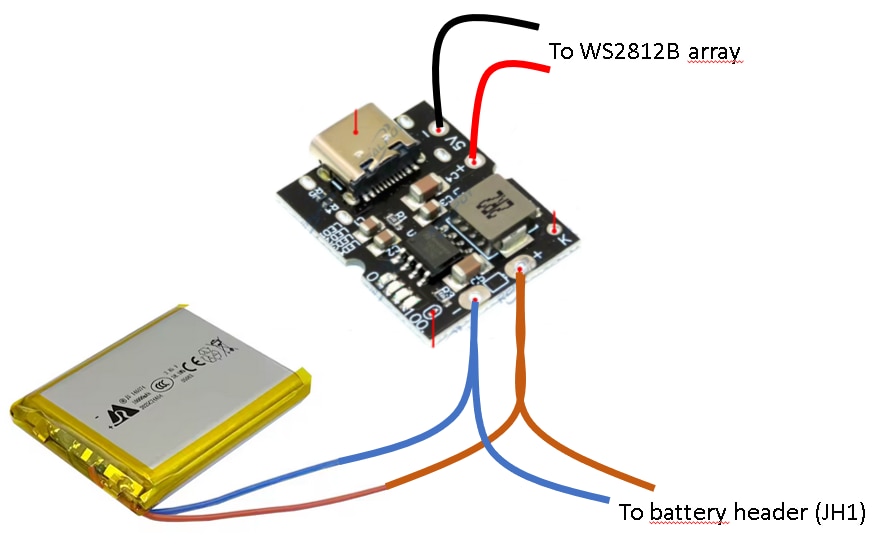
My other idea is to connect the battery to both the module and the max32666FTHR board battery header, like this:
image

The battery has its own integrated protection circuit.

However, I have two concerns with this:
The first is about the survival of the MAX1555 when the battery is under charge by the module. I think it would not mind as it would see 4.2V on its BAT pin, way below the maximum value (7V in the datasheet).
The second is about the survival of the charging chip inside the module when I plug a micro USB cable in J2 on the board. This would put the MAX1555 into charging mode, thus sending 4V into the positive cable of the battery and into the module charging chip, but I believe this should be fine as would be the case in the reverse situation.

What do you think of this? Am I right in assuming the second idea is fine for both charger ICs?

Thanks for your help

  • Sign in to reply
  • Cancel

Top Replies

  • michaelkellett
    michaelkellett 22 hours ago +1
    Looking at the MAX1555 data sheet suggests that connecting a charger will do no harm (to it). The text refers to low leakage current drawn from the battery with no power sources connected and on page…
Parents
  • misaz
    0 misaz 1 day ago

    Do not use battery port on MAX32666FTHR, power it through USB (5V) which you will already have in hand for LEDs.

    IMHO Maxim boards are not good for this use case. They are intended for 1.8/3.3V operation and everything above it seems to me like too much hassle with these boards.

    • Cancel
    • Vote Up 0 Vote Down
    • Sign in to reply
    • Verify Answer
    • Cancel
  • obones
    0 obones 1 day ago in reply to misaz

    Yes, but what happens if I also plug a micro USB cable in the J2 port for data communication ? Wouldn't the two sources of +5V be conflicting, possibly frying either the converter module or the USB host ?

    • Cancel
    • Vote Up 0 Vote Down
    • Sign in to reply
    • Verify Answer
    • Cancel
  • misaz
    0 misaz 1 day ago in reply to obones

    And do you need USB data? My idea was to let USB on FTHR empty and connect 5V to VBUS pin on headers.

    • Cancel
    • Vote Up 0 Vote Down
    • Sign in to reply
    • Verify Answer
    • Cancel
Reply
  • misaz
    0 misaz 1 day ago in reply to obones

    And do you need USB data? My idea was to let USB on FTHR empty and connect 5V to VBUS pin on headers.

    • Cancel
    • Vote Up 0 Vote Down
    • Sign in to reply
    • Verify Answer
    • Cancel
Children
  • obones
    0 obones 1 day ago in reply to misaz

    Yes, I'd really like to keep that possibility for the firmware I'm writing which is intended to be a "demonstration" of what's available.

    • Cancel
    • Vote Up 0 Vote Down
    • Sign in to reply
    • Verify Answer
    • Cancel
element14 Community

element14 is the first online community specifically for engineers. Connect with your peers and get expert answers to your questions.

  • Members
  • Learn
  • Technologies
  • Challenges & Projects
  • Products
  • Store
  • About Us
  • Feedback & Support
  • FAQs
  • Terms of Use
  • Privacy Policy
  • Legal and Copyright Notices
  • Sitemap
  • Cookies

An Avnet Company © 2026 Premier Farnell Limited. All Rights Reserved.

Premier Farnell Ltd, registered in England and Wales (no 00876412), registered office: Farnell House, Forge Lane, Leeds LS12 2NE.

ICP 备案号 10220084.

Follow element14

  • X
  • Facebook
  • linkedin
  • YouTube