element14 Community
element14 Community
    Register Log In
  • Site
  • Search
  • Log In Register
  • Community Hub
    Community Hub
    • What's New on element14
    • Feedback and Support
    • Benefits of Membership
    • Personal Blogs
    • Members Area
    • Achievement Levels
  • Learn
    Learn
    • Ask an Expert
    • eBooks
    • element14 presents
    • Learning Center
    • Tech Spotlight
    • STEM Academy
    • Webinars, Training and Events
    • Learning Groups
  • Technologies
    Technologies
    • 3D Printing
    • FPGA
    • Industrial Automation
    • Internet of Things
    • Power & Energy
    • Sensors
    • Technology Groups
  • Challenges & Projects
    Challenges & Projects
    • Design Challenges
    • element14 presents Projects
    • Project14
    • Arduino Projects
    • Raspberry Pi Projects
    • Project Groups
  • Products
    Products
    • Arduino
    • Avnet & Tria Boards Community
    • Dev Tools
    • Manufacturers
    • Multicomp Pro
    • Product Groups
    • Raspberry Pi
    • RoadTests & Reviews
  • About Us
  • Store
    Store
    • Visit Your Store
    • Choose another store...
      • Europe
      •  Austria (German)
      •  Belgium (Dutch, French)
      •  Bulgaria (Bulgarian)
      •  Czech Republic (Czech)
      •  Denmark (Danish)
      •  Estonia (Estonian)
      •  Finland (Finnish)
      •  France (French)
      •  Germany (German)
      •  Hungary (Hungarian)
      •  Ireland
      •  Israel
      •  Italy (Italian)
      •  Latvia (Latvian)
      •  
      •  Lithuania (Lithuanian)
      •  Netherlands (Dutch)
      •  Norway (Norwegian)
      •  Poland (Polish)
      •  Portugal (Portuguese)
      •  Romania (Romanian)
      •  Russia (Russian)
      •  Slovakia (Slovak)
      •  Slovenia (Slovenian)
      •  Spain (Spanish)
      •  Sweden (Swedish)
      •  Switzerland(German, French)
      •  Turkey (Turkish)
      •  United Kingdom
      • Asia Pacific
      •  Australia
      •  China
      •  Hong Kong
      •  India
      • Japan
      •  Korea (Korean)
      •  Malaysia
      •  New Zealand
      •  Philippines
      •  Singapore
      •  Taiwan
      •  Thailand (Thai)
      • Vietnam
      • Americas
      •  Brazil (Portuguese)
      •  Canada
      •  Mexico (Spanish)
      •  United States
      Can't find the country/region you're looking for? Visit our export site or find a local distributor.
  • Translate
  • Profile
  • Settings
Experts, Learning and Guidance
  • Technologies
  • More
Experts, Learning and Guidance
Ask an Expert Forum Solder able prototype board for 5A
  • Blog
  • Forum
  • Documents
  • Leaderboard
  • Files
  • Members
  • Mentions
  • Sub-Groups
  • Tags
  • More
  • Cancel
  • New
Join Experts, Learning and Guidance to participate - click to join for free!
Actions
  • Share
  • More
  • Cancel
Forum Thread Details
  • State Not Answered
  • Replies 5 replies
  • Subscribers 300 subscribers
  • Views 102 views
  • Users 0 members are here
Related
See a helpful answer?

Be sure to click 'more' and select 'suggest as answer'!

If you're the thread creator, be sure to click 'more' then 'Verify as Answer'!

Solder able prototype board for 5A

flows
flows 7 days ago

Hello, 

I need to create an IoT project that will automate something in my life. So i am making a automatic sunscreen controller which will make the screen go up or down based on the weather.

Now im almost finished with the project, it was time to connect the electronics. I am no expert at electronics so i looked up if i can just connect the nema 17 stepper motor to the power supply via the breadboard. As of my knowledge the Nema 17, at its peak, takes 1.7 amps per coil, it has two coils. So thats at most 3.4 amps. I have a power supply to power everything of 12V and 5A. It will melt the plastic of the breadboard with that current. 

So i was thinking maybe i could just put it on a solderable prototype board which makes it more secure, safe, and i will gain some extra points (yes thats something you can score on).

But i have no idea how i can know what prototype board can handle that current. Its also not stated on the sellers page.

On a arduino form someone recommended this prototype board: https://www.amazon.co.uk/Gikfun-Solder-able-Breadboard-Arduino-GK1007U/dp/B07D7PMCG5

But when i ask AI it says the board will also melt. Am i being misled by AI Sob? 

Picture of system:

Note: in this picture i use a expansion board because i though i couldn't directly connect the DRV8825 to the breadboard. 

image

  • Sign in to reply
  • Cancel

Top Replies

  • obones
    obones 7 days ago +2
    Those will take quite a bit of current, the pads are quite large. If you use solder to "bridge" the gaps between the pads, you'll get a quite large metallic junction which should be fine for the current…
  • kmikemoo
    kmikemoo 7 days ago in reply to obones +2
    flows obones was faster than me. ...What he said. If you really want to run that current on the protoboard - for just the driver board, "reinforce" that part of the trace with 18 or 20 AWG. Tack it to…
  • obones
    obones 5 days ago in reply to flows +2
    ESP32 doesn't even come close to 1A, the regulator won't even get hot.
  • obones
    0 obones 7 days ago

    Those will take quite a bit of current, the pads are quite large. If you use solder to "bridge" the gaps between the pads, you'll get a quite large metallic junction which should be fine for the current you are looking at.
    But looking at your schematic, you may not even have to use that anyway, the highest current goes from the wall wart to the DRV8825 expansion board, and to the motor. Use thick cables for these connections, the rest can go on a regular breadboard.

    • Cancel
    • Vote Up +2 Vote Down
    • Sign in to reply
    • Verify Answer
    • Cancel
  • kmikemoo
    0 kmikemoo 7 days ago in reply to obones

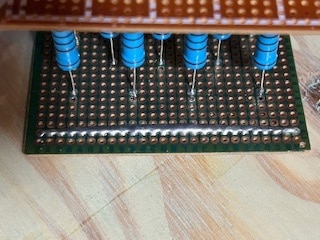
     flows   obones was faster than me.  Laughing  ...What he said.  If you really want to run that current on the protoboard - for just the driver board, "reinforce" that part of the trace with 18 or 20 AWG.  Tack it to the trace pads and be generous with the solder.

    image

    • Cancel
    • Vote Up +2 Vote Down
    • Sign in to reply
    • Verify Answer
    • Cancel
  • flows
    0 flows 6 days ago in reply to obones

    Thanks obones  and kmikemoo for the quick answer! So i can connect the power supply to the voltage regulator via the breadboard? (Which then connects to the ESP, via the breadboard) Wont it get to hot for the breadboard? And then as you said just connect the power supply directly to the expansionboard. Just so i can test it, and know i have atleast something to show at school if the protoboard idea fails Smile

    • Cancel
    • Vote Up 0 Vote Down
    • Sign in to reply
    • Verify Answer
    • Cancel
  • obones
    0 obones 5 days ago in reply to flows

    ESP32 doesn't even come close to 1A, the regulator won't even get hot.

    • Cancel
    • Vote Up +2 Vote Down
    • Sign in to reply
    • Verify Answer
    • Cancel
  • Jan Cumps
    0 Jan Cumps 4 days ago in reply to $parentForumReply.Author.DisplayName

    AI generated

    • Cancel
    • Vote Up 0 Vote Down
    • Sign in to reply
    • Verify Answer
    • Cancel
element14 Community

element14 is the first online community specifically for engineers. Connect with your peers and get expert answers to your questions.

  • Members
  • Learn
  • Technologies
  • Challenges & Projects
  • Products
  • Store
  • About Us
  • Feedback & Support
  • FAQs
  • Terms of Use
  • Privacy Policy
  • Legal and Copyright Notices
  • Sitemap
  • Cookies

An Avnet Company © 2026 Premier Farnell Limited. All Rights Reserved.

Premier Farnell Ltd, registered in England and Wales (no 00876412), registered office: Farnell House, Forge Lane, Leeds LS12 2NE.

ICP 备案号 10220084.

Follow element14

  • X
  • Facebook
  • linkedin
  • YouTube