Anyone using a portable/handheld oscilloscope/logic analyzer?
Im looking for recommendations of something to pick up.
Ideally with capabilities to hook into python or coding libraries over USB too.
Be sure to click 'more' and select 'suggest as answer'!
If you're the thread creator, be sure to click 'more' then 'Verify as Answer'!
Anyone using a portable/handheld oscilloscope/logic analyzer?
Im looking for recommendations of something to pick up.
Ideally with capabilities to hook into python or coding libraries over USB too.
I quite like the Pico scopes.
Sparked off by another thread I've just been comparing my 6242e (which I got from E14 in a RoadTest) and a 5444B which I bought myself (it's now superseded by the 5444d) .
You can buy equivalent hardware functionality from Rigol or Siglent for a bit less money but the Pico & software which works with all their scopes is much better than the built in software you get from any other low cost scope.
The Pico software compares very well with Tektronix, R & S or Keysight, and at far lower cost and with free upgrades and no need to pay for decoders for serial signals.
There are one or two issues with Pico that you should consider,
1) The DC offsetting on their analogue channels has nothing like the range that you get from Tek, R&S or Keysight. Many of the Rigols are a bit better too. This may not matter to you very much.
2) A Picoscope + PC is not as hand held as a true hand-held scope.
3) Having your scope connected to a PC via USB can make for extra earth loop and noise issues (never been a huge problem but the common earthing does affect accurate DC or low noise AC measuring.)
If you are about buy a new scope then think very carefully about the bandwidth that you actually need.
I've just been comparing the Pico 6242e (£7353) with the 5444B (now you would buy a 5444D at £2355).
The max speed of the 5444b(D) range is 200MHz and of the 6242e range it's 1GHz this means that if you need to work at >200MHz the 5444 obviously won't do.
But less obvious is that for audio or other lower frequency work the 6242e is a very poor choice.
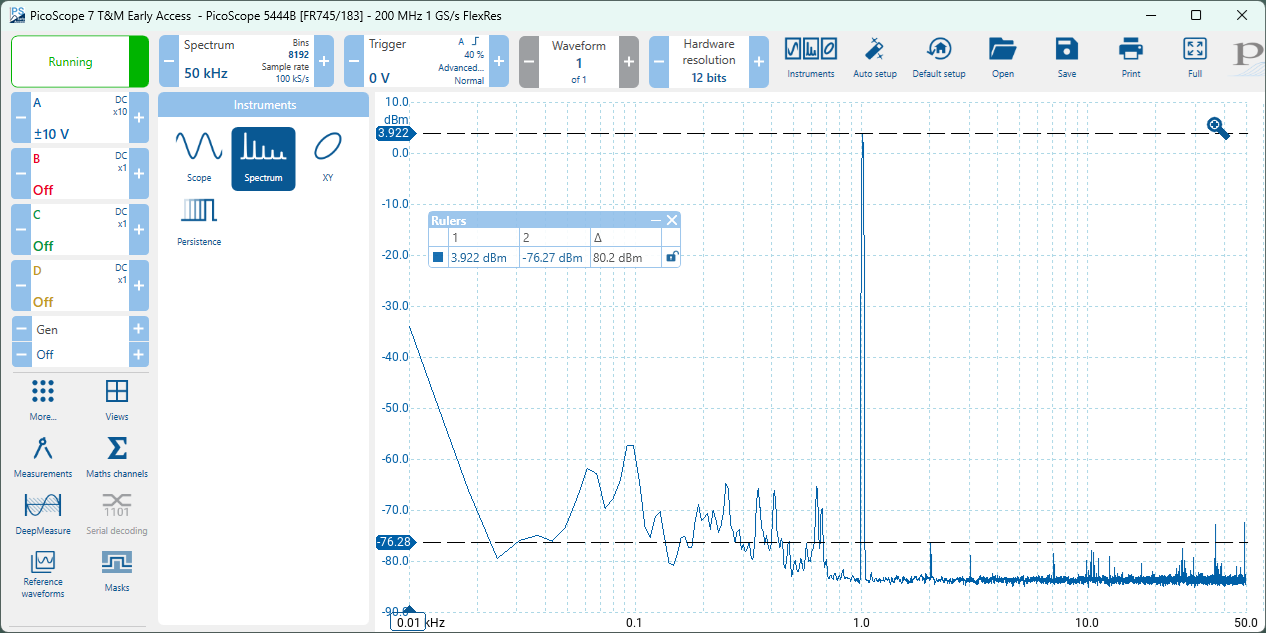
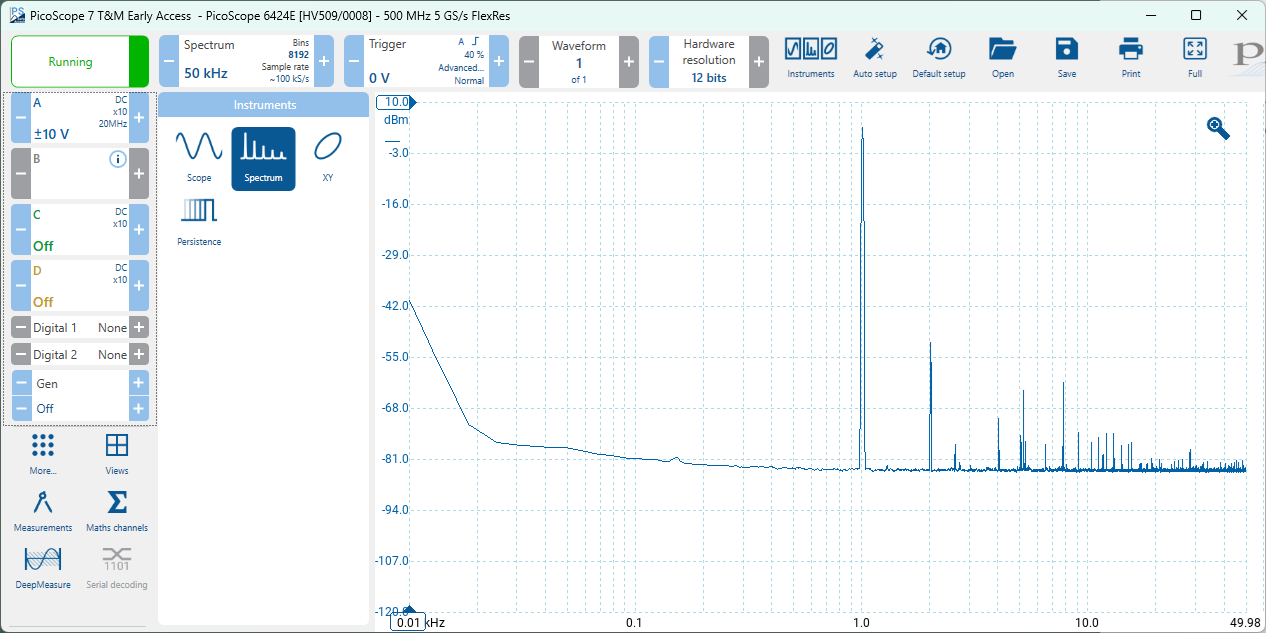
I measure the distortion at 5V RMS from a Neutrik Audio analyser (its THD is < 0.004% or -88dB), neither scope can get near the right answer but the 5444B is much closer. Im thinking of buying the new 5462e but it's spec for distortion a SFDR (Spurious Free Dynamic Range) is on 3dB better than the 5444B (73dB rather than 70dB) so I'm not sure if its worth it.

5444B measuring 1kHz sine from Neutrik A1, 12 bit setting for more direct comparison with 6242e (below).

6242e measuring the same signal.
BTW, one good takeaway from this experiment - the Picoscopes are the ONLY make I know of where the same control software can be used with two completely different models. And the icing on the cake is that the software is a new version which replaces the Picoscope6 supplied with both scopes when they were bought.

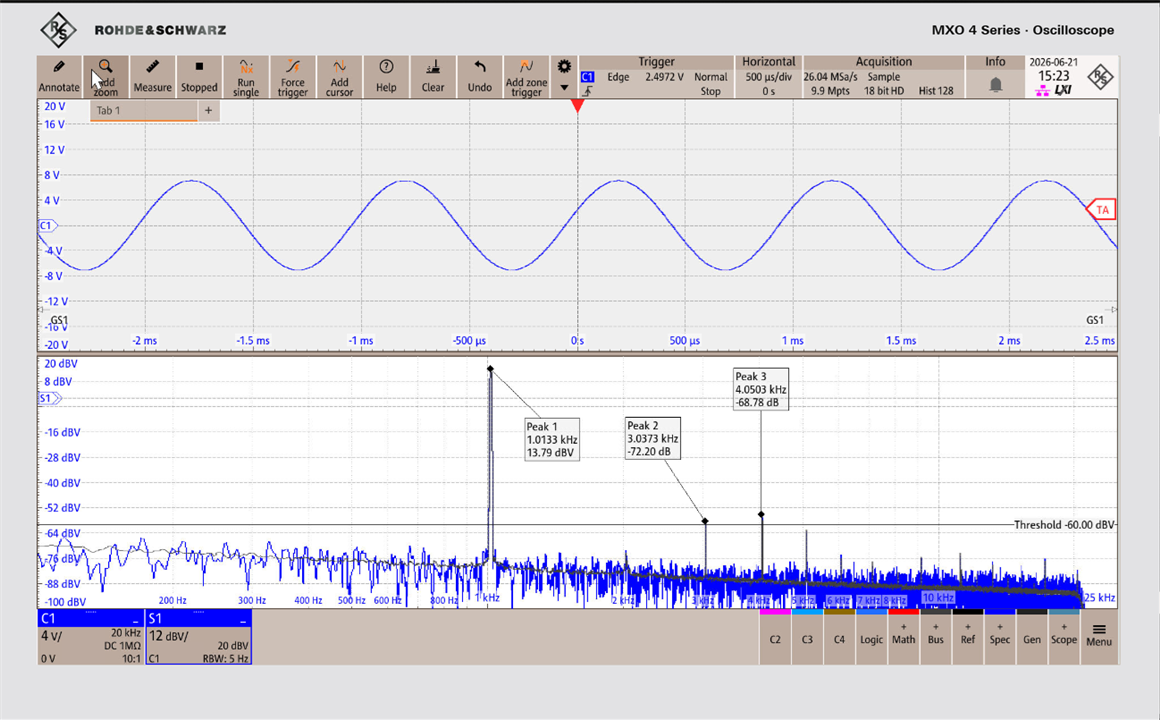
The R&S MZO4 does a lot better than the 6242e (so it should at 3x the price) but not as well as the 5444B - you can buy a reasonable car for the price difference there !
Many of the Picoscopes offer a digital input option, and although stand alone logic analysers are mostly much better than the ones built into scopes (some may challenge this rather sweeping assertion !) , the Pico software for digital inputs is better (IMO) than most scopes have.
Hope this is useful.
MK
I quite like the Pico scopes.
Sparked off by another thread I've just been comparing my 6242e (which I got from E14 in a RoadTest) and a 5444B which I bought myself (it's now superseded by the 5444d) .
You can buy equivalent hardware functionality from Rigol or Siglent for a bit less money but the Pico & software which works with all their scopes is much better than the built in software you get from any other low cost scope.
The Pico software compares very well with Tektronix, R & S or Keysight, and at far lower cost and with free upgrades and no need to pay for decoders for serial signals.
There are one or two issues with Pico that you should consider,
1) The DC offsetting on their analogue channels has nothing like the range that you get from Tek, R&S or Keysight. Many of the Rigols are a bit better too. This may not matter to you very much.
2) A Picoscope + PC is not as hand held as a true hand-held scope.
3) Having your scope connected to a PC via USB can make for extra earth loop and noise issues (never been a huge problem but the common earthing does affect accurate DC or low noise AC measuring.)
If you are about buy a new scope then think very carefully about the bandwidth that you actually need.
I've just been comparing the Pico 6242e (£7353) with the 5444B (now you would buy a 5444D at £2355).
The max speed of the 5444b(D) range is 200MHz and of the 6242e range it's 1GHz this means that if you need to work at >200MHz the 5444 obviously won't do.
But less obvious is that for audio or other lower frequency work the 6242e is a very poor choice.
I measure the distortion at 5V RMS from a Neutrik Audio analyser (its THD is < 0.004% or -88dB), neither scope can get near the right answer but the 5444B is much closer. Im thinking of buying the new 5462e but it's spec for distortion a SFDR (Spurious Free Dynamic Range) is on 3dB better than the 5444B (73dB rather than 70dB) so I'm not sure if its worth it.

5444B measuring 1kHz sine from Neutrik A1, 12 bit setting for more direct comparison with 6242e (below).

6242e measuring the same signal.
BTW, one good takeaway from this experiment - the Picoscopes are the ONLY make I know of where the same control software can be used with two completely different models. And the icing on the cake is that the software is a new version which replaces the Picoscope6 supplied with both scopes when they were bought.

The R&S MZO4 does a lot better than the 6242e (so it should at 3x the price) but not as well as the 5444B - you can buy a reasonable car for the price difference there !
Many of the Picoscopes offer a digital input option, and although stand alone logic analysers are mostly much better than the ones built into scopes (some may challenge this rather sweeping assertion !) , the Pico software for digital inputs is better (IMO) than most scopes have.
Hope this is useful.
MK
Hi Michael,
Interesting traces! Normally the noise floor is far lower on the MXO4, but I guess it might be some sort of issue due to the amplitude of the 1kHz tone? If so, I'm wondering if a very narrow notch filter could be made (maybe an LC one but I've not done any exploration to know if it's feasible.. would be very high value inductors and might drift too). Admittedly it's a crude workaround even if it works though : ( in the RF space, it's easy, since then a crystal filter can be used, it was a popular technique there.
Saw this on ebay, but too pricey : ( and would need the test freq shifted to 1.3kHz.