Anyone using a portable/handheld oscilloscope/logic analyzer?
Im looking for recommendations of something to pick up.
Ideally with capabilities to hook into python or coding libraries over USB too.
Be sure to click 'more' and select 'suggest as answer'!
If you're the thread creator, be sure to click 'more' then 'Verify as Answer'!
Anyone using a portable/handheld oscilloscope/logic analyzer?
Im looking for recommendations of something to pick up.
Ideally with capabilities to hook into python or coding libraries over USB too.
Hi! Portability is underrated; it allows one to capture signals more frequently, saving loads of time.
I've noticed jancumps uses a handheld device, and it very successfully helps out for all sorts of projects, from what I've seen.
PicoScopes are nice, annoyingly they hold their value so there are not many bargains on ebay even for the older models. The new PicoScope 7 software looks a lot more usable on a tablet. There are frequently Panasonic Toughpads on ebay for very little.
PicoScope programmability is excellent, since the SDK supports Python. I used the SDK to write my own cut-down functionality oscilloscope on a tablet (prior to PicoScope 7).
I have the most basic PicoScope 2205A model, I'm occasionally tempted to upgrade, but it's still useful as-is. Besides, it's either an upgrade or a nice raincoat. And where I am, that is also quite useful usually!
For logic analysis, PicoScope 7 supports that, it might be all you need. I have used a Kingst LA5016 for the past few years so I don't know how it compares with other USB logic analyzers. I like it, the software is not bad but could be more feature rich. And sometimes I wish the device had more storage. It's not been a major issue. Also, a downside is that there's no native Mac software for it, so if you use or eventually plan on using Apple PCs, it wouldn't be a good choice (whereas PicoScope 7 supports all platforms I believe!).
For the price I thought the LA5016 was pretty good, if you find you need a separate logic analyzer device.
I quite like the Pico scopes.
Sparked off by another thread I've just been comparing my 6242e (which I got from E14 in a RoadTest) and a 5444B which I bought myself (it's now superseded by the 5444d) .
You can buy equivalent hardware functionality from Rigol or Siglent for a bit less money but the Pico & software which works with all their scopes is much better than the built in software you get from any other low cost scope.
The Pico software compares very well with Tektronix, R & S or Keysight, and at far lower cost and with free upgrades and no need to pay for decoders for serial signals.
There are one or two issues with Pico that you should consider,
1) The DC offsetting on their analogue channels has nothing like the range that you get from Tek, R&S or Keysight. Many of the Rigols are a bit better too. This may not matter to you very much.
2) A Picoscope + PC is not as hand held as a true hand-held scope.
3) Having your scope connected to a PC via USB can make for extra earth loop and noise issues (never been a huge problem but the common earthing does affect accurate DC or low noise AC measuring.)
If you are about buy a new scope then think very carefully about the bandwidth that you actually need.
I've just been comparing the Pico 6242e (£7353) with the 5444B (now you would buy a 5444D at £2355).
The max speed of the 5444b(D) range is 200MHz and of the 6242e range it's 1GHz this means that if you need to work at >200MHz the 5444 obviously won't do.
But less obvious is that for audio or other lower frequency work the 6242e is a very poor choice.
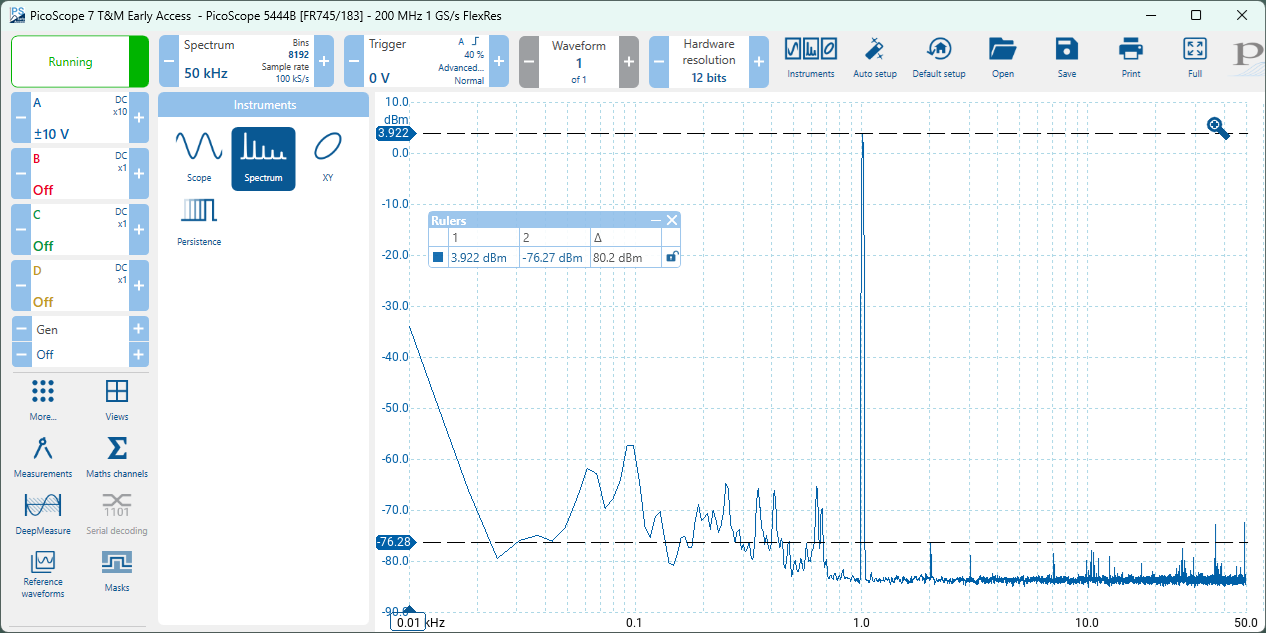
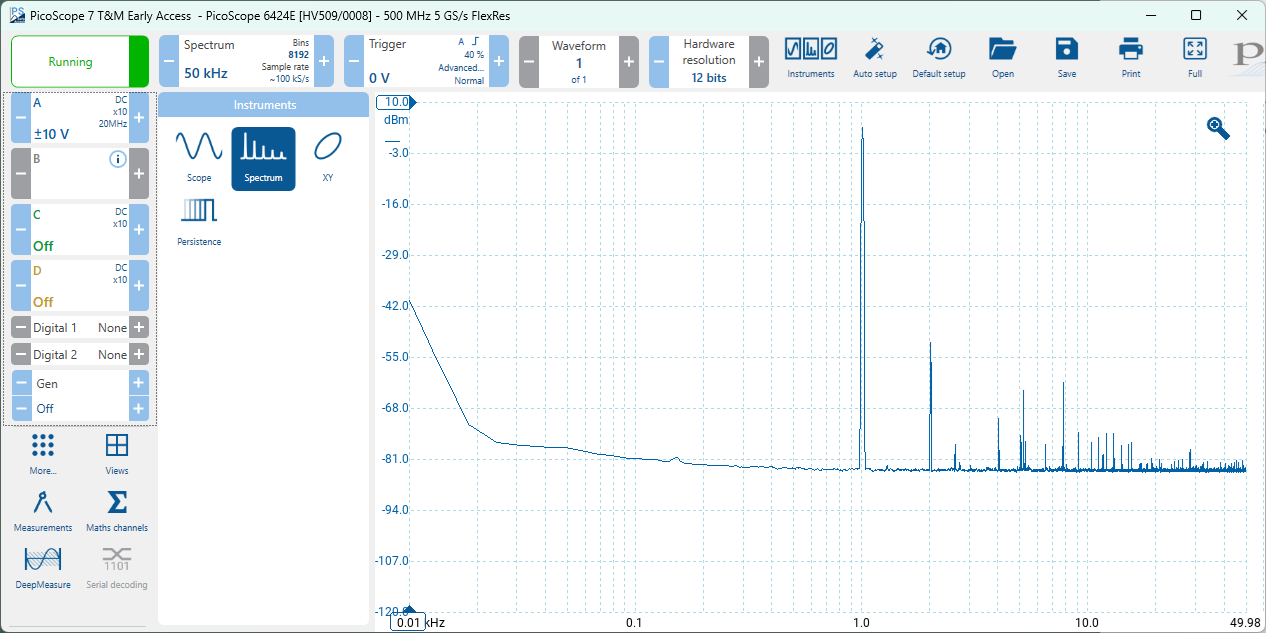
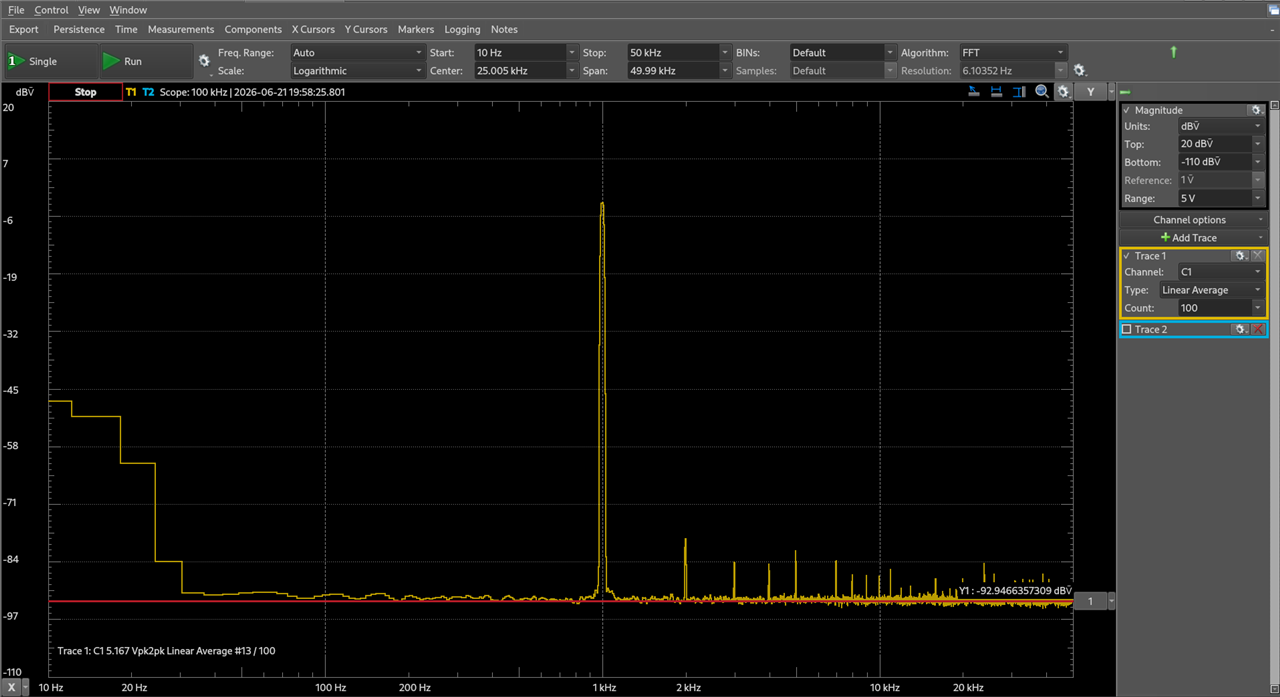
I measure the distortion at 5V RMS from a Neutrik Audio analyser (its THD is < 0.004% or -88dB), neither scope can get near the right answer but the 5444B is much closer. Im thinking of buying the new 5462e but it's spec for distortion a SFDR (Spurious Free Dynamic Range) is on 3dB better than the 5444B (73dB rather than 70dB) so I'm not sure if its worth it.

5444B measuring 1kHz sine from Neutrik A1, 12 bit setting for more direct comparison with 6242e (below).

6242e measuring the same signal.
BTW, one good takeaway from this experiment - the Picoscopes are the ONLY make I know of where the same control software can be used with two completely different models. And the icing on the cake is that the software is a new version which replaces the Picoscope6 supplied with both scopes when they were bought.

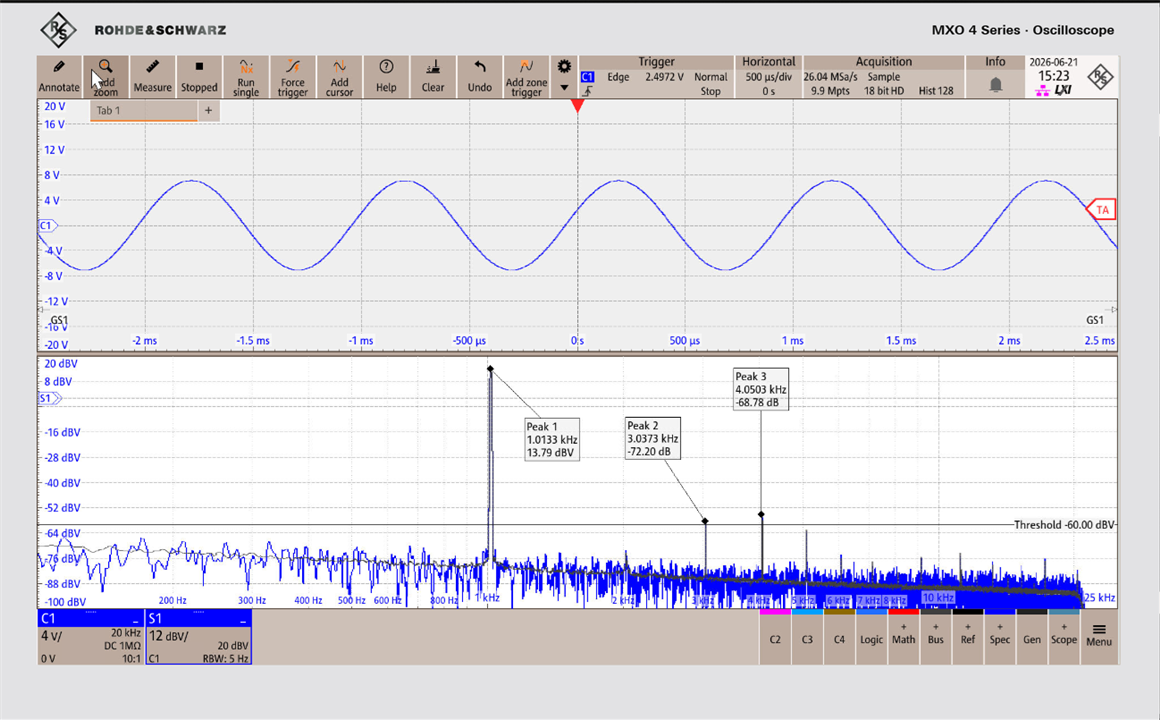
The R&S MZO4 does a lot better than the 6242e (so it should at 3x the price) but not as well as the 5444B - you can buy a reasonable car for the price difference there !
Many of the Picoscopes offer a digital input option, and although stand alone logic analysers are mostly much better than the ones built into scopes (some may challenge this rather sweeping assertion !) , the Pico software for digital inputs is better (IMO) than most scopes have.
Hope this is useful.
MK
Hi Michael,
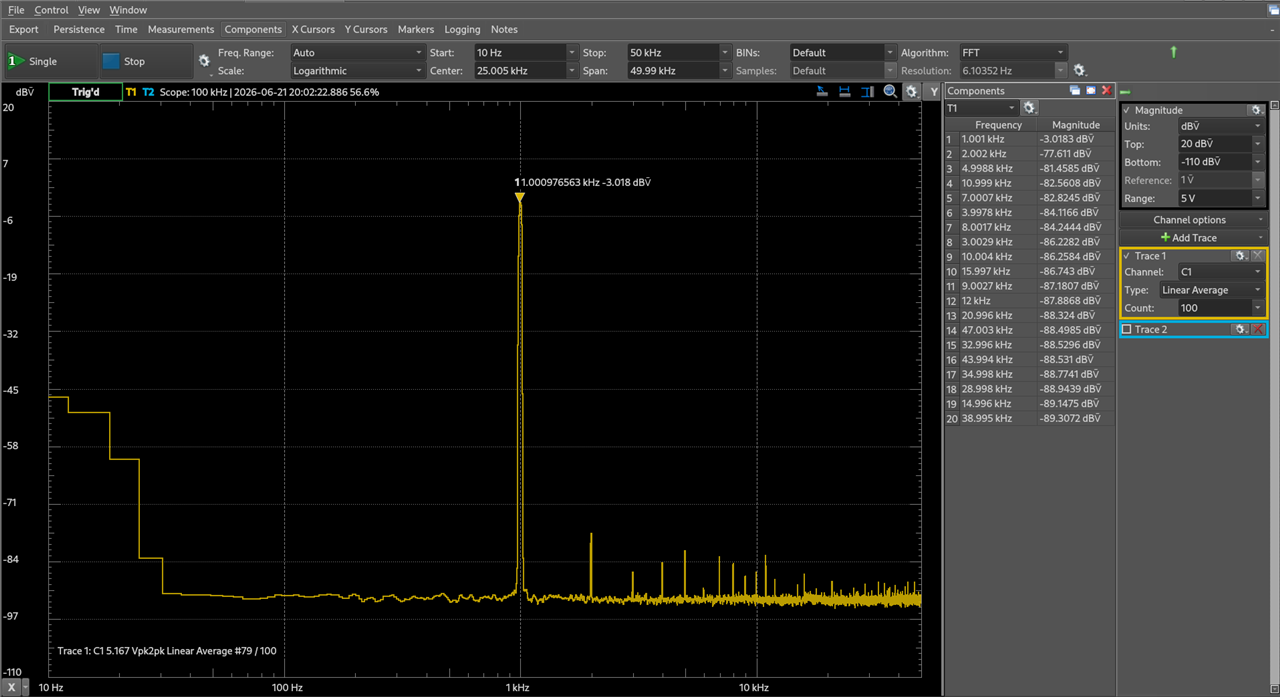
Interesting traces! Normally the noise floor is far lower on the MXO4, but I guess it might be some sort of issue due to the amplitude of the 1kHz tone? If so, I'm wondering if a very narrow notch filter could be made (maybe an LC one but I've not done any exploration to know if it's feasible.. would be very high value inductors and might drift too). Admittedly it's a crude workaround even if it works though : ( in the RF space, it's easy, since then a crystal filter can be used, it was a popular technique there.
I think it is worth taking a look at something from Digilent. I personally use AD3 for basic things. WaveForms is really great software that has ready-to-use components, e.g., Waveform Generator, Impedance Analyzer, Spectrum, or Supplies that could be modulated by the generator to simulate noise. There is also support for SDK. Here is an example of using the SDK to integrate the usage of some devices with ngscopeclient. Of course, the hardware is a bit limited if you're looking for something with a low-noise front end, but the series ADP3X50 or new ADP2440/2450 could be quite good. In that area I think that PicoScope gives more flexibility and better parameters. You can find hardware that has a fast sampling rate with large memory, like the Series 3000e or the latest 5000e series, where you can get a hybrid solution, native 16-bit, plus the same features from the 3000e.
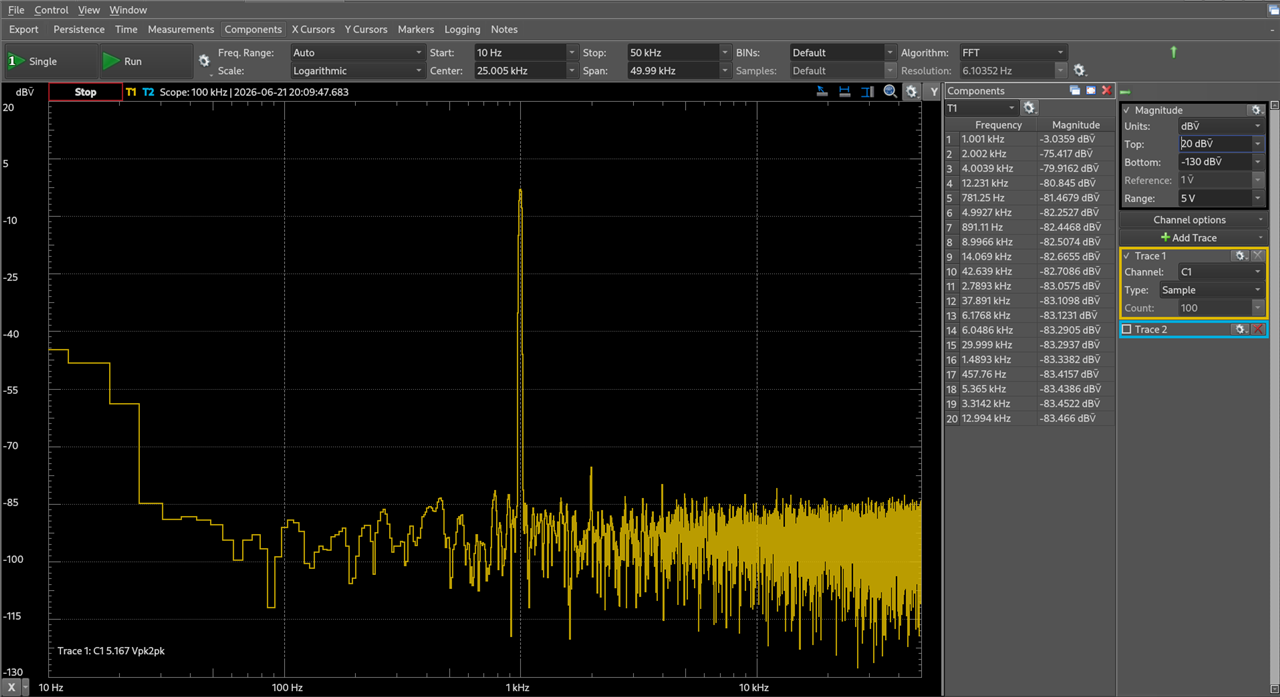
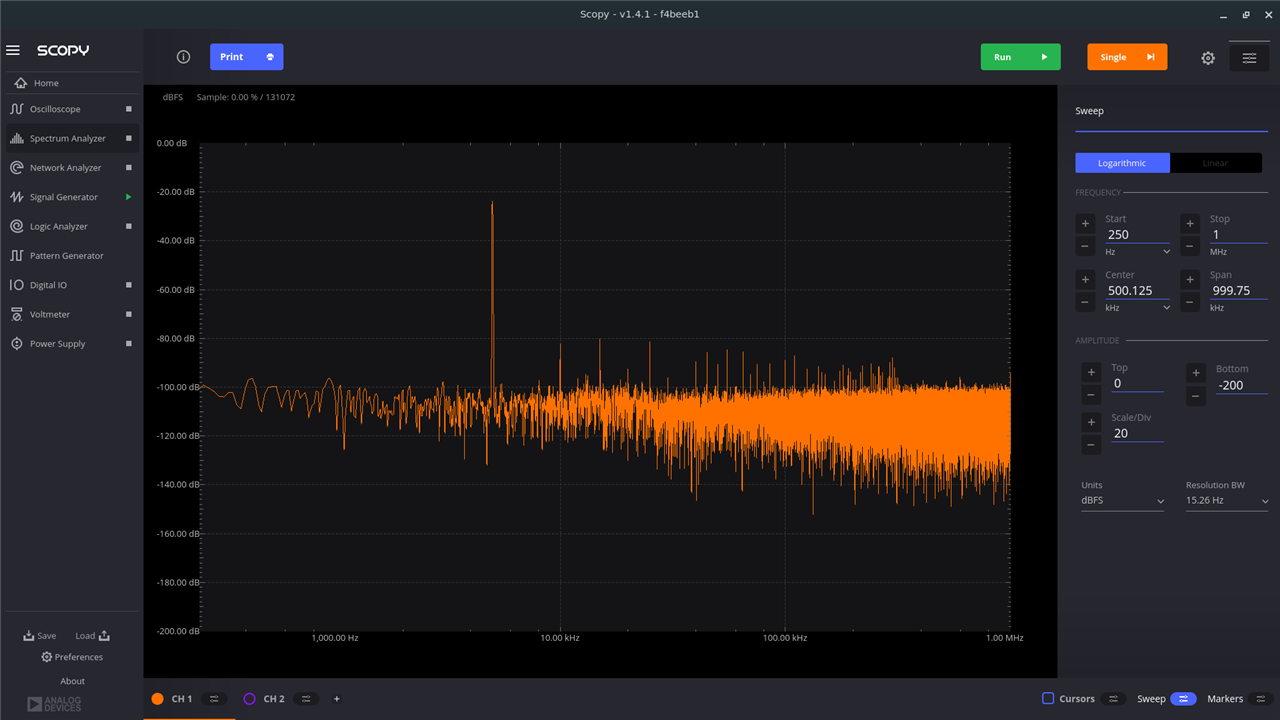
Here is similar as Michael measurement (1kHz sine 1V amplitude from AD3 generator) done with AD3:


And as a curiosity, output from Siglent SDS824X HD:


I saw there is something like Saleae Logic MSO, their logic analyzers and software are really good, but the oscilloscope part, I suppose, is still in development and not mature as other solutions.
Saw this on ebay, but too pricey : ( and would need the test freq shifted to 1.3kHz.

If you want a device that can hook into Python, I would suggest looking at the Analog Devices ADALM2000 device.
https://developer.analog.com/docs/system-level/software/libm2k/index.html
https://analogdevicesinc.github.io/libm2k/sphinx/build/html/examples.html
It's a 2 channel oscilloscope and have found it very useful with a range of other features.
https://developer.analog.com/docs/system-level/tools/m2k/intro.html

It's worth mentioning that Scopy is fully open source.
I love the multicomp handheld scopemeters Ive won in various E14 competitions. Whipping out a DVM sized scope meter is really convenient.
That being said, the PC software to these handheld are understandably crude, as the cost is paying for the meter itself.
USB scopes rely on the PC software as the GUI, the SW tool is better in my experience.
Is your question aimed at using python to analyze the data files created, or creating your own GUI ?
I love the multicomp handheld scopemeters
Same. Ideal for day to day work, and when you require isolated measurements.
PC software to these handheld are understandably crude,
Indeed. I never use it. Only PC integration I use is downloading screen captures from the internal storage.
example: RS-485 capture
Hello I bought the Hantek USB scope 6022BE because of price and that i take my laptop every where
which worked really well, i was not after RF signals
so i bought the Hantek 6022BL mso 16ch scope
which did work but limited in memory 1M per channel
the disc also had open source script information on it