element14 Community
element14 Community
    Register Log In
  • Site
  • Search
  • Log In Register
  • Community Hub
    Community Hub
    • What's New on element14
    • Feedback and Support
    • Benefits of Membership
    • Personal Blogs
    • Members Area
    • Achievement Levels
  • Learn
    Learn
    • Ask an Expert
    • eBooks
    • element14 presents
    • Learning Center
    • Tech Spotlight
    • STEM Academy
    • Webinars, Training and Events
    • Learning Groups
  • Technologies
    Technologies
    • 3D Printing
    • FPGA
    • Industrial Automation
    • Internet of Things
    • Power & Energy
    • Sensors
    • Technology Groups
  • Challenges & Projects
    Challenges & Projects
    • Design Challenges
    • element14 presents Projects
    • Project14
    • Arduino Projects
    • Raspberry Pi Projects
    • Project Groups
  • Products & Partners
    Products & Partners
    • Arduino
    • Avnet & Tria Boards Community
    • Dev Tools
    • Manufacturers
    • Multicomp Pro
    • Product Groups
    • Raspberry Pi
    • RoadTests & Reviews
  • About Us
    About the element14 Community
  • Store
    Store
    • Visit Your Store
    • Choose another store...
      • Europe
      •  Austria (German)
      •  Belgium (Dutch, French)
      •  Bulgaria (Bulgarian)
      •  Czech Republic (Czech)
      •  Denmark (Danish)
      •  Estonia (Estonian)
      •  Finland (Finnish)
      •  France (French)
      •  Germany (German)
      •  Hungary (Hungarian)
      •  Ireland
      •  Israel
      •  Italy (Italian)
      •  Latvia (Latvian)
      •  
      •  Lithuania (Lithuanian)
      •  Netherlands (Dutch)
      •  Norway (Norwegian)
      •  Poland (Polish)
      •  Portugal (Portuguese)
      •  Romania (Romanian)
      •  Russia (Russian)
      •  Slovakia (Slovak)
      •  Slovenia (Slovenian)
      •  Spain (Spanish)
      •  Sweden (Swedish)
      •  Switzerland(German, French)
      •  Turkey (Turkish)
      •  United Kingdom
      • Asia Pacific
      •  Australia
      •  China
      •  Hong Kong
      •  India
      •  Japan
      •  Korea (Korean)
      •  Malaysia
      •  New Zealand
      •  Philippines
      •  Singapore
      •  Taiwan
      •  Thailand (Thai)
      •  Vietnam
      • Americas
      •  Brazil (Portuguese)
      •  Canada
      •  Mexico (Spanish)
      •  United States
      Can't find the country/region you're looking for? Visit our export site or find a local distributor.
  • Translate
  • Profile
  • Settings
Experts, Learning and Guidance
  • Technologies
  • More
Experts, Learning and Guidance
Ask an Expert Forum Design a Non-Contact RPM meter
  • Blog
  • Forum
  • Documents
  • Leaderboard
  • Files
  • Members
  • Mentions
  • Sub-Groups
  • Tags
  • More
  • Cancel
  • New
Join Experts, Learning and Guidance to participate - click to join for free!
Actions
  • Share
  • More
  • Cancel
Forum Thread Details
  • State Suggested Answer
  • Replies 18 replies
  • Answers 3 answers
  • Subscribers 336 subscribers
  • Views 506 views
  • Users 0 members are here
Related
See a helpful answer?

Be sure to click 'more' and select 'suggest as answer'!

If you're the thread creator, be sure to click 'more' then 'Verify as Answer'!

Design a Non-Contact RPM meter

Humaninsane
Humaninsane 15 days ago

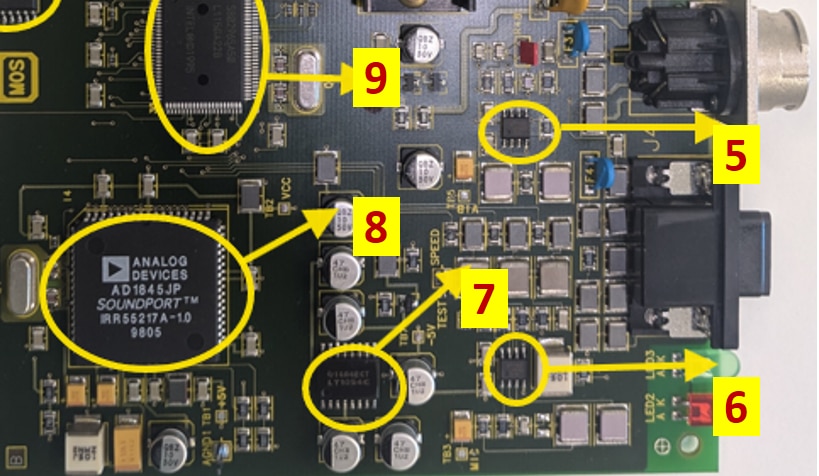
I am currently reverse-engineering a non-contact RPM sensor module that uses a Bosch knock sensor (

Knock Sensors (0261231046) - Knock Sensors - Bosch Auto Parts)

and a Condenser MIC output as the input. The knock sensor and MIC signal is fed into 2 separate op-amp

LMC66x CMOS Dual Operational Amplifiers datasheet (Rev. D)

, and the op-amp output goes to a CODEC 

AD1845 , DigChip http://www.digchip.com

for processing.

My goal is to understand the op-amp circuitry and determine the appropriate configuration needed to condition the knock sensor and MIC signal before feeding it to the CODEC. I am a bit confused about where to start and what concepts I should study regarding op-amp. and there is a charge pump as well, 

LT1054 Switched-Capacitor Voltage Converters With Regulators datasheet (Rev. G)

Could anyone guide me on:

How to analyze the existing op-amp circuit?
What op-amp configurations are commonly used for piezoelectric sensors such as knock sensors?
What topics should I study to better understand this signal-conditioning stage?
How can I determine the expected signal levels and bandwidth requirements before the CODEC input?

The ultimate task is to redesign this board while maintaining identical functionality and output behavior as the existing device, so understanding the analog front-end is critical.

Any suggestions on the right approach, reference materials, or debugging techniques would be greatly appreciated.

AI is confusing with too much data. Not getting a clear path.image
  • Sign in to reply
  • Cancel

Top Replies

  • michaelkellett
    michaelkellett 15 days ago in reply to Humaninsane +4 suggested
    From your picture of the pcb it's an old design. So my next question is - why do you want to copy it ? Pretty much all the parts are old (starting with the now obsolete AD1845). I'm sure that whatever…
  • geralds
    geralds 13 days ago in reply to Humaninsane +2
    aaa rr r e y you uu ready too ooo ru mbl e????? let's dance!!! Linear circuit design handbook: https://www.analog.com/en/resources/technical-books/linear-circuit-design-handbook.html (you can…
  • geralds
    geralds 15 days ago +1 suggested
    Sorry to tell you: you cannot rework this schematic as well we cannot. AD1845 Datasheet and Product Info | Analog Devices The CODEC is obsolete. 1. you need the values of all components 2. the ADC…
Parents
  • geralds
    0 geralds 15 days ago

    Sorry to tell you: you cannot rework this schematic as well we cannot.

    AD1845 Datasheet and Product Info | Analog Devices

    The CODEC is obsolete.
    1. you need the values of all components
    2. the ADC-Codec has a firmware you cannot read out because security key.
    3. the PCB is a multilayer board and also the parts are very close placed to each other; you cannot follow the tracks.

    Have you a component checker with you can readout its values? - I'm sure you haven't.

    • Cancel
    • Vote Up +1 Vote Down
    • Sign in to reply
    • Verify Answer
    • Reject Answer
    • Cancel
  • Humaninsane
    0 Humaninsane 14 days ago in reply to geralds

    we found a paper online. (Analysis of Vibration and Acoustic Signals for Noncontact Measurement of Engine Rotation Speed Xuansheng Shan 1 ,LuTang1 1 , He Wen1,* , Radek Martinek 2 andJanuszSmulko) we have plan to do without CODEC.

    Previously used Controller (S80296SA50) Did not have ADC pins ("Old controllers"). so CODEC was used.

    Existing board is a 2layer board. I have not tried to follow tracks!! Good idea. I'll try. but 1st I should understand Opamps i believe.

    • Cancel
    • Vote Up 0 Vote Down
    • Sign in to reply
    • Verify Answer
    • Cancel
  • geralds
    0 geralds 14 days ago in reply to Humaninsane

    Given all your previous posts, I strongly urge you, to learn the basics of electronics first.
    There is no point in discussing specialized applications, assemblies, or functions when you aren't even familiar with the fundamental concepts.
    Op-amps are definitely part of the basics.


    There are many types of RPM-meters available on the market today; depending on your requirements and budget, you can certainly find one that suits your needs.
    As Michael  michaelkellett  already mentioned in his post, create a list of requirements and buy the appropriate product. You will almost certainly save money that way compared to the high cost and effort of developing something yourself.
    Seriously, I speak from experience: it will be cheaper to buy it than to build it.

    • Cancel
    • Vote Up 0 Vote Down
    • Sign in to reply
    • Verify Answer
    • Cancel
  • Humaninsane
    0 Humaninsane 14 days ago in reply to geralds

    Ok.

    But I'll try first. any suggestion how to master Opamps

    • Cancel
    • Vote Up 0 Vote Down
    • Sign in to reply
    • Verify Answer
    • Cancel
  • geralds
    0 geralds 13 days ago in reply to Humaninsane

    aaarrre yyouuu ready tooooo rumble????? Sunglasses

    let's dance!!! 

    Linear circuit design handbook:

    https://www.analog.com/en/resources/technical-books/linear-circuit-design-handbook.html

    (you can download a zip file of entire book)

    Mixed signal and DSP design:

    https://www.analog.com/en/resources/technical-books/mixed_signal_dsp_design_book.html

    More resources:

    https://www.analog.com/en/resources.html

    LT-Spice, a simulation software for analoge schematics:

    https://www.analog.com/en/resources/design-tools-and-calculators/ltspice-simulator.html

    a bit more....

    www.analog.com

    www.ti.com

    https://www.elektor.com/collections/learning

    https://www.bosch-sensortec.com/en

    I wish you all the best and lots of fun!

    • Cancel
    • Vote Up +2 Vote Down
    • Sign in to reply
    • Verify Answer
    • Cancel
Reply
  • geralds
    0 geralds 13 days ago in reply to Humaninsane

    aaarrre yyouuu ready tooooo rumble????? Sunglasses

    let's dance!!! 

    Linear circuit design handbook:

    https://www.analog.com/en/resources/technical-books/linear-circuit-design-handbook.html

    (you can download a zip file of entire book)

    Mixed signal and DSP design:

    https://www.analog.com/en/resources/technical-books/mixed_signal_dsp_design_book.html

    More resources:

    https://www.analog.com/en/resources.html

    LT-Spice, a simulation software for analoge schematics:

    https://www.analog.com/en/resources/design-tools-and-calculators/ltspice-simulator.html

    a bit more....

    www.analog.com

    www.ti.com

    https://www.elektor.com/collections/learning

    https://www.bosch-sensortec.com/en

    I wish you all the best and lots of fun!

    • Cancel
    • Vote Up +2 Vote Down
    • Sign in to reply
    • Verify Answer
    • Cancel
Children
  • Humaninsane
    0 Humaninsane 11 days ago in reply to geralds

    Thank youUpside down

    • Cancel
    • Vote Up 0 Vote Down
    • Sign in to reply
    • Verify Answer
    • Cancel
element14 Community

element14 is the first online community specifically for engineers. Connect with your peers and get expert answers to your questions.

  • Members
  • Learn
  • Technologies
  • Challenges & Projects
  • Products
  • Store
  • About Us
  • Feedback & Support
  • FAQs
  • Terms of Use
  • Privacy Policy
  • Legal and Copyright Notices
  • Sitemap
  • Cookies

An Avnet Company © 2026 Premier Farnell Limited. All Rights Reserved.

Premier Farnell Ltd, registered in England and Wales (no 00876412), registered office: Farnell House, Forge Lane, Leeds LS12 2NE.

Follow element14

  • X
  • Facebook
  • linkedin
  • YouTube