


BACnet is a data communications protocol for building automation and control networks. It aids in intelligent building systems and helps achieve their control and data analysis goals. As an ASHRAE, ANSI, and ISO standard protocol, BACnet is designed to facilitate communication of building automation and control systems for applications such as heating, ventilating, an air-conditioning control, lighting control, access control, and fire detection systems and their associated equipment. 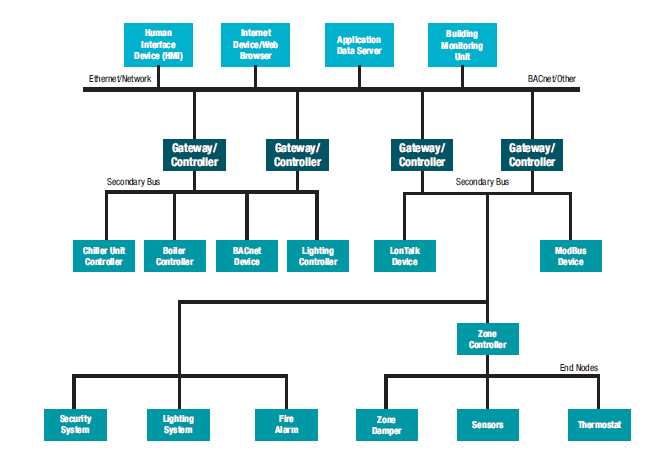
The BACnet protocol standard provides the infrastructure for the various systems to exchange information and is agnostic to the building service that it renders. To maximize the efficiency of these connected building systems, competent communication between the various building blocks is essential.
Building automation systems (BAS) are deployed across all levels ranging from small building segments to larger building establishments. BAS is a communication network infrastructure that manages various building services. The key to an effective BAS is having a ubiquitous system that can be deployed to serve new and old building technology as well as small and large commercial facilities. Typically, the complex building automation network of devices includes a primary and secondary bus that is connected to various nodes in the system: Building management service, Building control systems, Zone controllers and end nodes.
Other prominent communication protocols used in building automation systems are:
- The LonMark standard is based on the proprietary communications protocol LonTalk. The LonTalk protocol establishes a set of rules to manage communications between devices, while LonWorks defines the content and structure of the information that is exchanged between them. Like BACnet, LonWorks has been accepted and adopted by the international standards organizations (ANSI/CEA 709.1 and IEEE 1473-L).
- Modbus
 is a truly open standard and is one of the most widely used protocols in the industrial manufacturing environment. Its messaging structure establishes master-slave, client-server communications between devices. A relatively smaller percentage of installations are Modbus certified.
Systems based on Modbus tend to be smaller with highly centralized controls. The other problem with Modbus is that its concept for data access is “memory file” oriented which places the burden of understanding and structuring information on the controller that is asking for data. Each of the protocols has advantages and disadvantages and must be selected based on the needs of the facility and its ability to support a particular protocol. However, BACnet is the first choice where the system is not required to have limited size, scope and interoperability requirements.
The BACnet protocol institutes a standard way to send and receive messages using wired or wireless standard protocols BACnet data is exchanged between only devices that have BACnet-enabled applications The BACnet standard defines a standard way to communicate via data link/physical layers Ethernet RS-485 RS-232RS-232 and other protocol standards such as ARCNET and LonTalk In addition the BACnet standard also defines a standard way to communicate using UDP IP and HTTP(web services 
Compared to the seven-layer OSI model, BACnet implements a four-layer collapsed architecture. It consists of following layers:
- Application layer that provides communication services
- Network layer handles network-to-network communication
- Data link layer handles device-to-device communication within a network
- Physical layer converts electrical signals sent over the medium into data
Being an open protocol, BACnet is becoming increasingly adopted across various building device manufacturers. This is a critical feature since it provides a common foundation to enable building systems and devices from different manufacturers to interoperate. This directly drives a lower system cost as there are now minimal investments in delivering custom drivers and protocols. The level of intelligence required in a building is determined by the occupant and is not necessarily standard across the establishment; this protocol is effectively a glue logic which connects the various devices together. Since its inception, it has been designed to provide a standard for building automation.
Key Benefits of the BACnet Protocol
- Single primary management service for all the networks of systems
- Can be implemented in devices of any size ranging from microcontroller to embedded processors
- Infrastructure for easy system expansion providing flexibility to add more devices from multiple vendors
- Potential to integrate all – old and new – building automation and control functions
- Interoperability
To learn more about expanding uses of the open source BACnet protocol for Building Automation Systems, please download (below) the attached document by Texas Instruments called "An Introduction to BACnet."
Ready To Get Started with BACnet? 
Ideal for industrial and networking applications, including BACnet, the AM335x Starter Kit provides a stable and affordable platform to quickly start evaluation of Sitara ARM Cortex-A8 AM335x Processors (AM3352, AM3354, AM3356, AM3358) and accelerate development for smart appliance, industrial and networking applications. It is a low-cost development platform based on the ARM Cortex-A8 processor that is integrated with options such as Dual Gigabit Ethernet, DDR3 and LCD touch screen.
| Introduction to BACnet by Texas Instruments.pdf | |
| AM335x Starter Kit Hardware Users Guide by Texas Instruments.pdf |


-

DAB
-
Cancel
-
Vote Up
0
Vote Down
-
-
Sign in to reply
-
More
-
Cancel
Comment-

DAB
-
Cancel
-
Vote Up
0
Vote Down
-
-
Sign in to reply
-
More
-
Cancel
Children