


Bio-patch solutions are sensors worn on the body to enable continuous and semi-continuous monitoring of physiological and psychological parameters without tethering the patient or athlete to a wired hub. Bio-patch sensor data is transmitted wirelessly to a gateway to enable patients to self-monitor or healthcare professionals to remotely monitor vital information. The disposable nature of bio-patches also helps meet patient safety requirements in hospitals due to the limitation of onetime-use. This helps prevent exposure to infections associated with reuse of medical equipment at hospitals.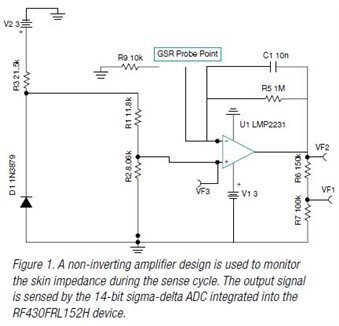
Physical Sensing of Skin Conductivity
Regulation of physiological states can occur both from physical conditions or cognitive functions associated with an individual’s state of mind. Electrodermal activity is a sensitivity index of nervous system activity. Nerve endings modulate physiological activity which may result, for example, in the stimulation of sweat glands.
This stimulation leads to changes in skin conductivity which can be monitored with a physical sensor. The ability to monitor both the physiological and cognitive functions for an extended period of time outside of a clinical environment allows for innovative health management solutions.
The bio-patch form factor also enables more direct skin contact providing more accurate data collection compared to other reusable wearable solutions. The bio-patch can also be placed in locations on the body that minimize noise artifacts associated with motion.
NFC ISO 15693 Sensor Transponder
A bio-patch solution based on Texas Instruments RF430FRL152H sensor transponder handles the sensor signal conditioning before processing the data and transmitting it to an adjacent receiver via NFC passive communication. The sensor components consist of a galvanic skin response (GSR) sensor and a thermistor which are in direct contact with the skin. The GSR signal conditioning is carried out using a non-inverting amplifier design. 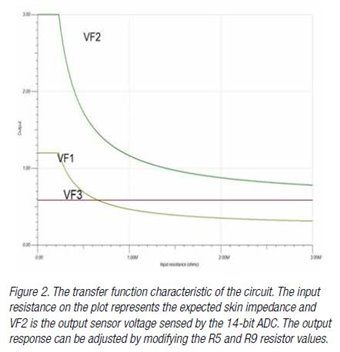
The onboard power management on the RF430FRL152H transponder senses whether the device is battery-powered or in proximity of an RF field running at the 13.56MHz NFC resonant frequency. The device is able to inductively couple the RF field and run in a passive mode configuration without the use of a battery since the scavenged RF field provides sufficient power to run the entire solution. In this case, the bio-patch collects sensor data only when in proximity of the RF field.
The circuit for the GSR sensor is shown in Figure 1. A non-inverting amplifier design is used to monitor the skin impedance during the sense cycle. The output signal is sensed by the 14-bit sigma-delta analog-to-digital converter (ADC) integrated into the RF430FRL152H device. The impedance of dry skin varies from 1,000 – 100,000 ohms. The transfer function characteristic of the circuit is shown in Figure 2 and is tuned to the expected range.
The input resistance on the plot in Figure 2 represents the expected skin impedance and VF2 is the output sensor voltage sensed by the 14-bit ADC. The output response can be adjusted by modifying the R5 and R9 resistor values.
The on-skin temperature is obtained via a thermistor and a reference resistor. A small current (2.4μA) is applied on the reference resistor and thermistor. The voltage on both the thermistor and reference resistor is sampled by the sigma-delta ADC. Using the known value of the reference resistor and the exact current being applied allows for an accurate determination of the thermistor value and the correlated temperature value.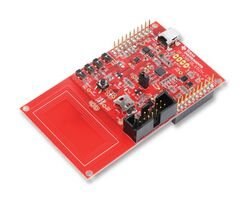
To learn more about designing an NFC-enabled bio-patch for an IoT medical application, please download the attached document by Texas Instruments called "Designing and evaluating an NFC-enabled bio-patch for medical and health & fitness applications," which was the source of information for this blog.
| Texas Instruments Introduction on Designing an NFC-enabled Bio-Patch.pdf |

