


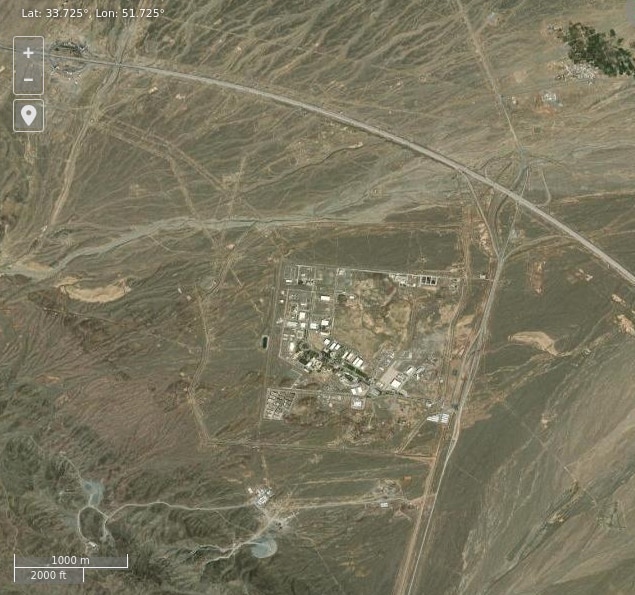
Iran’s Natanz nuclear facility. (Image Credit: NASA Earth Science Data and Information Systems/LANCE FIRMS (Wikimedia Commons))
This seems like a big mistake. Especially now.
Earlier this year on GitHub, Sadpainy, a developer, published a reconstructed version of Stuxnet, a computer worm. It was used in a cyberattack against Iran’s nuclear enrichment program. This doesn’t have the original source code. Instead, it’s reverse-engineered based on samples made available to the public.
First uncovered in 2010, Stuxnet turned out to be the most consequential cyberattack. It didn’t work like ordinary malware that causes network interference or steals data. The worm targeted industrial control systems like programmable logic controllers (PLCs) used with Siemens equipment. During its deployment, it changed the operation of frequency converters, which powered the centrifuges at Iran’s Natanz facility. Even the operators didn’t know what was going on, as they saw normal readings while the worm physically wore down the PLCs and damaged them.
According to the repository, this project is intended for research and education focusing on Stuxnet. While it’s not a confirmed leak of the original source code, the malware’s developers have not validated the code’s accuracy. The GitHub publication has gained people’s attention since Stuxnet has been studied through security-vendor reports and forensic analysis.
So, what did Stuxnet do? Siemens project files, infected USB drives, and network shares were used to spread the worm. Windows vulnerabilities were also exploited. In such cases, it affected shortcut files if a user tried to view an infected removable drive’s contents. When the worm entered a suitable environment, it would search for industrial-control configurations. The payload’s target? Frequency converters, equipment used in uranium enrichment, developed by Fararo Paya and Vacon. Stuxnet mechanically stressed the centrifuges by changing the frequency converters that controlled their rotational speeds. At the same time, it provided false status data to monitoring systems.
Stuxnet had some defenses. Stolen code-signing certificates from JMicron and Realtek were used. It also kept its presence hidden by installing rootkit-like drivers, and was coded to stop spreading on June 24th, 2012.
Impact estimates of the worm vary. For instance, some reports estimate that 1,000 centrifuges had been affected at Natanz. However, the specific number damaged, the period over which damage took place, and Stuxnet’s responsibility are all subjects of analysis.
There are build instructions on the repository for those who want to see how it worked. A Windows XP or Windows 7 VM is required to run it, and network connectivity shouldn’t be configured. With the right Siemens software and hardware, users can watch the full payload effects instead of the spreading mechanisms.
I shall be staying away from this one. 
Have a story tip? Message me here at element14.