


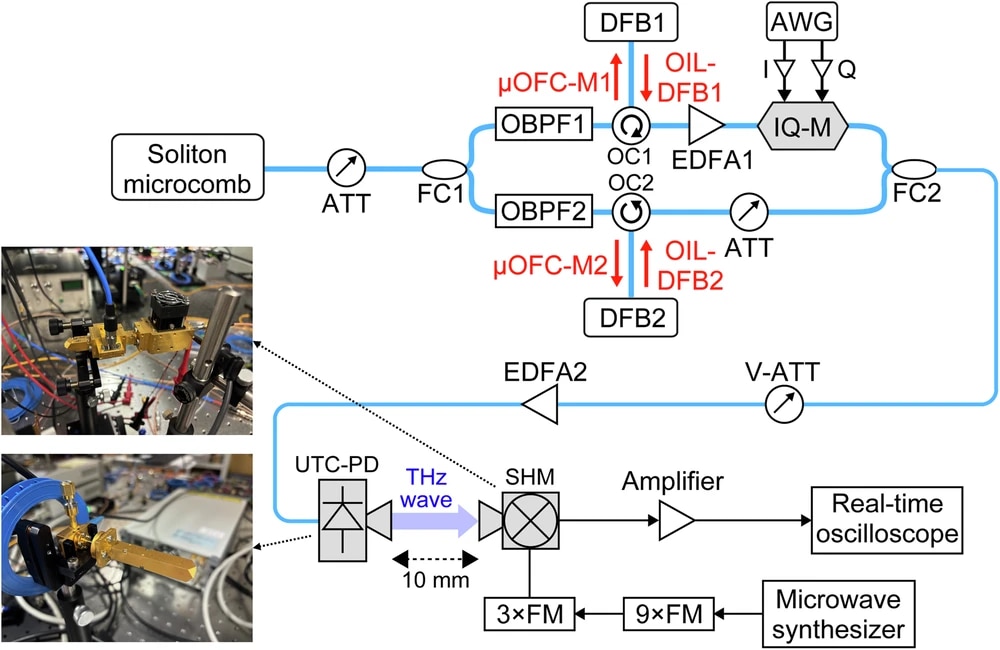
Schematic of the 560GHz wireless communication system with 112Gbps data speeds. (Image Credit: communications engineering)
Researchers from Japan’s Tokushima University, the University of Tokyo, and Gifu University created a new terahertz wireless communication system. It uses the 560GHz band and sends data at 112Gbps. This wireless breakthrough exceeds the performance of modern terahertz systems running on similar frequencies that reach gigabit-per-second speeds.
The team says this is the first for wireless technology to surpass 100Gbps at frequencies above 420GHz. This may lead to ultra-high frequency communications and 6G mobile networks that could deliver significantly faster data speeds, extremely low latency, and support a greater number of devices simultaneously. However, the team said that producing stable, high-quality signals above 350GHz is very challenging due to phase noise and declining power output.
They solved those issues by combining fiber-coupled microcombs with high-order data modulation together. The microcomb maintained stable soliton operation for over 24 hours under 1W pump power. These small photonic devices split a laser into multiple evenly spaced optical frequencies, providing a stable source for terahertz communications.
Two distributed-feedback lasers were phase-locked to adjacent comb lines to generate stable optical carriers. That improved linewidth and reduced error vector magnitude compared to free-running lasers. Afterward, the microcomb-generated optical tones were used in an optical heterodyning process to produce the 560GHz carrier, generated through a high-power uni-travelling-carrier photodiode.
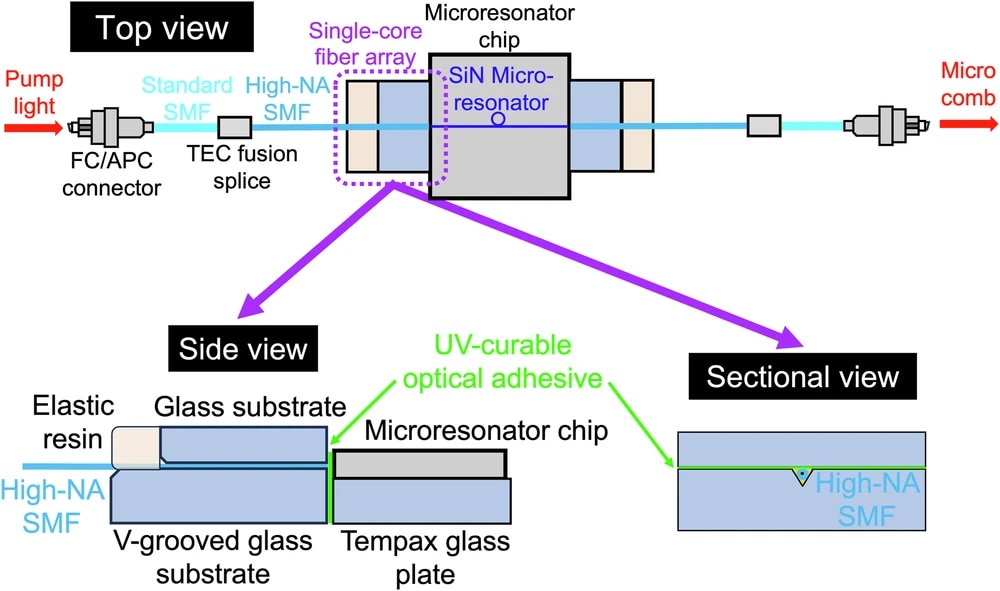
Fiber-to-chip coupling configuration for a silicon nitride microresonator. (Image Credit: communications engineering)
Additionally, the team made the system more durable and compact by coupling an optical fiber to a silicon nitride microcomb chip. As a result, this reduced optical misalignment issues and kept the optical coupling stable. The researchers could then make bulky laboratory equipment smaller for easier integration.
The researchers implemented thermal regulation to improve the reproducibility of its optical resonance and resistance to temperature changes. When they finished the device, the team proved its high-speed capabilities. They did this by producing two stable optical carriers via optical injection and used QPSK and 16QAM formats to achieve 84Gbps and 112Gbps.
Have a story tip? Message me here at element14.