element14 Community
element14 Community
    Register Log In
  • Site
  • Search
  • Log In Register
  • Community Hub
    Community Hub
    • What's New on element14
    • Feedback and Support
    • Benefits of Membership
    • Personal Blogs
    • Members Area
    • Achievement Levels
  • Learn
    Learn
    • Ask an Expert
    • eBooks
    • element14 presents
    • Learning Center
    • Tech Spotlight
    • STEM Academy
    • Webinars, Training and Events
    • Learning Groups
  • Technologies
    Technologies
    • 3D Printing
    • FPGA
    • Industrial Automation
    • Internet of Things
    • Power & Energy
    • Sensors
    • Technology Groups
  • Challenges & Projects
    Challenges & Projects
    • Design Challenges
    • element14 presents Projects
    • Project14
    • Arduino Projects
    • Raspberry Pi Projects
    • Project Groups
  • Products
    Products
    • Arduino
    • Avnet & Tria Boards Community
    • Dev Tools
    • Manufacturers
    • Multicomp Pro
    • Product Groups
    • Raspberry Pi
    • RoadTests & Reviews
  • About Us
    About the element14 Community
  • Store
    Store
    • Visit Your Store
    • Choose another store...
      • Europe
      •  Austria (German)
      •  Belgium (Dutch, French)
      •  Bulgaria (Bulgarian)
      •  Czech Republic (Czech)
      •  Denmark (Danish)
      •  Estonia (Estonian)
      •  Finland (Finnish)
      •  France (French)
      •  Germany (German)
      •  Hungary (Hungarian)
      •  Ireland
      •  Israel
      •  Italy (Italian)
      •  Latvia (Latvian)
      •  
      •  Lithuania (Lithuanian)
      •  Netherlands (Dutch)
      •  Norway (Norwegian)
      •  Poland (Polish)
      •  Portugal (Portuguese)
      •  Romania (Romanian)
      •  Russia (Russian)
      •  Slovakia (Slovak)
      •  Slovenia (Slovenian)
      •  Spain (Spanish)
      •  Sweden (Swedish)
      •  Switzerland(German, French)
      •  Turkey (Turkish)
      •  United Kingdom
      • Asia Pacific
      •  Australia
      •  China
      •  Hong Kong
      •  India
      •  Japan
      •  Korea (Korean)
      •  Malaysia
      •  New Zealand
      •  Philippines
      •  Singapore
      •  Taiwan
      •  Thailand (Thai)
      •  Vietnam
      • Americas
      •  Brazil (Portuguese)
      •  Canada
      •  Mexico (Spanish)
      •  United States
      Can't find the country/region you're looking for? Visit our export site or find a local distributor.
  • Translate
  • Profile
  • Settings
Open Source Hardware
  • Technologies
  • More
Open Source Hardware
Blog Discrete difference amplifier - DC analysis
  • Blog
  • Forum
  • Documents
  • Events
  • Polls
  • Members
  • Mentions
  • Sub-Groups
  • Tags
  • More
  • Cancel
  • New
Join Open Source Hardware to participate - click to join for free!
  • Share
  • More
  • Cancel
Group Actions
  • Group RSS
  • More
  • Cancel
Engagement
  • Author Author: Jan Cumps
  • Date Created: 4 Jul 2026 3:10 PM Date Created
  • Views 132 views
  • Likes 8 likes
  • Comments 4 comments
  • simple_dcr
Related
Recommended

Discrete difference amplifier - DC analysis

Jan Cumps
Jan Cumps
4 Jul 2026

This is the DC analysis of the difference amplifier module that shabaz designed for a Direct Conversion Receiver.
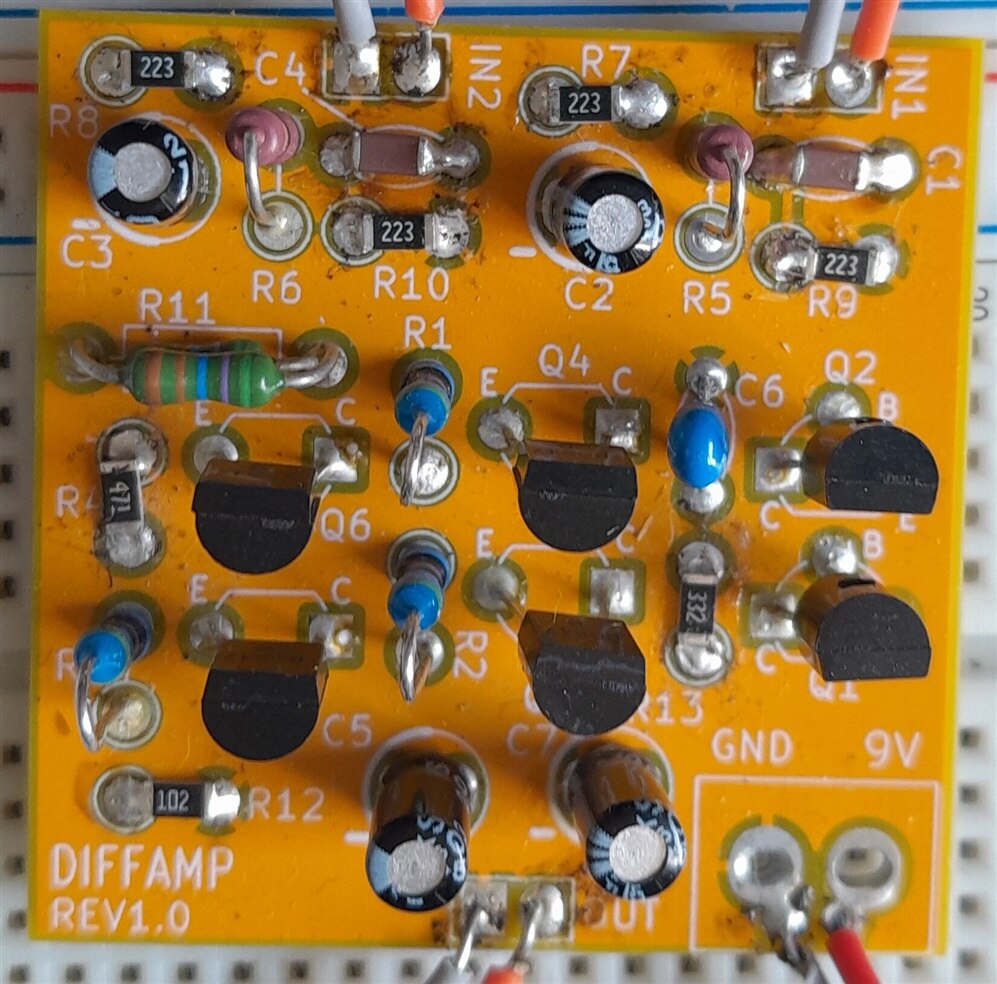
image

Before going into the small signal AC analysis, it's interesting to see how the amplifier behaves in steady state (DC).
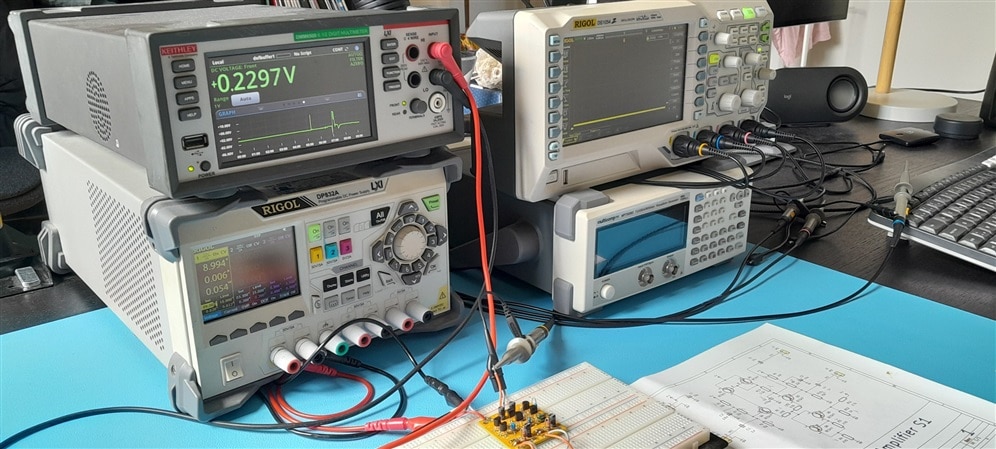
I measured all nodes on the amp, with the inputs shorted. The output was left open*.

Voltages (annotated in black on the schematic) were measured. transistor voltage bias (orange) and currents (brown) were calculated based on the voltages measured.

image

While it doesn't show the dynamic behaviour, it shows how each of the submodules of this design is set up.

 shabaz published the KiCad project on GitHub, including simulation. You could load it into KiCad and check if the steady state simulation and my measurements match ...
image

*except for an oscilloscope probe.

For all blog posts in this series, click here

  • Sign in to reply
Parents
  • Jan Cumps
    Jan Cumps 3 days ago

    first signal measurements.

    I used a 100 mVpp, 1 kHz sinus. Output loaded with a 27K resistor.

    1. signal at in1, in2 to ground
    2. signal at in2, in1 to ground
    3. same signal at both

    image

    image

    image

    the amp does what it needs to do. Amplifies differences, reject the same signal

    AI says the gain is 7.96 dB.

    > what is the gain in dB if I input 100 mV peak-to-peak and I get 250 mV peak-to-peak out?

    image

    • Cancel
    • Vote Up 0 Vote Down
    • Sign in to reply
    • More
    • Cancel
  • shabaz
    shabaz 3 days ago in reply to Jan Cumps

    Glad it's working! Although I had simulated it, my stripboard prototype had not worked fully, I had some mistake in my connections but there were enough parts that it was hard to troubleshoot. Looking forward to assembling this in the intercom circuit, since it plays a key role there.

    • Cancel
    • Vote Up +1 Vote Down
    • Sign in to reply
    • More
    • Cancel
Comment
  • shabaz
    shabaz 3 days ago in reply to Jan Cumps

    Glad it's working! Although I had simulated it, my stripboard prototype had not worked fully, I had some mistake in my connections but there were enough parts that it was hard to troubleshoot. Looking forward to assembling this in the intercom circuit, since it plays a key role there.

    • Cancel
    • Vote Up +1 Vote Down
    • Sign in to reply
    • More
    • Cancel
Children
No Data
element14 Community

element14 is the first online community specifically for engineers. Connect with your peers and get expert answers to your questions.

  • Members
  • Learn
  • Technologies
  • Challenges & Projects
  • Products
  • Store
  • About Us
  • Feedback & Support
  • FAQs
  • Terms of Use
  • Privacy Policy
  • Legal and Copyright Notices
  • Sitemap
  • Cookies

An Avnet Company © 2026 Premier Farnell Limited. All Rights Reserved.

Premier Farnell Ltd, registered in England and Wales (no 00876412), registered office: Farnell House, Forge Lane, Leeds LS12 2NE.

Follow element14

  • X
  • Facebook
  • linkedin
  • YouTube