element14 Community
element14 Community
    Register Log In
  • Site
  • Search
  • Log In Register
  • Community Hub
    Community Hub
    • What's New on element14
    • Feedback and Support
    • Benefits of Membership
    • Personal Blogs
    • Members Area
    • Achievement Levels
  • Learn
    Learn
    • Ask an Expert
    • eBooks
    • element14 presents
    • Learning Center
    • Tech Spotlight
    • STEM Academy
    • Webinars, Training and Events
    • Learning Groups
  • Technologies
    Technologies
    • 3D Printing
    • FPGA
    • Industrial Automation
    • Internet of Things
    • Power & Energy
    • Sensors
    • Technology Groups
  • Challenges & Projects
    Challenges & Projects
    • Design Challenges
    • element14 presents Projects
    • Project14
    • Arduino Projects
    • Raspberry Pi Projects
    • Project Groups
  • Products
    Products
    • Arduino
    • Avnet & Tria Boards Community
    • Dev Tools
    • Manufacturers
    • Multicomp Pro
    • Product Groups
    • Raspberry Pi
    • RoadTests & Reviews
  • About Us
    About the element14 Community
  • Store
    Store
    • Visit Your Store
    • Choose another store...
      • Europe
      •  Austria (German)
      •  Belgium (Dutch, French)
      •  Bulgaria (Bulgarian)
      •  Czech Republic (Czech)
      •  Denmark (Danish)
      •  Estonia (Estonian)
      •  Finland (Finnish)
      •  France (French)
      •  Germany (German)
      •  Hungary (Hungarian)
      •  Ireland
      •  Israel
      •  Italy (Italian)
      •  Latvia (Latvian)
      •  
      •  Lithuania (Lithuanian)
      •  Netherlands (Dutch)
      •  Norway (Norwegian)
      •  Poland (Polish)
      •  Portugal (Portuguese)
      •  Romania (Romanian)
      •  Russia (Russian)
      •  Slovakia (Slovak)
      •  Slovenia (Slovenian)
      •  Spain (Spanish)
      •  Sweden (Swedish)
      •  Switzerland(German, French)
      •  Turkey (Turkish)
      •  United Kingdom
      • Asia Pacific
      •  Australia
      •  China
      •  Hong Kong
      •  India
      •  Japan
      •  Korea (Korean)
      •  Malaysia
      •  New Zealand
      •  Philippines
      •  Singapore
      •  Taiwan
      •  Thailand (Thai)
      •  Vietnam
      • Americas
      •  Brazil (Portuguese)
      •  Canada
      •  Mexico (Spanish)
      •  United States
      Can't find the country/region you're looking for? Visit our export site or find a local distributor.
  • Translate
  • Profile
  • Settings
Open Source Hardware
  • Technologies
  • More
Open Source Hardware
Blog Vintage Curvy PCB Traces with KiCad 7
  • Blog
  • Forum
  • Documents
  • Events
  • Polls
  • Members
  • Mentions
  • Sub-Groups
  • Tags
  • More
  • Cancel
  • New
Join Open Source Hardware to participate - click to join for free!
  • Share
  • More
  • Cancel
Group Actions
  • Group RSS
  • More
  • Cancel
Engagement
  • Author Author: shabaz
  • Date Created: 3 Jul 2023 11:43 PM Date Created
  • Views 10159 views
  • Likes 10 likes
  • Comments 32 comments
  • kicad 7
  • kicad 6
  • kicad
Related
Recommended

Vintage Curvy PCB Traces with KiCad 7

shabaz
shabaz
3 Jul 2023
Vintage Curvy PCB Traces with KiCad 7

Table of Contents

  • Introduction
  • What’s Required?
  • Running the Plugin
  • Fixing Issues
  • Summary

Introduction

Old-school printed circuit boards (PCBs) often had wavy copper traces! They were done manually by rolling out UV-light-blocking crepe sticky-backed tape onto clear film.

image

The photo above shows a layout I did as a teenager (I wasn't very good at it). It's for a lighting control unit.

I have meant to experiment with a particular rounded-track feature for KiCad 7 for ages. It ought to produce a reasonable likeness to those old vintage circuit boards! I gave it a shot today. It can transform machine-generated PCB tracks to look more like hand-taped PCB layouts.

What’s Required?

The only prerequisite is to complete your board design (you can still edit it later) and install a special plugin. To install the plugin, on the KiCad startup screen, click on the icon for the Plugin and Content Manager:

image

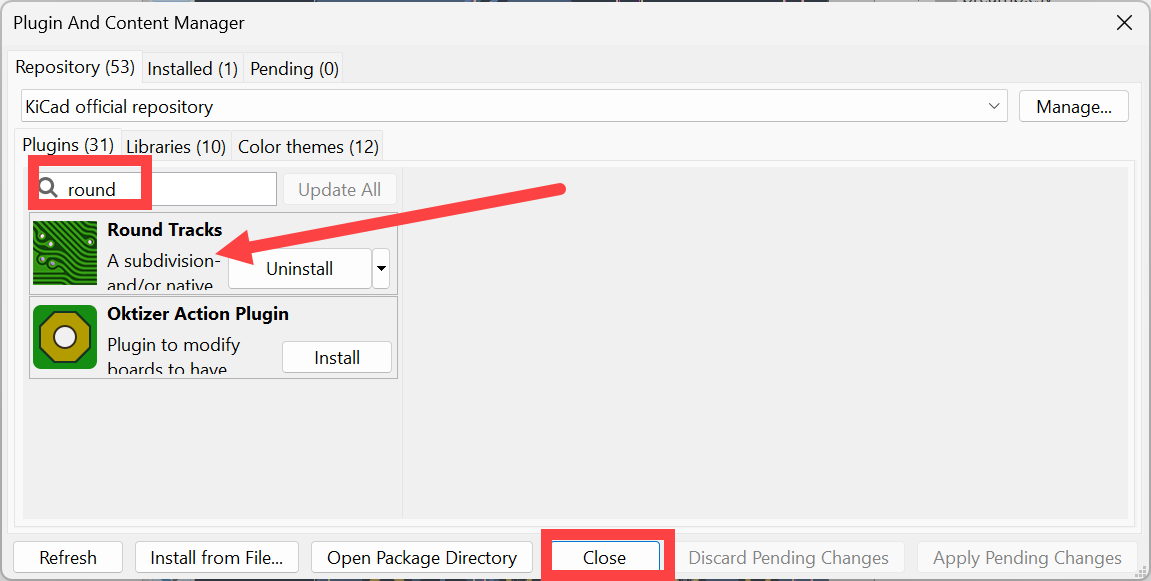
Search for the Round Tracks plugin, click on it, and install it:
image


Now open up the PCB Editor for the project you’re working on. In my case, it was an amplifier board:
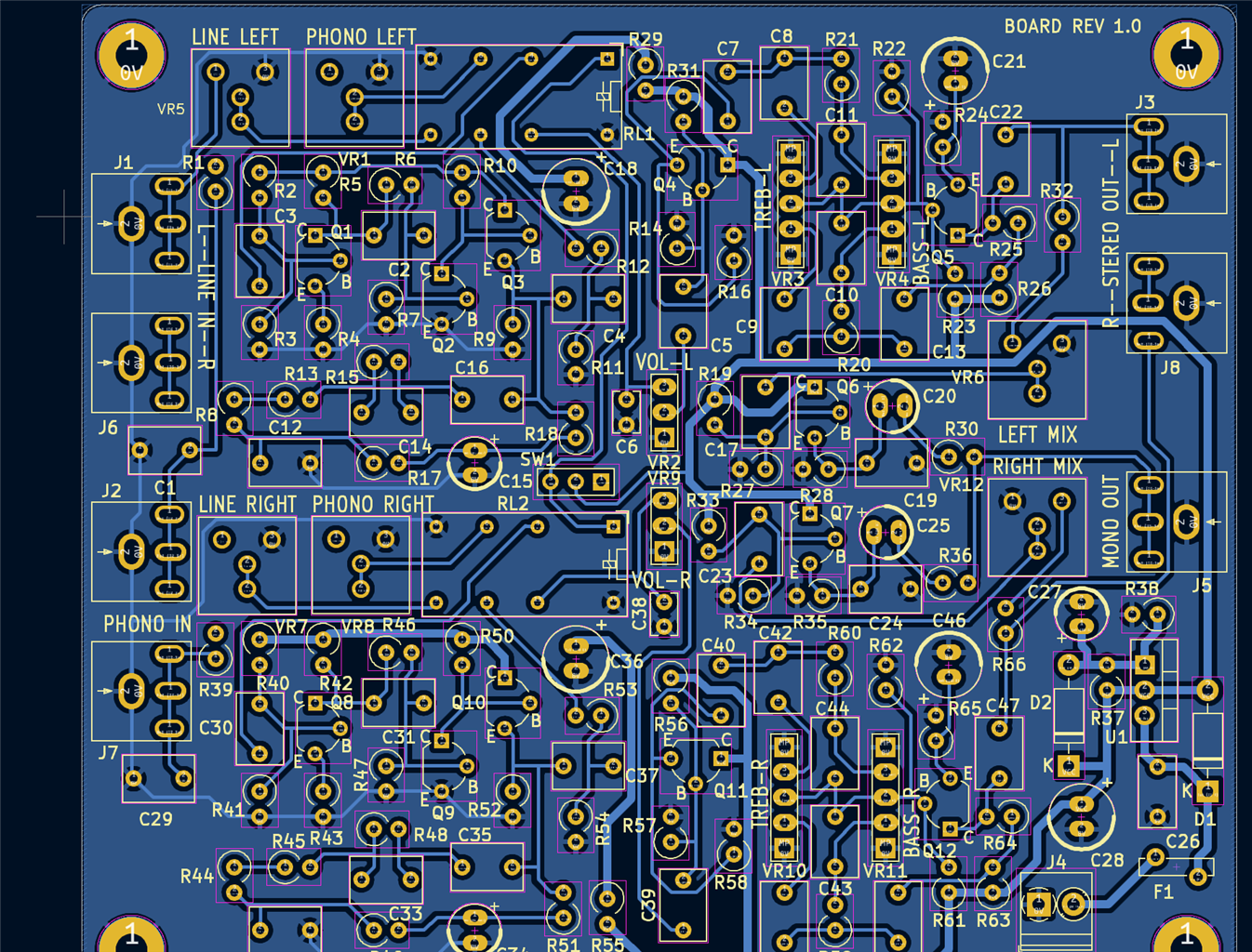
image

As you can see in the screenshot above, the board is already routed, but using sharp corners on the PCB tracks everywhere.

Running the Plugin

In the PCB Editor, click Tools->External Plugins->Round Tracks. A small settings window will appear. The screenshot below shows what settings I used; there’s not a lot there to configure!

image

Click on Run, and it shouldn’t take too long to execute:

image

Click on OK, and then the new board layout will appear!

Fixing Issues

When you run the Design Rule Check (DRC), some new errors may be revealed. For instance, I had four errors with this board. The first one is highlighted here:
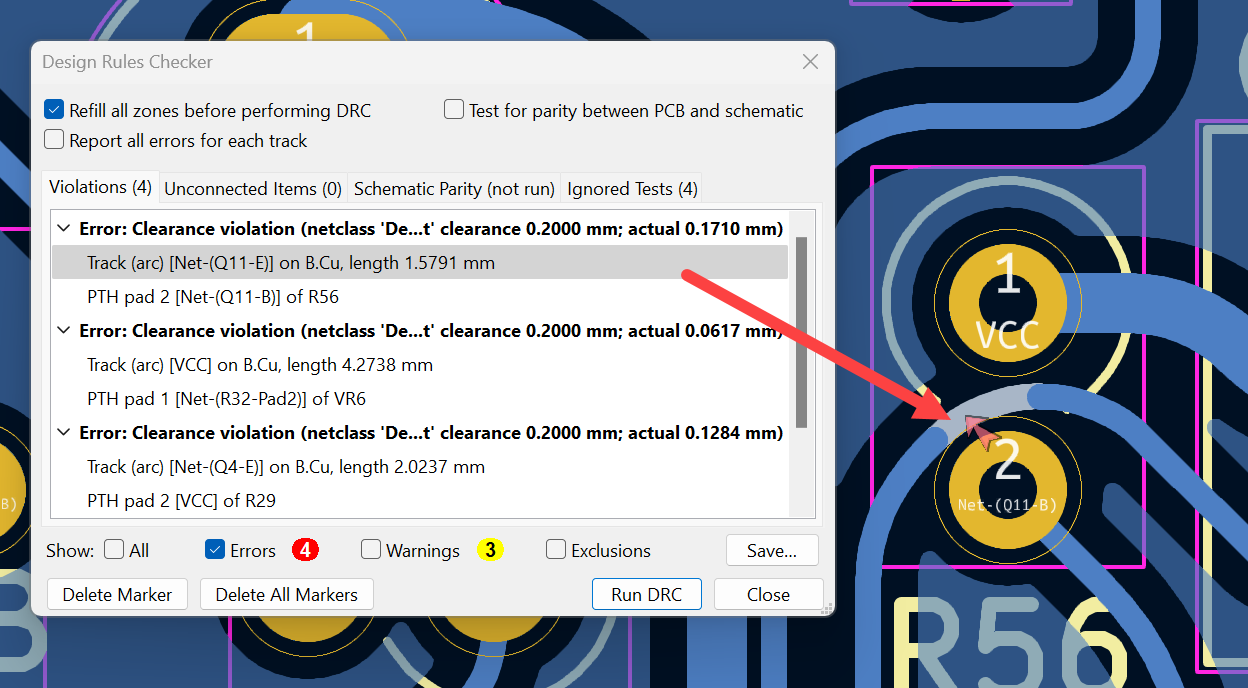
image

This was easy to fix by closing the newly generated board and editing the original board layout:
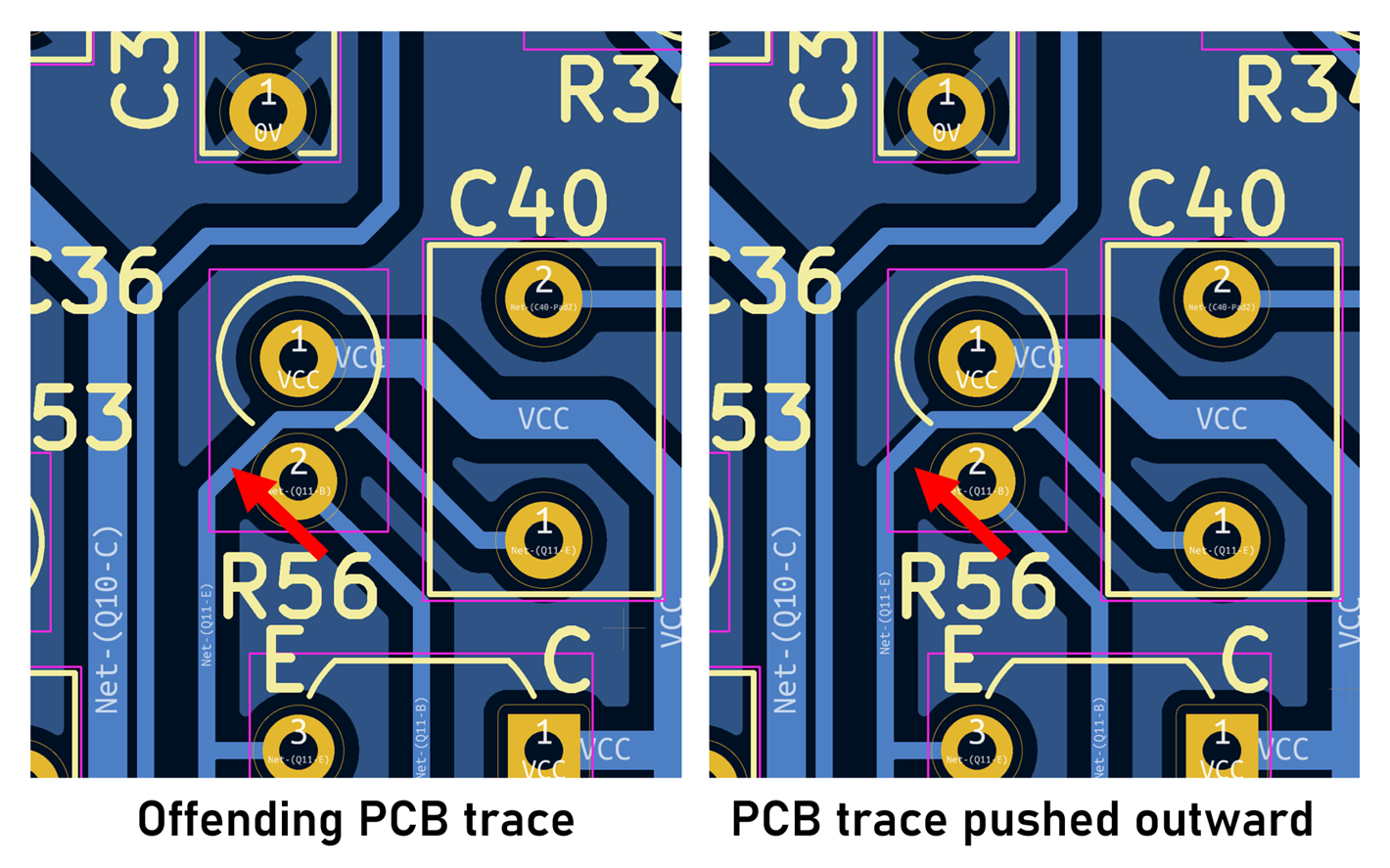
image

The plugin was re-run, and as seen in the screenshot below, the problem was sorted!

image

All four errors were similar and fixed using the same method.

image


Generally, I think it did a fantastic job, although a few cosmetic artifacts could be tweaked. For instance, a kind of delta shape is visible at the top-right in the screenshot above that could be cleaned up simply by deleting any redundant traces in the generated output.

The new PCB layout will be in a file with a new name (with a -rounded suffix) if the Create a new file option was checked in earlier settings.

Here’s the final error-free result, with most of the redundant traces removed:
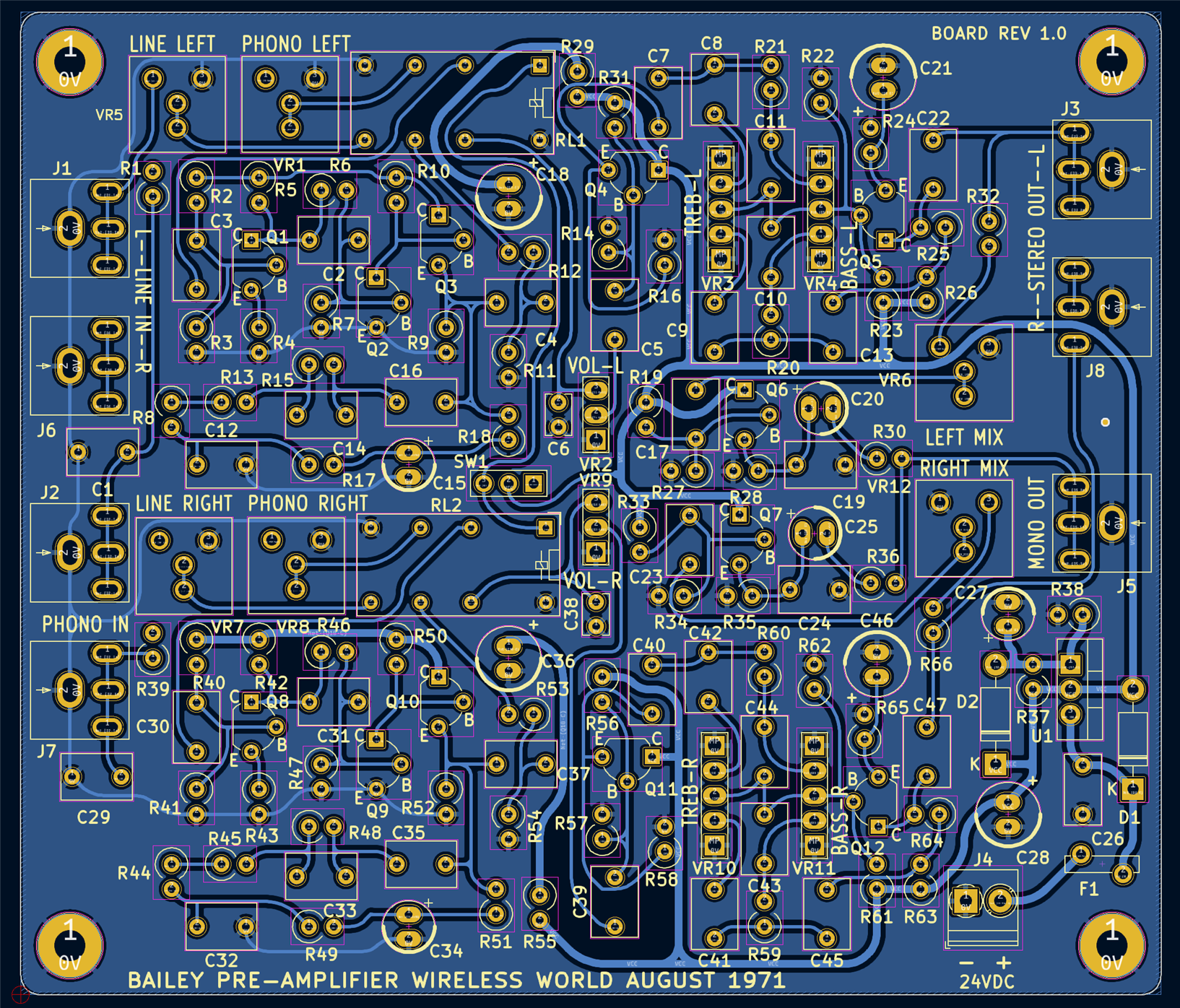
image

I think it's not bad, although to keep it 1970s style, it shouldn't have copper fill (or at least, not so tidy copper fill) around the traces!


Summary

Curved vintage-style PCB traces is quite a niche thing to want to do, but it could be interesting, especially for restoring or recreating old electronic products or perhaps retrofitting new functions or interfaces. With KiCad, it was straightforward to do, using a Round Tracks plugin and executing it against a normally-completed PCB design.

The plugin generated a new PCB file, so it is possible to edit the original PCB layout and re-run the plugin as desired, to improve it and resolve any clearance issues caused by rounding tracks too close to other PCB elements.

With KiCad 7, some extra things could be done to improve the look further. For instance, the silkscreen font can be changed to any arbitrary old font (although silkscreen was less common on early boards).

Thanks for reading!

  • Sign in to reply
  • jc2048
    jc2048 over 2 years ago

    This is a double-sided board I did in the early 1980s. This was a home project. It's done using tape-and-dot, with transfers for the chip footprints, all done twice life-size and reduced with a process camera. The board isn't pth (too expensive at the time), so the vias are breakoff pins. It's a memory board, so it made sense to run the tracks through the pins along the row of eight chips. The style is an odd mixture of wavy lines, and the 45-degree angles which was the 'house style' where I worked and which I defaulted to out of habit.

    image

    • Cancel
    • Vote Up 0 Vote Down
    • Sign in to reply
    • More
    • Cancel
  • Jan Cumps
    Jan Cumps over 2 years ago

    "They were done manually by rolling out UV-light-blocking crepe sticky-backed tape onto clear film."

    That was my first electronic summer job. Designing double-sided drivers and voltage doublers to create high voltage generators.

    These circuits were used in a powder paint factory, where they'd paint alu and metal profiles. By applying high voltage to the profiles, the paint powder would be attracted to those profiles, and the yield was way higher. More powder reached the profile faster, and stuck better before going into the oven.

    • Cancel
    • Vote Up 0 Vote Down
    • Sign in to reply
    • More
    • Cancel
  • genebren
    genebren over 2 years ago in reply to shabaz

    shabaz,

    I did some digging through my items stored in the garage (boxes from my last move from seven years ago), but I was not able to find the last group of boards that I remember doing (an earlier version of a synthesizer project, 10+ boards).  It funny, as I have such vivid memories of seeing the box that I stored the artworks in, but I will have to think on this and hopefully remember another place that I might have stash this.

    I will let you know if I am able to dig something up.

    Gene

    • Cancel
    • Vote Up 0 Vote Down
    • Sign in to reply
    • More
    • Cancel
  • shabaz
    shabaz over 2 years ago in reply to genebren

    Impressive! It would be awesome to see any if you still have them. The one in the blog is the only one I have.

    I was just googling vintage preamps, to see if I could find an old design for a comparison. I found this neat layout

    image(Image source: google images):

    It's a 'disc adapter' that used to be supplied as part of a Quad 33 preamp. It was a user-insertable board (there was a slot on the rear), and looks like it could be rotated, to swap in different resistors/capacitors etc, depending on what turntable/cartridge was being connected! 

    • Cancel
    • Vote Up 0 Vote Down
    • Sign in to reply
    • More
    • Cancel
  • genebren
    genebren over 2 years ago

    That is pretty cool. I used to design PCB using rolled tape and dry transfer rub on pads on clear Mylar. I have probably have done 40+ boards using this method.  The style really does bring memories!

    • Cancel
    • Vote Up 0 Vote Down
    • Sign in to reply
    • More
    • Cancel
<>
element14 Community

element14 is the first online community specifically for engineers. Connect with your peers and get expert answers to your questions.

  • Members
  • Learn
  • Technologies
  • Challenges & Projects
  • Products
  • Store
  • About Us
  • Feedback & Support
  • FAQs
  • Terms of Use
  • Privacy Policy
  • Legal and Copyright Notices
  • Sitemap
  • Cookies

An Avnet Company © 2026 Premier Farnell Limited. All Rights Reserved.

Premier Farnell Ltd, registered in England and Wales (no 00876412), registered office: Farnell House, Forge Lane, Leeds LS12 2NE.

ICP 备案号 10220084.

Follow element14

  • X
  • Facebook
  • linkedin
  • YouTube