element14 Community
element14 Community
    Register Log In
  • Site
  • Search
  • Log In Register
  • Community Hub
    Community Hub
    • What's New on element14
    • Feedback and Support
    • Benefits of Membership
    • Personal Blogs
    • Members Area
    • Achievement Levels
  • Learn
    Learn
    • Ask an Expert
    • eBooks
    • element14 presents
    • Learning Center
    • Tech Spotlight
    • STEM Academy
    • Webinars, Training and Events
    • Learning Groups
  • Technologies
    Technologies
    • 3D Printing
    • FPGA
    • Industrial Automation
    • Internet of Things
    • Power & Energy
    • Sensors
    • Technology Groups
  • Challenges & Projects
    Challenges & Projects
    • Design Challenges
    • element14 presents Projects
    • Project14
    • Arduino Projects
    • Raspberry Pi Projects
    • Project Groups
  • Products
    Products
    • Arduino
    • Avnet & Tria Boards Community
    • Dev Tools
    • Manufacturers
    • Multicomp Pro
    • Product Groups
    • Raspberry Pi
    • RoadTests & Reviews
  • About Us
  • Store
    Store
    • Visit Your Store
    • Choose another store...
      • Europe
      •  Austria (German)
      •  Belgium (Dutch, French)
      •  Bulgaria (Bulgarian)
      •  Czech Republic (Czech)
      •  Denmark (Danish)
      •  Estonia (Estonian)
      •  Finland (Finnish)
      •  France (French)
      •  Germany (German)
      •  Hungary (Hungarian)
      •  Ireland
      •  Israel
      •  Italy (Italian)
      •  Latvia (Latvian)
      •  
      •  Lithuania (Lithuanian)
      •  Netherlands (Dutch)
      •  Norway (Norwegian)
      •  Poland (Polish)
      •  Portugal (Portuguese)
      •  Romania (Romanian)
      •  Russia (Russian)
      •  Slovakia (Slovak)
      •  Slovenia (Slovenian)
      •  Spain (Spanish)
      •  Sweden (Swedish)
      •  Switzerland(German, French)
      •  Turkey (Turkish)
      •  United Kingdom
      • Asia Pacific
      •  Australia
      •  China
      •  Hong Kong
      •  India
      • Japan
      •  Korea (Korean)
      •  Malaysia
      •  New Zealand
      •  Philippines
      •  Singapore
      •  Taiwan
      •  Thailand (Thai)
      • Vietnam
      • Americas
      •  Brazil (Portuguese)
      •  Canada
      •  Mexico (Spanish)
      •  United States
      Can't find the country/region you're looking for? Visit our export site or find a local distributor.
  • Translate
  • Profile
  • Settings
Passive Components
  • Technologies
  • More
Passive Components
Forum How can I deal with resistors when I'm colorblind?
  • Blog
  • Forum
  • Documents
  • Quiz
  • Events
  • Polls
  • Members
  • Mentions
  • Sub-Groups
  • Tags
  • More
  • Cancel
  • New
Join Passive Components to participate - click to join for free!
Actions
  • Share
  • More
  • Cancel
Forum Thread Details
  • State Suggested Answer
  • Replies 47 replies
  • Answers 4 answers
  • Subscribers 118 subscribers
  • Views 13199 views
  • Users 0 members are here
  • green
  • identification
  • color
  • colorblind
  • component
  • red
Related

How can I deal with resistors when I'm colorblind?

4ringfan
4ringfan over 10 years ago

Hey guys, Mike Wiltrout here.  I believe many of you may know my father, John Wiltrout.


This really is not much of an introduction post, but it is my first on E-14.  It is picture laden so I apologize for that ahead of time.  I did, however, feel like it would be an interesting topic that some of you might be able to help me with, so here goes!


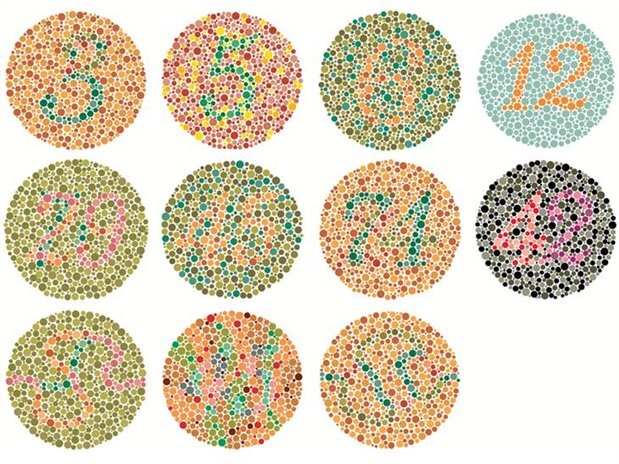
In my early childhood, I recall wanting to be a fireman.  One day, my mother took me in to the clinic for a school physical.  It was then that the doctor showed me a series of images with different color dots on them to determine if I was colorblind.  Supposedly somewhere in the mix of dots on each image was supposed to be a number that I was to recite when I could make it out.  Unfortunately for me I could make very few of them out.  Below is an example of just such a chart and on that chart below I can really only make out the '12' in the upper right corner.  It was then that the doctor began telling me about all of the careers that I would never be able to pursue.  Included in that list was fireman.  When I asked the doctor why I would not be able to be a fireman, he told me that firemen need to be able to see colors to be able to tell how hot a flame was.  So I left the doctor's office that day a little bit sad and discouraged.
image

My father, being the troubleshooter that he is, set out to try and help me with my colorblind condition.  He picked up color swatches in hopes that I might be able to "re-learn" the colors or at least be able to use the color swatches to compare against colors I wanted to know.  Turns out it just doesn't work that way.  The problem comes with being unable to differentiate.  Red can look like orange, orange can look like yellow, yellow can look like green, green can look like blue, and so on.  ORANGE means STOP and WHITE means GO!  As a teen, I was interested in flying and wanted to get into the Air Force Academy, but pilots need to be able to see colors so they can tell if a plane is coming at them or flying away from them using colors on the wing and tail.  I then considered the National Guard, where I was told that I could not be an engineer and that the ONLY military career paths that were open to me were about few different ones: a chaplain, a draftsman, or an infantryman.  They wouldn't even let me be a cook because I cannot tell if meat is raw or cooked.  Anyhow, you get the idea, being color blind can be a challenge.  My wife finally made me get rid of my favorite blue office chair, because she could no longer stand the "hideous purple thing."


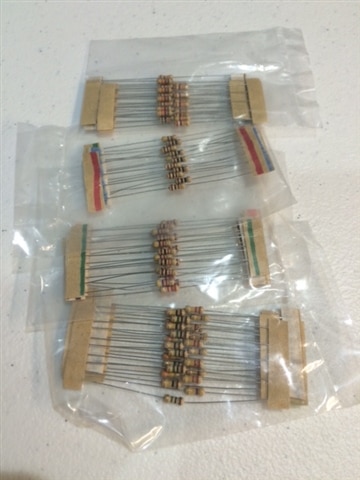
So, here is and has been my dilemma.  How do I differentiate and identify the various color coded resistors?


image


My solutions so far consist of the following:


  • GET A BUDDY TO HELP ME - Preferably a buddy who is also not colorblind, but while a buddy might be able to help me sort a new collection of resistors into bins, he isn't going to be attached to my hip when I need a resistor identified on a project that I'm working on at 3AM.image
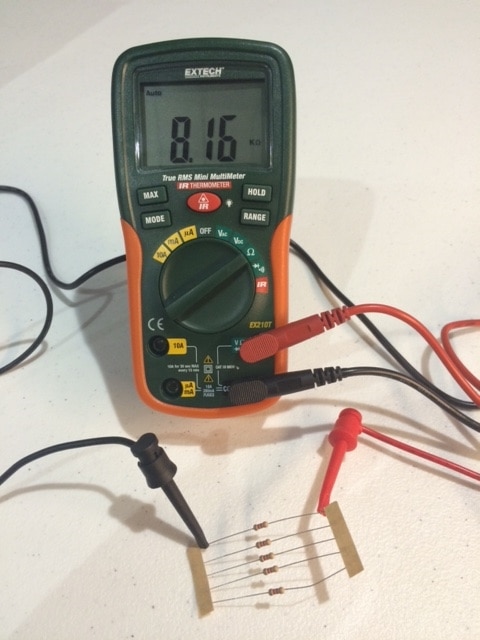
  • MEASURE THE RESISTOR USING A MULTIMETER - This may work to identify a resistor outside of a circuit, but it also does not take into account any tolerances of the resistor, which I also cannot discern.  I do not want to de-solder a leg on each resistor I need to measure on a PCB, either.
    image
  • LABEL THE RESISTORS - This will work if I buy resistors that are in label pre-packaged bags and I am able to label them right away.  I probably would look to label them according to either European or SMT standards in order to keep the labels as small as possible.  This method takes a considerable amount if time, and I will probably only use it for prototyping.
    image
  • PREMARKED RESISTORS - Some resistors like SMT resistors have their values printed on them.  These I can figure out.
  • VISUAL COMPUTER AIDED ANALYSIS - Another idea that I had was to use either a camera, or a USB microscope to "scan" the resistor.  The image could then be dropped into a computer program that would orient the resistor and scan the color bands displaying a value in Ohms and providing me the tolerance.  I have no experience with any program that can automatic manipulation and color matching, so I'm stuck there.
  • FIX MYSELF? - The last idea would be to somehow fix myself with some type of contacts, glasses, or other medical method.  (Again, not my field of expertise.)


The problem is not limited to resistors, either.  I'm thinking a career in bomb disposal sounds pretty interesting, "Should I cut the RED wire or the BLUE wire?"


So lets hear some suggestions!  GO!

  • Sign in to reply
  • Cancel

Top Replies

  • dougw
    dougw over 10 years ago in reply to 4ringfan +4
    Hi Mike, I'm currently immersed in some pretty heavy projects, so I don't have much time to devote to this, but I just wrote a quick program in VB6 that will show the color of any pixel on the screen …
  • valdaquendë
    valdaquendë over 8 years ago +4 suggested
    As a color-blind individual myself, I've had to struggle with this for quite a while. I read about ReScan, on this site and others but it is PC/Android only and requires a bit of putzing to install and…
  • dougw
    dougw over 10 years ago +3 suggested
    Maybe this app would help... Optical recognition of resistor codes | Labrigger from Nothing Labs (Rich Olson) Resistor Photo ID
Parents
  • Former Member
    0 Former Member over 10 years ago

    One of the problems with taking a picture is lighting and the reflective surface of the resistor. Just like the latest debacle on the internet with the blue & black dress or white & gold dress. You can tell from the picture above that some of the color is washed out from the glare of the light used to illuminate the resistor. If the contrast is not right then the red may look brown. Perhaps we should get the industry to also print numbers on the bands so we have a verification as to what color we are actually looking at. Unfortunately that won't work so we need something that has a color corrected light source with a polarized filter for the camera lens to reduce glare and then we may get an almost accurate idea as too which colors we are looking at if they are not faded. Software to read the color bands and tolerance that can give us a numerical value with the tolerance range. I think that would aid not only colorblind people but anyone that hasn't taken the time to memorize the color codes. where to start?

    • Cancel
    • Vote Up 0 Vote Down
    • Sign in to reply
    • Verify Answer
    • Cancel
  • 4ringfan
    0 4ringfan over 10 years ago in reply to Former Member

    jguss43 ,


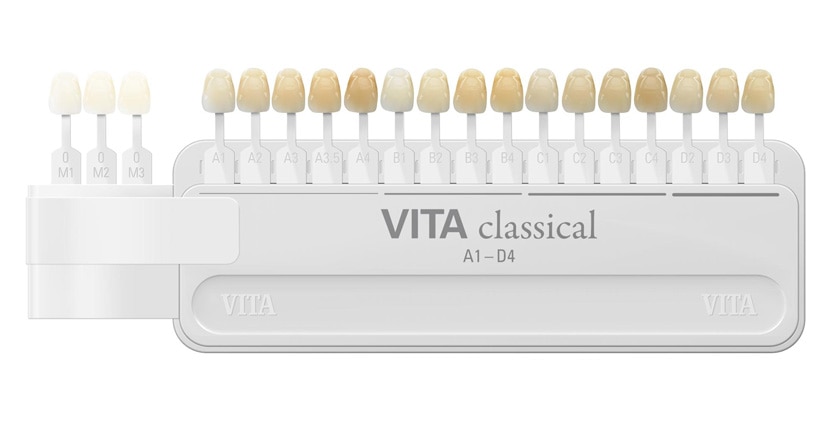
    Lighting and shading is an excellent point.  In the dental industry, when they go to put a false tooth in your mouth, they put the patient under daylight lighting conditions and then they pick different teeth from a shade guide.  They hold the individual shade up next to your existing teeth and move through the shade guide until they have one that most closely resembles the existing teeth.

    image

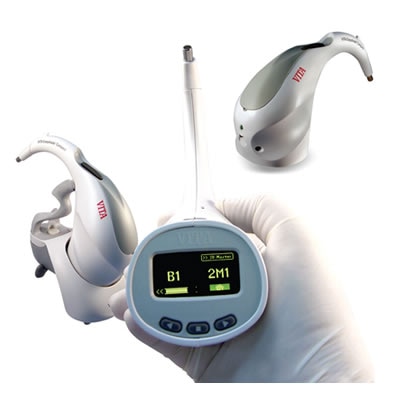
    An advancement on that is that they have a device that emits a specific wavelength of light and reads the color that is reflected back to it.  It then displays a letter / number combination that coincides with the correct tooth shade to select from the guide.

    image

    mcb1 , I have not taken my digital microscope apart to see if the dial that I am moving is actually moving a lens, or if it is just a potentiometer that is spinning to adjust the zoom.  I understand the differences between an optical and digital zoom, and the fact that a digitally zoomed image will decrease the dpi resolution of the image.  Some of the image issues that you see in my picture revolve around the fact that I just took a picture of the screen with my camera instead of doing an actual screen capture.  I do not think that there was a lot of pixelation at least at the resolution that I had zoomed to.


    My hopes with the microscope were to simply be able to capture a part in a tight location and isolate it from the surrounding parts, blow it up large enough so that I was not also fighting my eyesight as well as my color blindness.  I can control the brightness of the microscope, it is just a ring of LEDs.  I'm not sure what temperature of light that the LEDs are giving off, or if the colors reflected back are accurate or not.  I can't do much about shadows without being able to get close and illuminate the entire part, and I can't fix the fact that some resistors will be dulled and old while others may be new and shiny.


    The color is what the color is.  I just need to find a simple, fast, cost effective way to read them resistor's colors and Ohms.  I'd like to use the device to read the colors of wires too.  That'd be handy when I'm trying to figure out what wires are taps on a transformer, etc.  Without color recognition, I see many explosive project failures in my future. Hehe.

    • Cancel
    • Vote Up +2 Vote Down
    • Sign in to reply
    • Verify Answer
    • Reject Answer
    • Cancel
  • mcb1
    0 mcb1 over 10 years ago in reply to 4ringfan

    Mike

    Sounds like you have the necessary nouse to sort out the imaging ...image


    I do like that you can use it for more than just resistors, as wiring is another problem ...especially in vehicles.


    Now that you've raised the issue, I'm sure others will be looking for solutions.


    Mark

    • Cancel
    • Vote Up 0 Vote Down
    • Sign in to reply
    • Verify Answer
    • Cancel
Reply
  • mcb1
    0 mcb1 over 10 years ago in reply to 4ringfan

    Mike

    Sounds like you have the necessary nouse to sort out the imaging ...image


    I do like that you can use it for more than just resistors, as wiring is another problem ...especially in vehicles.


    Now that you've raised the issue, I'm sure others will be looking for solutions.


    Mark

    • Cancel
    • Vote Up 0 Vote Down
    • Sign in to reply
    • Verify Answer
    • Cancel
Children
No Data
element14 Community

element14 is the first online community specifically for engineers. Connect with your peers and get expert answers to your questions.

  • Members
  • Learn
  • Technologies
  • Challenges & Projects
  • Products
  • Store
  • About Us
  • Feedback & Support
  • FAQs
  • Terms of Use
  • Privacy Policy
  • Legal and Copyright Notices
  • Sitemap
  • Cookies

An Avnet Company © 2026 Premier Farnell Limited. All Rights Reserved.

Premier Farnell Ltd, registered in England and Wales (no 00876412), registered office: Farnell House, Forge Lane, Leeds LS12 2NE.

ICP 备案号 10220084.

Follow element14

  • X
  • Facebook
  • linkedin
  • YouTube