


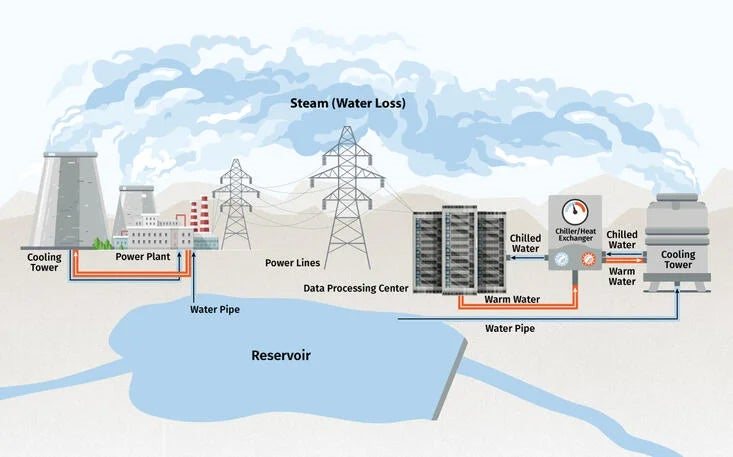
AI data centers use water to cool the servers. (Image Credit: UCR/Evan Fields)
I was wondering why water used in data centers can’t be reused. Nature cycles water constantly, it seems odd that the water is used to cool but then disappears. Why?
Artificial intelligence may seem completely digital. But in reality, it relies on physical data centers that consume water and electricity. According to researchers, especially Shaolei Ren from the University of California, Riverside, the system’s infrastructure can have a huge impact on the environment, even as they become more widely used.
Those large data centers have thousands of powerful computers, which generate a lot of heat. To manage that heat, they need cooling systems, and most of them rely on evaporative technology that cools the air by turning water into vapor. Power production to operate the servers also uses water indirectly, as many power plants require it.
Research also suggests that training OpenAI’s GPT-3 at Microsoft’s data centers used up 5.4 million liters of water, with hundreds of thousands of liters evaporated. Another analysis with Ren determined that a 100-word ChatGPT email consumed roughly 519 milliliters of water on average. This includes water for cooling servers and the water footprint of the electricity powering them. However, water usage varies based on where the data center is located, the time of year, how efficient it is, and its energy mix. That number could rise in hotter areas and decrease in cooler places, so it’s not a fixed number but rather an estimate.
Scale worsens the issue. In the “Making AI Less Thirsty” study, Ren’s team projected that global AI demand could require 4.2 – 6.6 billion m3 of water taken from a source every year by 2027. Although that’s only an estimated figure, it aligns with company disclosures and government reviews that mention water use has increased as AI and cloud computing expand.
According to Microsoft, it has taken 6.4 million m3 of water in 2022, a 34% increase from 2021. That same year, Google also saw an uptick in water withdrawal by 20% to 19.5 million m3. A UK government review discovered that the expansion of AI and data centers is leading to more water demand. It also criticized the lack of transparency concerning how much water is extracted.
While that figure refers to water withdrawal instead of water consumption, it’s still a significant amount of water for AI and data center cooling systems. AI actually uses less water compared to agriculture, which accounts for 72% of freshwater withdrawals. So, it’s worth noting that global comparisons are potentially misleading as data centers pull water from local watersheds. As AI infrastructure grows, the bigger question shifts to how much water each data center uses and where that water is sourced. Without much company disclosure on those details, it’s much harder to determine how it affects the communities where the data centers are located.
People are worried because the water is consumed locally and not returned to its original form. The water isn’t destroyed. But rather, it’s evaporated during cooling, returned warmer or sent to wastewater systems, or used indirectly to generate electricity that powers the servers. This means the issue is less about water being gone forever and more about extracting water from local watersheds. So, it might not be available for other uses like households or farming, especially in water-limited areas. Simply put, water is taken from one spot and not returned to the same area.
Have a story tip? Message me here at element14.
