


Hi Element14 Community! 
Traditional alkaline batteries tend to "die" at the most inconvenient times. I used to I have them in devices like wireless mouse and keyboards, and it felt that the batteries were draining fairly quickly, catching me with no replacements when the devices finally stopped working  .
.
Measuring the voltage on such "dead" batteries does not tell too much, the voltage on them being still not that low, usually at around 1.2V. Because of this I was always curious how much energy is actually left in the battery when devices are no longer able to reliably work with them.
Back in 2023 I road tested the Aim-TTi SMU4201 Source Measure Unit (link), and since then always had the idea to do some experiments with these quickly dying batteries. So, instead of disposing the used batteries I shoved them into pile for storage:
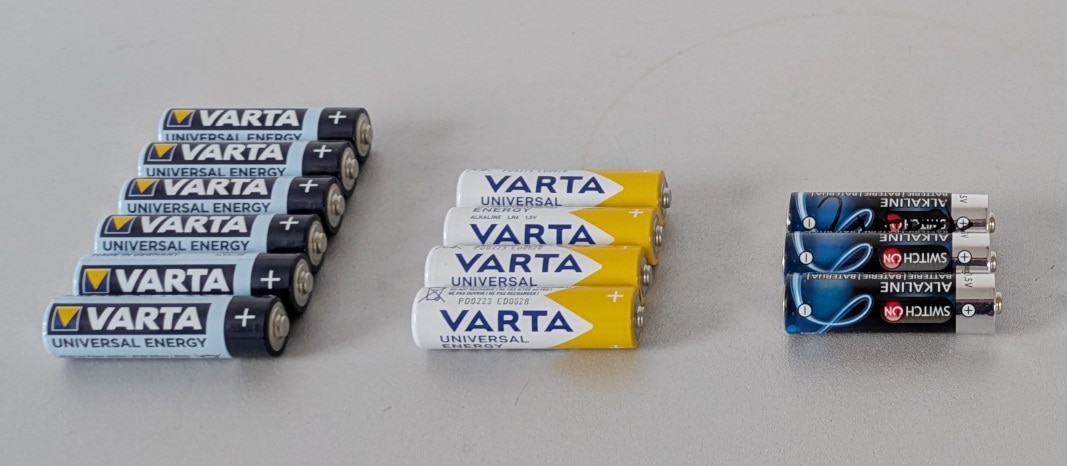
Now, as I had some time, and I wanted to get rid of these dead batteries  . I decided to do some experiments with some of the AA batteries I collected.
For this I quickly soldered some wires on a battery holder, and set up 4-wire measurement on the SMU4201:

Then I opened up Jupyter Notebook, set up remote control of the SMU4201 over LXI / VISA, and started playing with one of the batteries.
After some time I decided to test the batteries at 200mA, 100mA, 50mA and 25mA discharge currents. Each stage discharges the battery until a cutoff voltage of 0.1V is reached. Then we let the battery to recover for one minutes, after which the test continues with next stage. The test is also time limited to around 1.5 hours per battery.
During the tests the Battery Voltage and Discharge Current was continuously monitored, and the data was saved into CSV files. After I run the experiments on all the batteries, it was time to process the collected data.
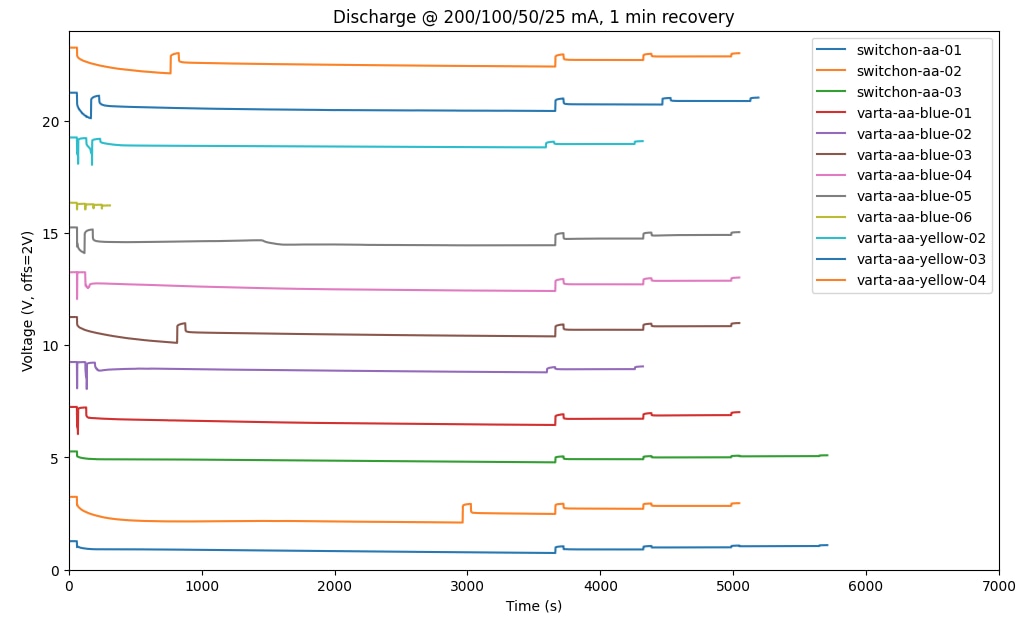
First, I plotted the discharge curves for the batteries individually. It is interesting to see that at higher currents the battery voltage quickly falls to unusable levels, but with lower currents the voltage stabilizes at the discharge can continue for a longer time.

The "tolerated" discharge current differs from battery to battery. One of the Varta-s for example was completely unusable at 200mA and 100mA, but then it was stable at 50mA discharge while its voltage remained over ~0.8V.

I also plotted the discharge curves in a single graph to show the behavior difference between batteries:
Finally, I did some math to calculate the total energy we discharged from each battery:
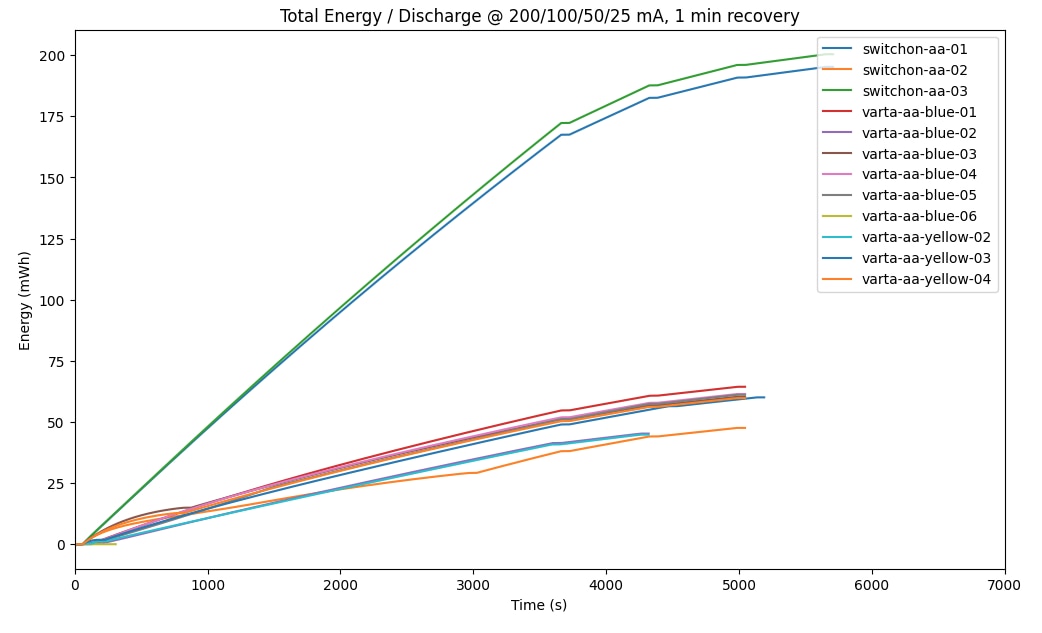
According to the internet the capacity of an AA battery should be around 2-3000 mAh or 2-4Wh. Now let's see how much energy we managed to extract from the dead batteries:
- 2 of the batteries are around ~200mWh, which corresponds to around 5-10% of the nominal capacity of an AA battery (these 2 batteries seems to have higher capacity left. maybe they were used in a different device compared to the other ones
 )
) - 9 batteries had between 45-65mWh (~1-3% in capacity) left in them
- 1 battery was completely dead
Looks like most of the batteries were depleted quite efficiently by the devices they were used in. I kind of expected to have a bit more capacity left in them. 
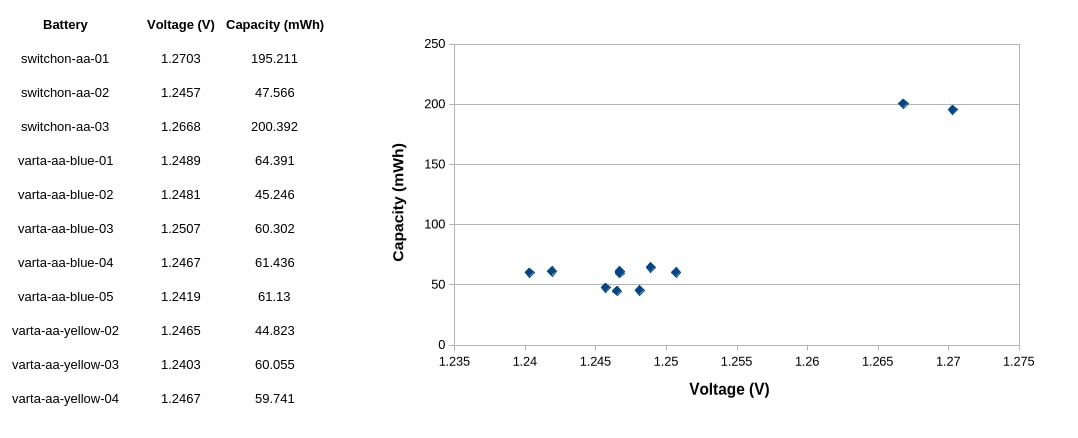
I also wanted to see if there is a correlation between no load voltage, and remaining capacity. So, it looks there is some, but you will probably need very good memory to draw any conclusions based on it:
So, can the energy left in dead batteries useful at all? Probably not. Although the energy left in the batteries is comparable to the capacity of an LR44, extracting energy at such low voltages is not easy. In case there an apocalypse, with no other energy source available and we have some nano-power boost converters (like the MAX17222) on hand we may be able to power some micro-controllers / sensors for a couple of days. Otherwise, looks like there is not much use to these dead batteries. 
For anyone interested, here is a Gist with Jupyter notebook I used for the experiments.
Hope you enjoyed this post!
Top Comments