


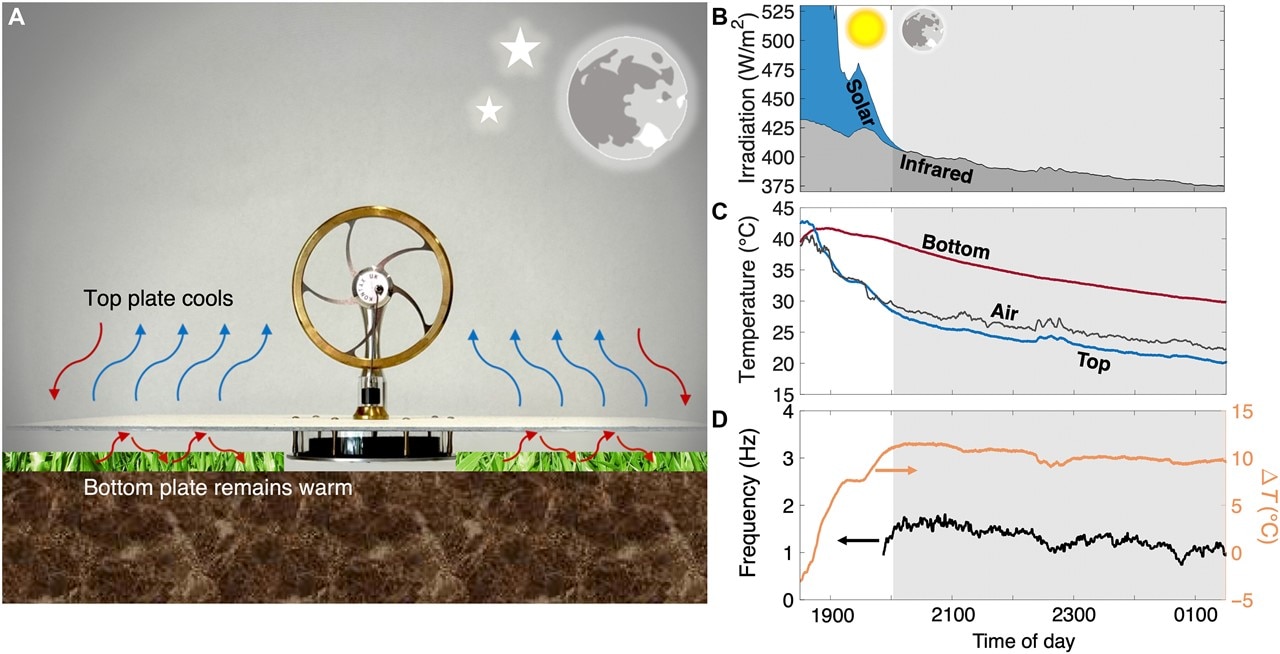
Render and data show radiative cooling of the top plate to the night sky and warming of the bottom plate to the ground. This produced a temperature difference that powered the engine. (Image Credit: ScienceAdvances)
Engineers at the University of California, Davis, have developed a device that generates power at night by capturing the thermal gradient between the Earth’s warmth and the cold of space. Over time, this technology may offer fuel-free ventilation for greenhouses and other buildings.
This device utilizes a Stirling engine, a device that generates mechanical motion from temperature differences. These engines operate with small thermal gradients, making them different from internal combustion engines that run on a large temperature gap. Stirling engines only need a slight temperature contrast, such as between a hot coffee cup and the air around it.
"These engines are very efficient when only small temperature differences exist, whereas other types of engines work better with larger temperature differences and can produce more power," Jeremy Munday, professor of electrical and computer engineering at UC Davis, said.
Sterling engines use a fuel source to heat one side, producing a temperature difference. Rather than burning fuel, the team investigated whether the cold side could be coupled to space. "It doesn't actually have to touch space physically, it can just interact radiatively with space," Munday said. Our bodies release heat toward the sky on cool nights, making our heads feel colder. The researchers used that principle as inspiration to harness radiative cooling for their system.
In their setup, a basic Stirling engine (piston linked to a flywheel) is placed on a panel that functions as a thermal radiator. The panel mounts to the ground via an aluminum bracket inserted 5cm into the soil. They deployed the system outdoors at night, and it drew heat from the ground to keep one side warm. At the same time, the top panel releases heat to the sky, which cools the other side. The team coated an infrared emissive paint on the sky-facing surface, maximizing radiative heat loss.
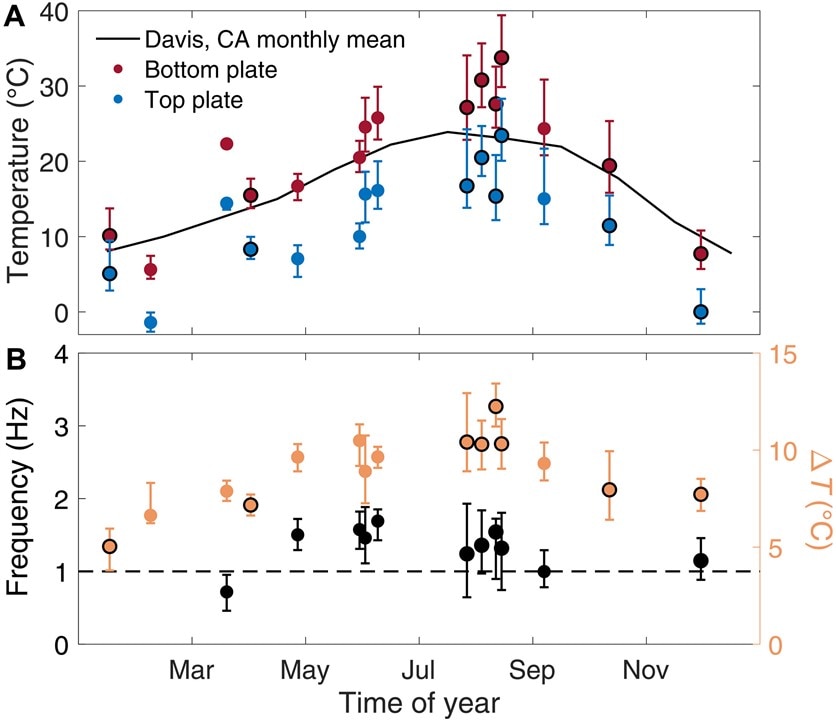
Year-round measurements show that the engine’s plate temperatures, temperature differential, and rotation rate correlate with the weather. (Image Credit: ScienceAdvances)
The team conducted tests for a year and discovered the system produced at least 400 milliwatts of mechanical power/m2. During demonstrations, the engine powered a small fan and generated an electric current when connected to a small electric motor.
This demonstrates that sufficient energy can be harvested from the night sky. The technique is more practical in areas experiencing low humidity and clear skies. Eventually, the system could ventilate greenhouses or residential buildings without energy sources.
Have a story tip? Message me here at element14.

