element14 Community
element14 Community
    Register Log In
  • Site
  • Search
  • Log In Register
  • Community Hub
    Community Hub
    • What's New on element14
    • Feedback and Support
    • Benefits of Membership
    • Personal Blogs
    • Members Area
    • Achievement Levels
  • Learn
    Learn
    • Ask an Expert
    • eBooks
    • element14 presents
    • Learning Center
    • Tech Spotlight
    • STEM Academy
    • Webinars, Training and Events
    • Learning Groups
  • Technologies
    Technologies
    • 3D Printing
    • FPGA
    • Industrial Automation
    • Internet of Things
    • Power & Energy
    • Sensors
    • Technology Groups
  • Challenges & Projects
    Challenges & Projects
    • Design Challenges
    • element14 presents Projects
    • Project14
    • Arduino Projects
    • Raspberry Pi Projects
    • Project Groups
  • Products
    Products
    • Arduino
    • Avnet & Tria Boards Community
    • Dev Tools
    • Manufacturers
    • Multicomp Pro
    • Product Groups
    • Raspberry Pi
    • RoadTests & Reviews
  • About Us
    About the element14 Community
  • Store
    Store
    • Visit Your Store
    • Choose another store...
      • Europe
      •  Austria (German)
      •  Belgium (Dutch, French)
      •  Bulgaria (Bulgarian)
      •  Czech Republic (Czech)
      •  Denmark (Danish)
      •  Estonia (Estonian)
      •  Finland (Finnish)
      •  France (French)
      •  Germany (German)
      •  Hungary (Hungarian)
      •  Ireland
      •  Israel
      •  Italy (Italian)
      •  Latvia (Latvian)
      •  
      •  Lithuania (Lithuanian)
      •  Netherlands (Dutch)
      •  Norway (Norwegian)
      •  Poland (Polish)
      •  Portugal (Portuguese)
      •  Romania (Romanian)
      •  Russia (Russian)
      •  Slovakia (Slovak)
      •  Slovenia (Slovenian)
      •  Spain (Spanish)
      •  Sweden (Swedish)
      •  Switzerland(German, French)
      •  Turkey (Turkish)
      •  United Kingdom
      • Asia Pacific
      •  Australia
      •  China
      •  Hong Kong
      •  India
      •  Japan
      •  Korea (Korean)
      •  Malaysia
      •  New Zealand
      •  Philippines
      •  Singapore
      •  Taiwan
      •  Thailand (Thai)
      •  Vietnam
      • Americas
      •  Brazil (Portuguese)
      •  Canada
      •  Mexico (Spanish)
      •  United States
      Can't find the country/region you're looking for? Visit our export site or find a local distributor.
  • Translate
  • Profile
  • Settings
Power & Energy
  • Technologies
  • More
Power & Energy
Blog Honeycomb-Shaped 3D PV Modules Could Generate More Electricity Than Flat Panels
  • Blog
  • Forum
  • Quiz
  • Documents
  • Polls
  • Events
  • Mentions
  • Sub-Groups
  • Tags
  • More
  • Cancel
  • New
  • Share
  • More
  • Cancel
Toptech-Voices
Group Actions
  • Group RSS
  • More
  • Cancel
Engagement
  • Author Author: Catwell
  • Date Created: 31 Jul 2026 6:26 PM Date Created
  • Views 21 views
  • Likes 2 likes
  • Comments 1 comment
  • alternative_energy
  • power generation
  • solar panel
  • manufacturing
  • biomimicry
  • power
  • energy
  • solar
  • innovation
Related
Recommended

Honeycomb-Shaped 3D PV Modules Could Generate More Electricity Than Flat Panels

Catwell
Catwell
31 Jul 2026

image

Figure showing the honeycomb-structured 3D PV design, the mechanical metamaterial support, and the light recapture mechanism. (Image Credit: Advanced Materials Technologies)

Although PV modules are useful, they have a flaw. They don’t retain all the captured sunlight, as reflected photons escape from the surface before being converted into electricity. Anti-reflection coatings and surface texturing don’t eliminate those losses, but they can reduce them. And there are other techniques to deal with this issue. In 2022, engineers sought inspiration from bees and developed a honeycomb-structured 3D photovoltaic module that redirects reflected sunlight toward solar cells. 

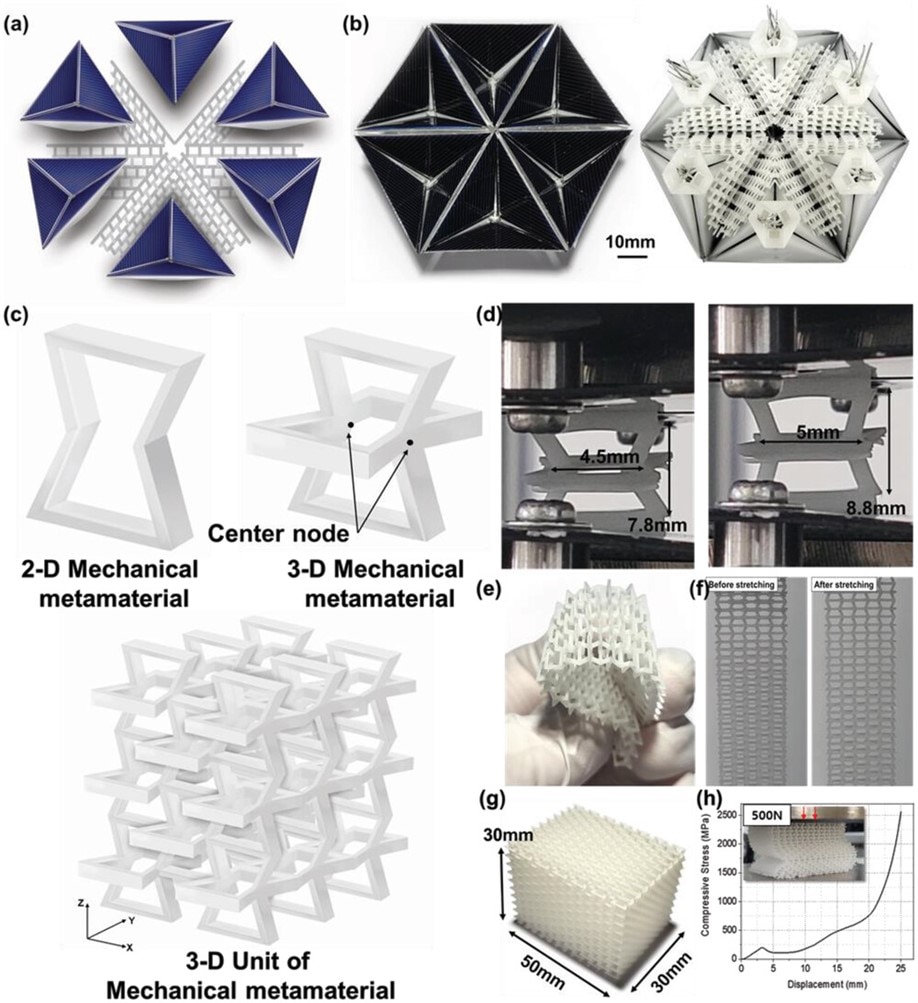
The team’s module uses a 3D tetrahedron-like concave geometry assembled into a hexagonal honeycomb structure. Each honeycomb cell has six interconnected tetrahedron units with mechanical metamaterials supporting them. With this concave configuration, reflected and scattered light is redirected onto nearby solar cell surfaces. That makes the sunlight more likely to be absorbed and converted into electricity, a process that improves power production via enhanced light recapture.

To support the module’s complex geometry, the team added a mechanical metamaterial with a negative Poisson’s ratio. These materials expand laterally as tension is applied, unlike those that become thinner when stretched. This ensures the mechanical stress is more evenly distributed. Additionally, the photovoltaic module can flex and conform to curved surfaces while all the solar cells align.
image
Image showing the 3D photovoltaic module, its mechanical metamaterial framework, and the structural tests. (Image Credit: Advanced Materials Technologies)

Before fabricating the module, the team used computer simulations and optical ray-tracing analysis for geometry optimizations. They also observed how light moved through the 3D cavities. Afterward, they tested the finished prototypes against conventional flat photovoltaic modules to evaluate electrical output and mechanical performance.

During experiments, the geometry improved light capture. Compared to flat cells, tetrahedral units set at a 40-degree angle generated an 11% increase in short-circuit current. Meanwhile, those positioned at a 60-degree angle had a 39% increase. The team also tested the entire honeycomb module and discovered it generated roughly 28% more electricity than a flat photovoltaic module under controlled conditions. Performance results matched the team’s optical simulations. This suggests that enhanced light recaptured within the concave structure improved performance.

This technique could enable photovoltaic systems to be deployed in applications where standard flat modules aren’t practical, such as vehicles and curved surfaces. Improving energy collection through geometric design instead of new photovoltaic materials enables higher power output without changing the underlying solar cell technology.

Have a story tip? Message me here at element14.

  • Sign in to reply
  • kmikemoo
    kmikemoo 12 hours ago

    We can only hope that this technology makes it to market.

    • Cancel
    • Vote Up 0 Vote Down
    • Sign in to reply
    • More
    • Cancel
element14 Community

element14 is the first online community specifically for engineers. Connect with your peers and get expert answers to your questions.

  • Members
  • Learn
  • Technologies
  • Challenges & Projects
  • Products
  • Store
  • About Us
  • Feedback & Support
  • FAQs
  • Terms of Use
  • Privacy Policy
  • Legal and Copyright Notices
  • Sitemap
  • Cookies

An Avnet Company © 2026 Premier Farnell Limited. All Rights Reserved.

Premier Farnell Ltd, registered in England and Wales (no 00876412), registered office: Farnell House, Forge Lane, Leeds LS12 2NE.

Follow element14

  • X
  • Facebook
  • linkedin
  • YouTube