


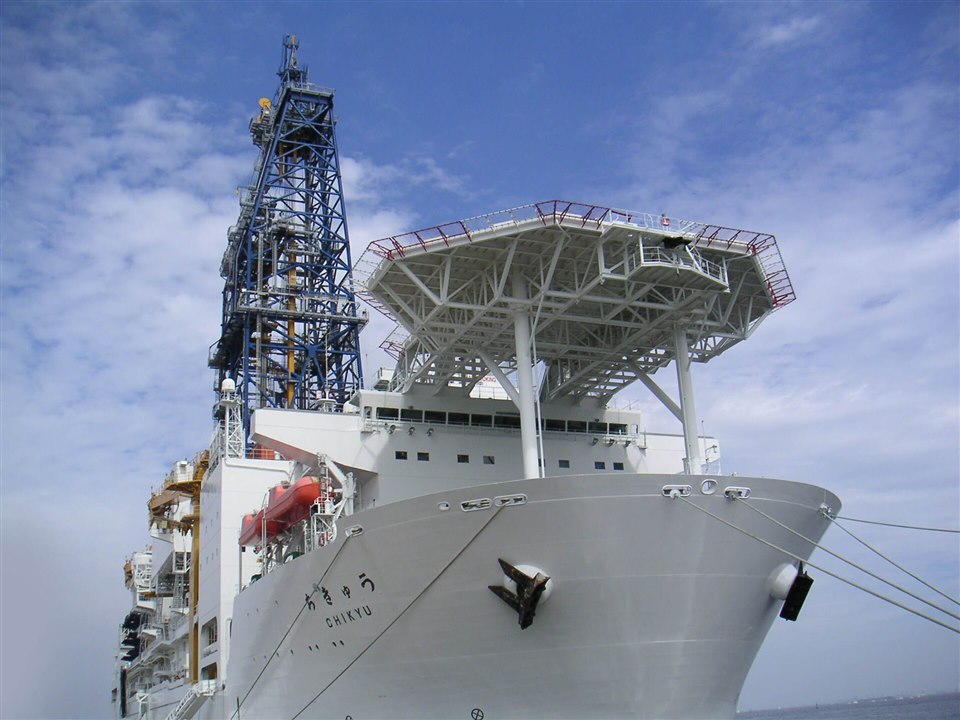
Japan’s Chikyu deep-sea drilling vessel recently extracted samples of rare earth elements from seabed sediment. (Photo By Gleam - Photo taken by Gleam., CC BY-SA 3.0)
Japan is starting to take action on a decade-old plan to move away from China as its main exporter for rare-earth minerals. Recently, the Japan Agency for Marine-Earth Science and Technology (JAMSTEC) used its deep-sea drilling Chikyu ship to extract mud containing rare earths from a seabed (depth of nearly 6,000m) near the Minamitorishima island. The team expects to perform a full-scale test excavation in February 2027 to remove 350 tons/day. It’s not yet clear how much the team extracted during retrieval.
Researchers identified the mud during 2012-2015 surveys, publishing the huge deposit, consisting of 16 million metric tons of rare earth minerals, in 2018. According to estimates, the volume is sufficient to meet global demand for centuries. This means the dysprosium could last 730 years while the yttrium may last 780 years. Since the discovery, the Japanese government has spent $250 million on the extraction project via the Strategic Innovation Promotion Program (SIP).
Schoichi Ishii, the Cabinet Office of the Ocean Innovation Platform, led the project. JAMSTEC used a long pipe connected to a cylindrical excavator to drill into the mud. Afterward, water flowed continuously inside the system to suck up and move drilled sediment from the seabed surface to the vessel. Using this technique prevents the sediment from spreading around in the ocean while ensuring the retrieval of approximately 350 tons of mud per day.
Japan mostly relies on China (over 60%) to supply rare Earth elements, which include magnets for electric and hybrid vehicle motors. However, China recently prohibited Japan from exporting technology, software, and goods used for civilian and military applications. Among those are materials used for manufacturing drones, chips, and other products, threatening Japan’s automotive industry.
Unfortunately, developers would face major cost and logistics hurdles when mining the seabed for rare earth elements. Despite the discovery of rare earth element deposits, full-scale mining has yet to be achieved.
Ishii isn’t concerned about cost. He says that Japan’s government aims to secure a stable metal supply chain for domestic industries. He also compared this project to the U.S. government’s $400 million investment in MP Materials, a California-based company that restarted rare earth production on land for a reliable supply.
Have a story tip? Message me here at element14.
