


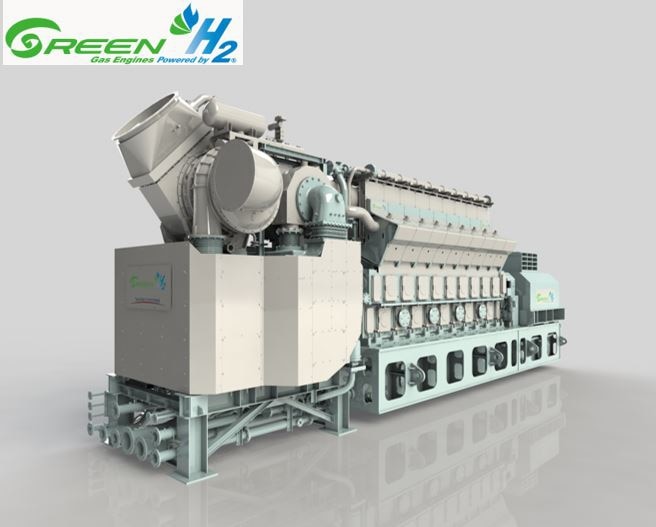
Rendering of the co-firing hydrogen engine built by Kawasaki Heavy Industries. (Image Credit: Kawasaki)
Kawasaki Heavy Industries constructed the first-ever 8MW KG Series co-firing hydrogen engine, which generates electricity. It operates on natural gas mixed with 30% hydrogen by volume. This proportion is typically delivered through current pipeline networks without major upgrades. The company started taking orders for the engine in September 2025 after a lengthy and successful 11-month verification test at Kobe works.
For now, the engine doesn’t operate on 100% hydrogen. With the 30% mixture, sites that already have natural gas systems can install the engine without overhauling distribution lines or storage tanks. It took over ten years for the company to improve the system.
Previous versions of the KG series gas engines can be modified to support hydrogen co-firing. For instance, a decade-old natural gas power plant can operate on a fuel that was unavailable commercially after plant construction. This approach ensures equipment lasts longer while gradually reducing carbon intensity, eliminating the need for costly fleet replacement.
Kawasaki performed verification testing from October 2024 to September 2025. It involved real-world operating conditions that lab trials can’t simulate. The team evaluated hydrogen supply chain integration, long-term maintainability, and safety procedures, including leak detection and purge systems tailored for hydrogen’s properties. Hydrogen leak sensors have been integrated along the fuel supply system, along with nitrogen purge systems that render the lines inert during startup, shutdown, or fault events.
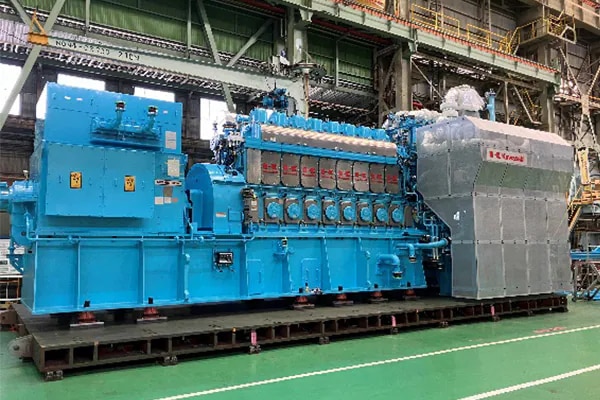
External view of the marina hydrogen engine. (Image Credit: Kawasaki)
Additionally, Kawasaki, Yanmar, and Japan Engine Corporation announced they built the first marine hydrogen engine on October 26th. Testing involved evaluating several engine classes using a new liquefied hydrogen fuel system. Kawasaki and Yanmar achieved stable hydrogen combustion in medium-speed four-stroke engines at rated output. Japan Engine is working on a low-speed two-stroke hydrogen engine, expected to start operations in Spring 2026. These engines are dual-fuel architecture, allowing vessels to switch between hydrogen and diesel. The KG series and marine hydrogen engine require infrastructure that is still being built. To address this, Kawasaki is making parallel investments in hydrogen supply chains.
In November 2025, Kawasaki and Japan Suiso Energy commenced construction on the Kawasaki LH2 Terminal, Japan’s first liquid hydrogen import facility. It’s expected to include a 50,000 m3 liquid hydrogen storage tank. In addition, the terminal will handle ship and truck cargo, becoming operational by 2030.
This terminal functions as an import point and a hydrogen refueling hub. Meanwhile, the partners are developing a 40,000 m3 liquid hydrogen carrier. This is a huge upgrade from the 1,250 m3 Suiso Frontier that completed the country’s first hydrogen shipment from Australia in 2022.
Have a story tip? Message me here at element14.
