element14 Community
element14 Community
    Register Log In
  • Site
  • Search
  • Log In Register
  • Community Hub
    Community Hub
    • What's New on element14
    • Feedback and Support
    • Benefits of Membership
    • Personal Blogs
    • Members Area
    • Achievement Levels
  • Learn
    Learn
    • Ask an Expert
    • eBooks
    • element14 presents
    • Learning Center
    • Tech Spotlight
    • STEM Academy
    • Webinars, Training and Events
    • Learning Groups
  • Technologies
    Technologies
    • 3D Printing
    • FPGA
    • Industrial Automation
    • Internet of Things
    • Power & Energy
    • Sensors
    • Technology Groups
  • Challenges & Projects
    Challenges & Projects
    • Design Challenges
    • element14 presents Projects
    • Project14
    • Arduino Projects
    • Raspberry Pi Projects
    • Project Groups
  • Products & Partners
    Products & Partners
    • Arduino
    • Avnet & Tria Boards Community
    • Dev Tools
    • Manufacturers
    • Multicomp Pro
    • Product Groups
    • Raspberry Pi
    • RoadTests & Reviews
  • About Us
    About the element14 Community
  • Store
    Store
    • Visit Your Store
    • Choose another store...
      • Europe
      •  Austria (German)
      •  Belgium (Dutch, French)
      •  Bulgaria (Bulgarian)
      •  Czech Republic (Czech)
      •  Denmark (Danish)
      •  Estonia (Estonian)
      •  Finland (Finnish)
      •  France (French)
      •  Germany (German)
      •  Hungary (Hungarian)
      •  Ireland
      •  Israel
      •  Italy (Italian)
      •  Latvia (Latvian)
      •  
      •  Lithuania (Lithuanian)
      •  Netherlands (Dutch)
      •  Norway (Norwegian)
      •  Poland (Polish)
      •  Portugal (Portuguese)
      •  Romania (Romanian)
      •  Russia (Russian)
      •  Slovakia (Slovak)
      •  Slovenia (Slovenian)
      •  Spain (Spanish)
      •  Sweden (Swedish)
      •  Switzerland(German, French)
      •  Turkey (Turkish)
      •  United Kingdom
      • Asia Pacific
      •  Australia
      •  China
      •  Hong Kong
      •  India
      •  Japan
      •  Korea (Korean)
      •  Malaysia
      •  New Zealand
      •  Philippines
      •  Singapore
      •  Taiwan
      •  Thailand (Thai)
      •  Vietnam
      • Americas
      •  Brazil (Portuguese)
      •  Canada
      •  Mexico (Spanish)
      •  United States
      Can't find the country/region you're looking for? Visit our export site or find a local distributor.
  • Translate
  • Profile
  • Settings
Power & Energy
  • Technologies
  • More
Power & Energy
Blog MIT Develops a Potentially Safer Battery for Internal Medical Devices
  • Blog
  • Forum
  • Quiz
  • Documents
  • Polls
  • Events
  • Mentions
  • Sub-Groups
  • Tags
  • More
  • Cancel
  • New
  • Share
  • More
  • Cancel
Group Actions
  • Group RSS
  • More
  • Cancel
Engagement
  • Author Author: Catwell
  • Date Created: 15 Oct 2026 8:30 AM Date Created
  • Views 11 views
  • Likes 1 like
  • Comments 0 comments
  • bioresorbable
  • mit
  • hmi
  • human
  • on_campus
  • battery
  • university
  • medical
Related
Recommended

MIT Develops a Potentially Safer Battery for Internal Medical Devices

Catwell
Catwell
15 Oct 2026

image

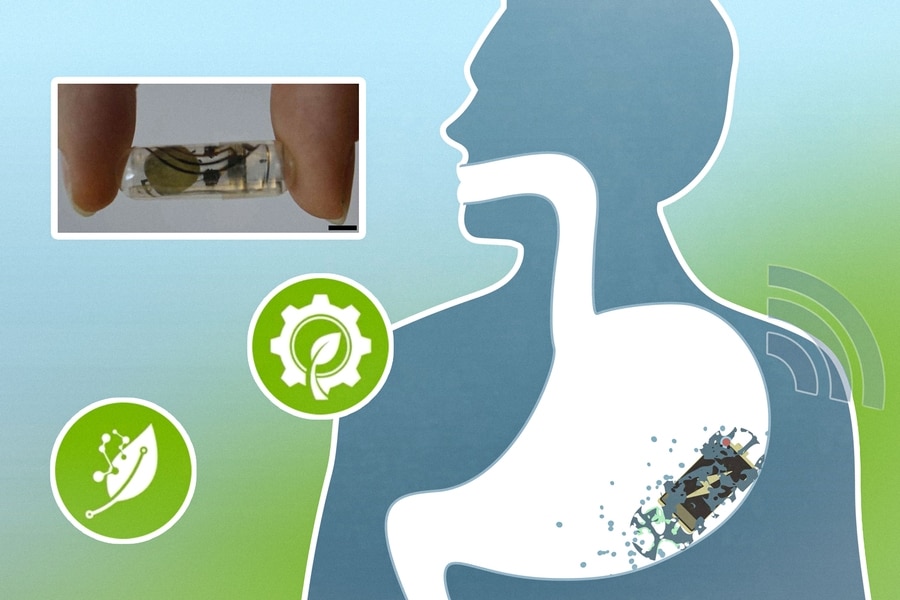
MIT developed batteries for ingestible medical devices. (Image Credit: MIT)

Swallowable devices have batteries with metals that aren’t safe for the body if the protective coatings wear out while moving through the digestive system. MIT researchers recently developed a battery that can power ingestible medical devices before they break down in a GI tract. The 1.84 V battery powered an RFID and a capsule that electrically stimulates the stomach.

For the anode, MIT used magnesium, and molybdenum trioxide (MoO3) and activated carbon for the cathode. While discharging, magnesium oxidizes, releasing electrons that pass through an external circuit, powering the device. Ion transportation between the electrodes is done through a gelatin-based gel electrolyte with a biodegradable ionic liquid made from choline chloride and lactic acid.

The team chose materials that can break down and have body absorption qualities, making the battery bioresorbable. Cellulose nanofibrils (CNFs) were integrated as binders into the cathode, and a gel with gelatin and glycerol was used. It’s also coated in protective melted beeswax to ensure the battery doesn’t degrade earlier than expected in the stomach.

Two different battery formats were created. The first is a 7.5 mm-diameter disc, and the other is a 24 mm-long rectangular version. The smallest one fits inside a 000-size capsule. Extra space is available for other components plus a therapeutic payload, too.  
image
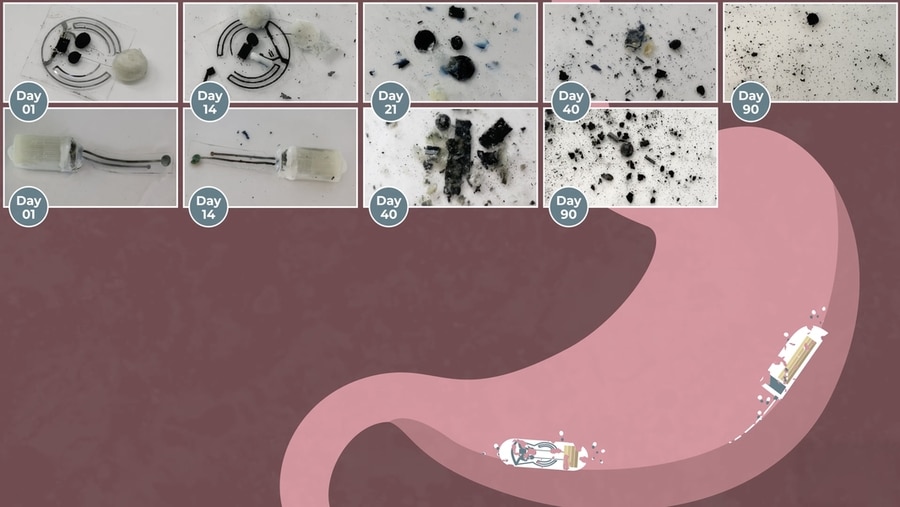
The team developed a 7.5 mm disc-shaped battery and a 24 mm long rectangular battery for various applications. (Image Credit: MIT)

Before testing, the batteries were immersed in a simulated gastric fluid (pH 1.2 at 37°C) to see how they worked. Each battery performed normally for three days before declining. Within a few weeks to months, they broke down. For accelerated degradation testing, they raised the temperature to 75°C. This caused the encapsulation layers to slowly separate, and, within two weeks, the electrodes decomposed. It took several months for the batteries to break down under accelerated conditions. 

Pigs were involved in the experiment. The researchers connected the rectangular battery to a capsule that provides electrical stimulation to the stomach lining. It was continually stimulated for up to three days. Twenty minutes of gastric electrical stimulation for twenty caused the animals’ ghrelin levels to rise by ~50%. Across the three swine models, the average increase was 36.3% ± 12.85%. X-ray imaging revealed that the capsules with the battery stayed in the stomach for three days without moving into the intestines. The batteries operated even though their voltage and capacity declined.  

The disc-shaped battery was used in another experiment to power an RFID tag that sends data about where the capsule is inside the GI tract. This system transmitted signals over distances of up to 1.5 meters, extending the earlier RFID tags’ communication range.

However, the entire system isn’t fully bioresorbable. For instance, the electrical-stimulation capsule has a non-bioresorbable PCB, which should pass through the GI tract and be excreted. The researchers are now planning a clinical trial of the SAFARI medication-adherence system, which they expect to start in two years.

Have a story tip? Message me here at element14.

  • Sign in to reply
element14 Community

element14 is the first online community specifically for engineers. Connect with your peers and get expert answers to your questions.

  • Members
  • Learn
  • Technologies
  • Challenges & Projects
  • Products
  • Store
  • About Us
  • Feedback & Support
  • FAQs
  • Terms of Use
  • Privacy Policy
  • Legal and Copyright Notices
  • Sitemap
  • Cookies

An Avnet Company © 2026 Premier Farnell Limited. All Rights Reserved.

Premier Farnell Ltd, registered in England and Wales (no 00876412), registered office: Farnell House, Forge Lane, Leeds LS12 2NE.

Follow element14

  • X
  • Facebook
  • linkedin
  • YouTube