element14 Community
element14 Community
    Register Log In
  • Site
  • Search
  • Log In Register
  • Community Hub
    Community Hub
    • What's New on element14
    • Feedback and Support
    • Benefits of Membership
    • Personal Blogs
    • Members Area
    • Achievement Levels
  • Learn
    Learn
    • Ask an Expert
    • eBooks
    • element14 presents
    • Learning Center
    • Tech Spotlight
    • STEM Academy
    • Webinars, Training and Events
    • Learning Groups
  • Technologies
    Technologies
    • 3D Printing
    • FPGA
    • Industrial Automation
    • Internet of Things
    • Power & Energy
    • Sensors
    • Technology Groups
  • Challenges & Projects
    Challenges & Projects
    • Design Challenges
    • element14 presents Projects
    • Project14
    • Arduino Projects
    • Raspberry Pi Projects
    • Project Groups
  • Products
    Products
    • Arduino
    • Avnet & Tria Boards Community
    • Dev Tools
    • Manufacturers
    • Multicomp Pro
    • Product Groups
    • Raspberry Pi
    • RoadTests & Reviews
  • About Us
    About the element14 Community
  • Store
    Store
    • Visit Your Store
    • Choose another store...
      • Europe
      •  Austria (German)
      •  Belgium (Dutch, French)
      •  Bulgaria (Bulgarian)
      •  Czech Republic (Czech)
      •  Denmark (Danish)
      •  Estonia (Estonian)
      •  Finland (Finnish)
      •  France (French)
      •  Germany (German)
      •  Hungary (Hungarian)
      •  Ireland
      •  Israel
      •  Italy (Italian)
      •  Latvia (Latvian)
      •  
      •  Lithuania (Lithuanian)
      •  Netherlands (Dutch)
      •  Norway (Norwegian)
      •  Poland (Polish)
      •  Portugal (Portuguese)
      •  Romania (Romanian)
      •  Russia (Russian)
      •  Slovakia (Slovak)
      •  Slovenia (Slovenian)
      •  Spain (Spanish)
      •  Sweden (Swedish)
      •  Switzerland(German, French)
      •  Turkey (Turkish)
      •  United Kingdom
      • Asia Pacific
      •  Australia
      •  China
      •  Hong Kong
      •  India
      •  Japan
      •  Korea (Korean)
      •  Malaysia
      •  New Zealand
      •  Philippines
      •  Singapore
      •  Taiwan
      •  Thailand (Thai)
      •  Vietnam
      • Americas
      •  Brazil (Portuguese)
      •  Canada
      •  Mexico (Spanish)
      •  United States
      Can't find the country/region you're looking for? Visit our export site or find a local distributor.
  • Translate
  • Profile
  • Settings
Power & Energy
  • Technologies
  • More
Power & Energy
Blog NASA Plans to Launch a Nuclear Reactor in Space
  • Blog
  • Forum
  • Quiz
  • Documents
  • Polls
  • Events
  • Mentions
  • Sub-Groups
  • Tags
  • More
  • Cancel
  • New
  • Share
  • More
  • Cancel
Toptech-Voices
Group Actions
  • Group RSS
  • More
  • Cancel
Engagement
  • Author Author: Catwell
  • Date Created: 4 Sep 2026 10:24 PM Date Created
  • Views 28 views
  • Likes 3 likes
  • Comments 1 comment
  • alternative energy
  • reactor
  • nasa
  • space
  • power
  • energy
  • innovation
Related
Recommended

NASA Plans to Launch a Nuclear Reactor in Space

Catwell
Catwell
4 Sep 2026

image

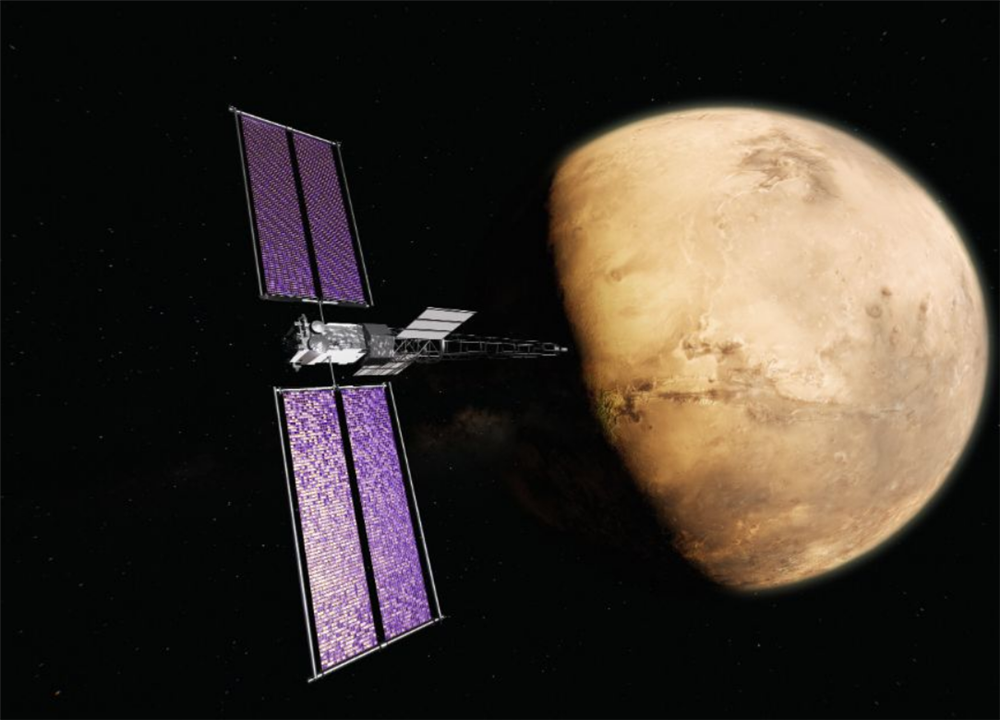
Artist’s concept of the Space Reactor-1 Freedom spacecraft flying past Mars. (Image Credit: NASA)

Solar power can be limited for deep space travel. When spacecraft move farther away from the sun, the sunlight reaching their solar panel weakens. To address that issue, NASA is turning to a nuclear reactor for its deep space propulsion test. And that starts with the Space Reactor-1 Freedom spacecraft, expected to launch in late 2028. This mission will also carry three small SkyFall helicopters to survey the terrain and find potential landing sites for crewed missions.  

Nuclear fission will produce power for the spacecraft. The onboard reactor uses High-Assay Low-Enriched Uranium (HALEU) as fuel, which undergoes fission. Heat is released before being turned into electricity through a closed Brayton cycle power conversion system. Overall, the system generates 20 kW of electricity. The Power and Propulsion element produces 48 kW of power for the systems and propulsion, which has a 12-kW Hall thruster.

Electric propulsion doesn’t need as much propellant as chemical propulsion because it expels propellant at higher velocities. While electric thrusters generate low thrust, they run for hundreds or thousands of hours, delivering sustained acceleration for deep space missions.
image
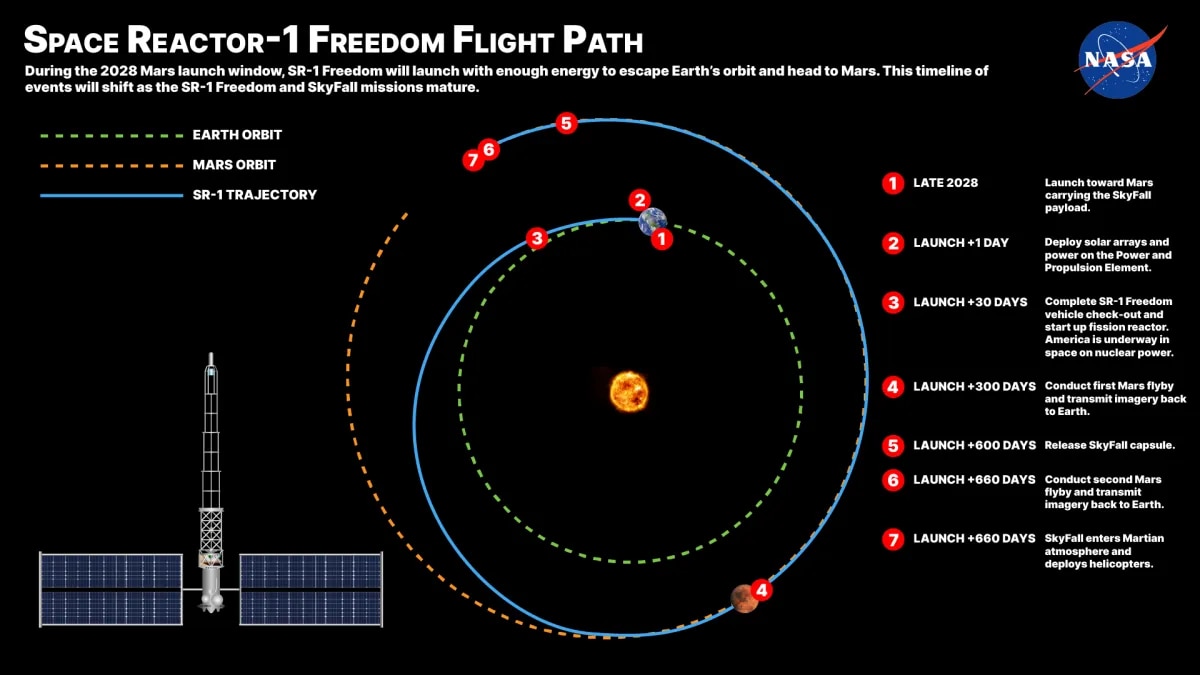
The flight path of Freedom’s journey to Mars. (Image Credit: NASA)

Set for a late 2028 launch, Freedom arrives at Mars in 2029. Once there, it will cruise by the planet. NASA can then test nuclear-electric propulsion in deep space without landing the spacecraft. Doing it this way reduces risks with using nuclear systems in space. Tests like these could help the space agency prepare for future nuclear-powered missions.

Additionally, the Space Reactor-1 Freedom will deliver the SkyFall payload. SkyFall enters the Mars atmosphere, deploying three Ingenuity-style helicopters in mid-air after the parachute and braking rockets slow down the descent. Afterward, the helicopters fly away and land on the surface. With ground-penetrating radar and imaging equipment aboard, the helicopters are expected to help find subsurface ice. It’s also designed to measure wind speed, air temperature, and wind direction.

This isn’t the first time nuclear technology is being used in space. In 1965, the US Air Force and the Atomic Energy Commission launched SNAP-10A, the first nuclear reactor in space. It only lasted 43 days and generated over 500 watts of power.

NASA is also developing a nuclear-fission reactor to provide power on the moon. The system could produce 40 kW of power on lunar nights. Freedom serves as a test mission for building nuclear propulsion experience.

Have a story tip? Message me here at element14.

  • Sign in to reply
  • Qbit
    Qbit 2 hours ago

    Great progress since 1965, excited to see it in the void.

    • Cancel
    • Vote Up 0 Vote Down
    • Sign in to reply
    • More
    • Cancel
element14 Community

element14 is the first online community specifically for engineers. Connect with your peers and get expert answers to your questions.

  • Members
  • Learn
  • Technologies
  • Challenges & Projects
  • Products
  • Store
  • About Us
  • Feedback & Support
  • FAQs
  • Terms of Use
  • Privacy Policy
  • Legal and Copyright Notices
  • Sitemap
  • Cookies

An Avnet Company © 2026 Premier Farnell Limited. All Rights Reserved.

Premier Farnell Ltd, registered in England and Wales (no 00876412), registered office: Farnell House, Forge Lane, Leeds LS12 2NE.

Follow element14

  • X
  • Facebook
  • linkedin
  • YouTube