


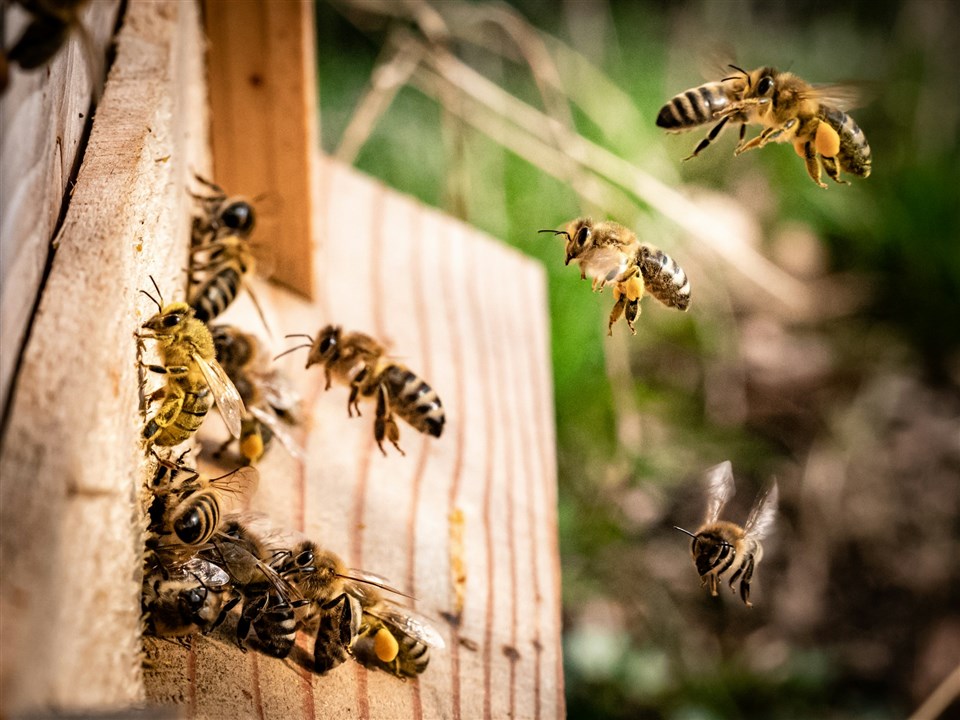
Honeybees entering a beehive. (Image Credit: Kai Wenzel/Unsplash)
Healthy bee colonies are essential to produce honey. However, it’s becoming more difficult to keep bees alive. Luckily, AI is helping with that issue. Nate’s Hive, which manages ~6 billion bees in the US, has its own system that beekeepers use to detect threats and monitor colony health. It also improved honey production.
A parasite called the Varroa mite feeds on bees, transmitting harmful viruses. It can take weeks for an infestation to destroy a colony. Since Nate’s Hives moves colonies across the country for crop pollination, issues can arise between inspections. This makes it important to detect infestations early.
That’s where AI comes in. Nate’s Hive has been testing an AI-powered acoustic tool using a smartphone to listen for internal beehive activity. Different buzzing patterns are made by honeybees based on the colony’s condition. If a queen bee is healthy, an organized hive is better maintained, which creates a steady buzzing noise. During a queen bee’s illness or disappearance, irregular sounds may be produced from the colony as it becomes disorganized. AI can analyze changes in those recordings, which helps beekeepers determine if there’s something wrong before it gets worse.
The company also tests robotic hives for monitoring Varroa mite populations. One system includes four bee colonies. Once a week, it will remove and capture images of every frame. Analysis is done on all the images to identify mites on the bees.
Usually, beekeepers collect samples of 300 bees, shaking off mites before estimating the population. The system introduces another monitoring technique that notifies beekeepers about growing mite populations. This allows the beekeepers to take action when necessary. Instead of replacing all the hives, the company hopes to place one robotic system in each apiary yard to monitor conditions across all colonies.
Nate’s Hive goes one step further by using digital recordkeeping. QR codes help beekeepers track hive health over time. With this data, breeders choose a queen from colonies with greater resilience, and that can make more honey.
AI-assisted satellite imagery is being considered to help with hive placement. Identifying crops that produce nectar and determining when they bloom could enable AI to help beekeepers find productive locations and identify environmental risks. Even then, these technologies won’t replace humans. Beekeepers must interpret the data and decide how each colony should be managed.
Have a story tip? Message me here at element14.