element14 Community
element14 Community
    Register Log In
  • Site
  • Search
  • Log In Register
  • Community Hub
    Community Hub
    • What's New on element14
    • Feedback and Support
    • Benefits of Membership
    • Personal Blogs
    • Members Area
    • Achievement Levels
  • Learn
    Learn
    • Ask an Expert
    • eBooks
    • element14 presents
    • Learning Center
    • Tech Spotlight
    • STEM Academy
    • Webinars, Training and Events
    • Learning Groups
  • Technologies
    Technologies
    • 3D Printing
    • FPGA
    • Industrial Automation
    • Internet of Things
    • Power & Energy
    • Sensors
    • Technology Groups
  • Challenges & Projects
    Challenges & Projects
    • Design Challenges
    • element14 presents Projects
    • Project14
    • Arduino Projects
    • Raspberry Pi Projects
    • Project Groups
  • Products
    Products
    • Arduino
    • Avnet & Tria Boards Community
    • Dev Tools
    • Manufacturers
    • Multicomp Pro
    • Product Groups
    • Raspberry Pi
    • RoadTests & Reviews
  • About Us
  • Store
    Store
    • Visit Your Store
    • Choose another store...
      • Europe
      •  Austria (German)
      •  Belgium (Dutch, French)
      •  Bulgaria (Bulgarian)
      •  Czech Republic (Czech)
      •  Denmark (Danish)
      •  Estonia (Estonian)
      •  Finland (Finnish)
      •  France (French)
      •  Germany (German)
      •  Hungary (Hungarian)
      •  Ireland
      •  Israel
      •  Italy (Italian)
      •  Latvia (Latvian)
      •  
      •  Lithuania (Lithuanian)
      •  Netherlands (Dutch)
      •  Norway (Norwegian)
      •  Poland (Polish)
      •  Portugal (Portuguese)
      •  Romania (Romanian)
      •  Russia (Russian)
      •  Slovakia (Slovak)
      •  Slovenia (Slovenian)
      •  Spain (Spanish)
      •  Sweden (Swedish)
      •  Switzerland(German, French)
      •  Turkey (Turkish)
      •  United Kingdom
      • Asia Pacific
      •  Australia
      •  China
      •  Hong Kong
      •  India
      • Japan
      •  Korea (Korean)
      •  Malaysia
      •  New Zealand
      •  Philippines
      •  Singapore
      •  Taiwan
      •  Thailand (Thai)
      • Vietnam
      • Americas
      •  Brazil (Portuguese)
      •  Canada
      •  Mexico (Spanish)
      •  United States
      Can't find the country/region you're looking for? Visit our export site or find a local distributor.
  • Translate
  • Profile
  • Settings
Power & Energy
  • Technologies
  • More
Power & Energy
Blog New Research Unveils Previously Unknown Electrical Properties In Graphene And New Material Discoveries
  • Blog
  • Forum
  • Quiz
  • Documents
  • Polls
  • Events
  • Mentions
  • Sub-Groups
  • Tags
  • More
  • Cancel
  • New
  • Share
  • More
  • Cancel
Group Actions
  • Group RSS
  • More
  • Cancel
Engagement
  • Author Author: CharlesGantt
  • Date Created: 5 Nov 2019 10:43 AM Date Created
  • Views 1023 views
  • Likes 7 likes
  • Comments 3 comments
  • superlattice
  • new discovery
  • graphene
  • material science
  • msl
Related
Recommended

New Research Unveils Previously Unknown Electrical Properties In Graphene And New Material Discoveries

CharlesGantt
CharlesGantt
5 Nov 2019

Graphene is one of those super-materials that continues to surprise scientists worldwide with its level of usefulness and relatively unique characteristics. It seems like new discoveries with the material are being made every month, and it’s quickly becoming clear that one-day graphene will be heralded as one of the most important materials humans have ever discovered. It has already proven key in the advancement of electronics, batteries, and pigments among other things. Just last year researchers discovered that if you layer two sheets of graphene together, and rotate one of them by just 1.1-degrees, a semiconductor is formed, now researchers in Switzerland have managed to build on that discovery, and have created entirely new materials using similar techniques.


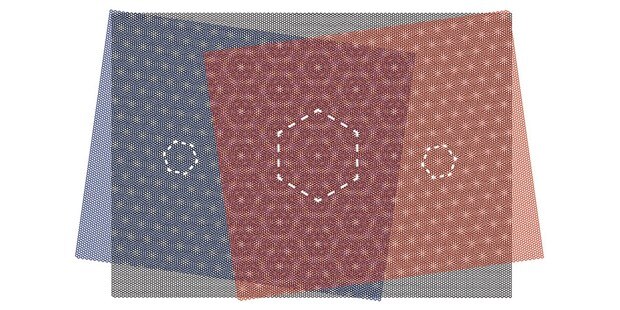
Scientist from the University of Basel in Switzerland have released a new paper detailing how combining layers of graphene boron nitride together create entirely new materials that were not previously discovered. These new materials can be used to artificially produce new electronic material properties. This is achieved by placing a hexagonally arranged layer of graphene between two layers of boron nitride forming a sort of graphene sandwich. The layers are then rotated slightly in relation to each other forming honeycomb patterns of differing sizes, otherwise known as a moire pattern.  These patterns result in new electrical properties that could lead to advancements in everything from energy production and storage, all the way to new nano-scale robots that could be used to deliver potent doses of drugs directly to cancer tumors.
 

image

A graphene layer (black) of hexagonally arranged carbon atoms is placed between two layers of boron nitride atoms, which are also arranged hexagonally with a slightly different size. The overlap creates honeycomb patterns in various sizes. (Image: Swiss Nanoscience Institute, University of Basel).


“To put it simply, the atomic patterns determine the behavior of electrons in a material, and we are combining different naturally occurring patterns to create new synthetic materials,” Baumgartner, the project’s supervisor, said in a university news release. “Now we have discovered effects in these tailor-made electronic devices that are consistent with a three-layer superstructure.”


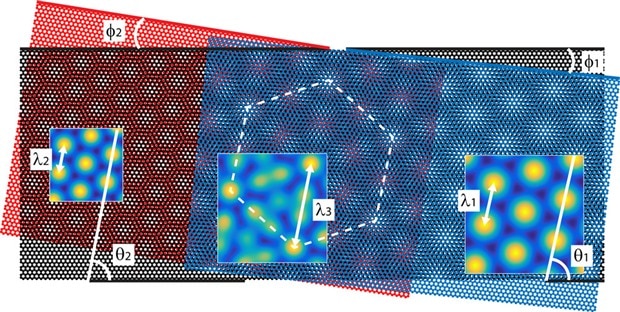
By rotating the layers of graphene and boron nitride in opposite directions, two structures called “superlattices” were formed. More specifically, a superlattice was formed between the bottom layer of boron nitride and the middle layer of graphene, and another superlattice was formed between the top boron nitride layer and the sandwiched graphene layer.


“So far, MSL (moiré superlattices) engineering in graphene has concentrated mostly on MSLs based on two relevant layers (2L-MSLs). However, fully encapsulated graphene necessarily forms two interfaces, namely at the top and at the bottom, which can result in a much richer and more flexible tailoring of the graphene band structure. Because of the 1.8% larger lattice constant of hBN, the largest possible moiré period that can be achieved in graphene/hBN systems is limited to about 14 nm, which occurs when the two layers are fully aligned. This situation changes when both hBN layers are aligned to the graphene layer. Here, we report the observation of a new MSL which can be understood by the overlay of two 2L-MSLs that form between the graphene monolayer and the top and bottom hBN layers of the encapsulation stack, respectively.
 

image

Illustration of three different MSLs formed in an hBN/graphene/hBN heterostructure. Blue, black, and red hexagonal lattices represent top hBN, graphene, and bottom hBN lattices, respectively. ϕ1 (ϕ2) is the twist angle between top (bottom) hBN and graphene. θ1 (θ2) indicates the orientation of the corresponding MSL with respect to graphene. The resulting moiré periods are indicated with λ1,2,3. The 3L-MSL (middle part) has a larger period than both 2L-MSLs (left and right parts). Insets: moiré potential calculations. (Image Credit: Swiss Nanoscience Institute, University of Basel)


“We fabricated fully encapsulated graphene devices with both the top and the bottom hBN layers aligned to the graphene using a dry-transfer method.  We estimate an alignment precision of ∼1°. A global metallic bottom gate is used to tune the charge carrier density, and one-dimensional Cr/Au edge contacts are used to contact the graphene,” the paper’s authors wrote.


At the moment the research is still too young to draw any conclusions as to what the impact of this discovery will be, but I could see the potential for this technology to advance graphene-based microprocessors, sensor arrays, and even energy storage. As I mentioned at the top of this article, this discovery could have major impacts on nano-robotics as well as medicine, by helping further along the miniaturization of electronics. I am curious about your thoughts on how this new discovery could be utilized, so leave a comment below with your ideas!


Source: https://www.unibas.ch/en/News-Events/News/Uni-Research/Super-superlattices---The-moir--patterns-of-three-layers-change-t…
Read The Paper Here: https://pubs.acs.org/doi/10.1021/acs.nanolett.8b05061

  • Sign in to reply

Top Comments

  • jw0752
    jw0752 over 6 years ago +2
    Very interesting research. Thanks for posting. John
  • dubbie
    dubbie over 6 years ago +1
    I understood the moire patterns part, but not the new materials resulting part. Still, it sounds as if this is going to be useful. Dubbie
  • lcargill
    lcargill over 6 years ago +1
    Very groovy! These are micro storage units much like honeycomb! They open and close. They will be terrifically useful in intergalactic space travel and delivering molecules to specific sites in the body…
Parents
  • lcargill
    lcargill over 6 years ago

    Very groovy! These are micro storage units much like honeycomb! They open and close. They will be terrifically useful in intergalactic space travel and delivering molecules to specific sites in the body. Imagine loading a unit with exosomes to be time released in the brain. Right now we can get 100 Billion exosomes in 5mL or 15 Billion in 1 mL. If you want to talk about that contact me on FB.


    You know a group of crazy surgeons opened a woman’s blood brain barrier for 36 hours recently to try to remove plaque from an Alzheimer’s patient’s brain. That won’t work, ultimately, because it will just continue to secrete amyloid. But, other strategies to stop inflammation just might. Pretty crazy stuff! Looking forward to your medical applications.


    Dr. Lucia Cargill

    Santa Rosa CA

    • Cancel
    • Vote Up +1 Vote Down
    • Sign in to reply
    • More
    • Cancel
Comment
  • lcargill
    lcargill over 6 years ago

    Very groovy! These are micro storage units much like honeycomb! They open and close. They will be terrifically useful in intergalactic space travel and delivering molecules to specific sites in the body. Imagine loading a unit with exosomes to be time released in the brain. Right now we can get 100 Billion exosomes in 5mL or 15 Billion in 1 mL. If you want to talk about that contact me on FB.


    You know a group of crazy surgeons opened a woman’s blood brain barrier for 36 hours recently to try to remove plaque from an Alzheimer’s patient’s brain. That won’t work, ultimately, because it will just continue to secrete amyloid. But, other strategies to stop inflammation just might. Pretty crazy stuff! Looking forward to your medical applications.


    Dr. Lucia Cargill

    Santa Rosa CA

    • Cancel
    • Vote Up +1 Vote Down
    • Sign in to reply
    • More
    • Cancel
Children
No Data
element14 Community

element14 is the first online community specifically for engineers. Connect with your peers and get expert answers to your questions.

  • Members
  • Learn
  • Technologies
  • Challenges & Projects
  • Products
  • Store
  • About Us
  • Feedback & Support
  • FAQs
  • Terms of Use
  • Privacy Policy
  • Legal and Copyright Notices
  • Sitemap
  • Cookies

An Avnet Company © 2026 Premier Farnell Limited. All Rights Reserved.

Premier Farnell Ltd, registered in England and Wales (no 00876412), registered office: Farnell House, Forge Lane, Leeds LS12 2NE.

ICP 备案号 10220084.

Follow element14

  • X
  • Facebook
  • linkedin
  • YouTube