


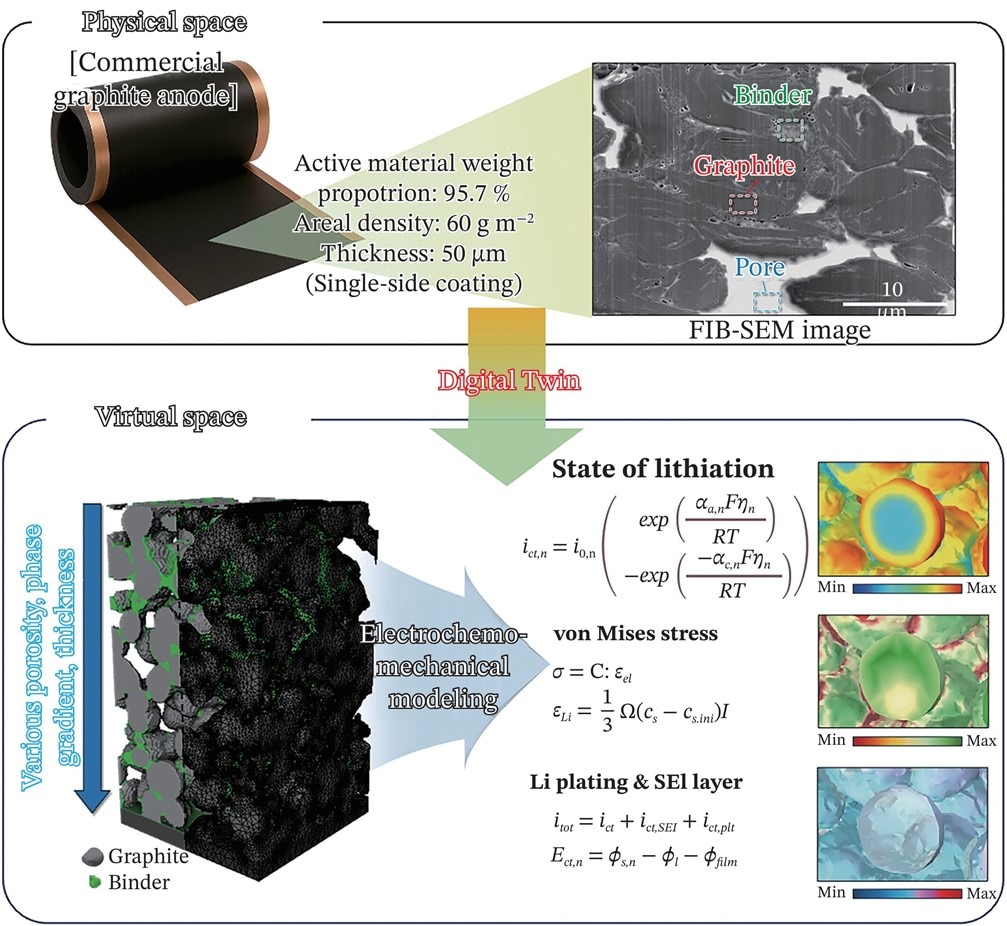
Diagram of the team’s research. (Image Credit: Kang et al., InfoMat 2026. Creative Commons Attribution License)
Fast charging cuts down on lithium-ion batteries charging time. However, transporting the lithium into electrodes at high rates leads to quicker degradation. Scientists at the Korean Advanced Institute of Science and Technology (KAIST) developed a 3D digital twin of a graphite battery anode to find out why that happens via tiny variations.
The team investigated the effects of fast charging by reconstructing a graphite anode microstructure using experimental data from a commercial electrode. This electrode had 95.7 wt% graphite and 4.3 wt% binder (made of styrene-butadiene rubber (SBR) and carboxymethyl cellulose (CMC)). They used focused ion beam-scanning electron microscopy (FIB-SEM) for electrode microstructure characterization. Graphite particles had an average diameter of 10μm with a 5μm deviation.
The researchers relied on those measurements to create virtual 3D electrodes. Simulated domains were 50 x 50 x 50μm3 or 50 x 50 x 83μm3, matching the 50μm and 83μm electrode thickness. They tested two porosities, 35% and 45%, and changed how the binder spread throughout the electrode. The mild configuration had the binder distributed evenly. In the steep configuration, the binder fraction decreased from the separator side toward the current collector.
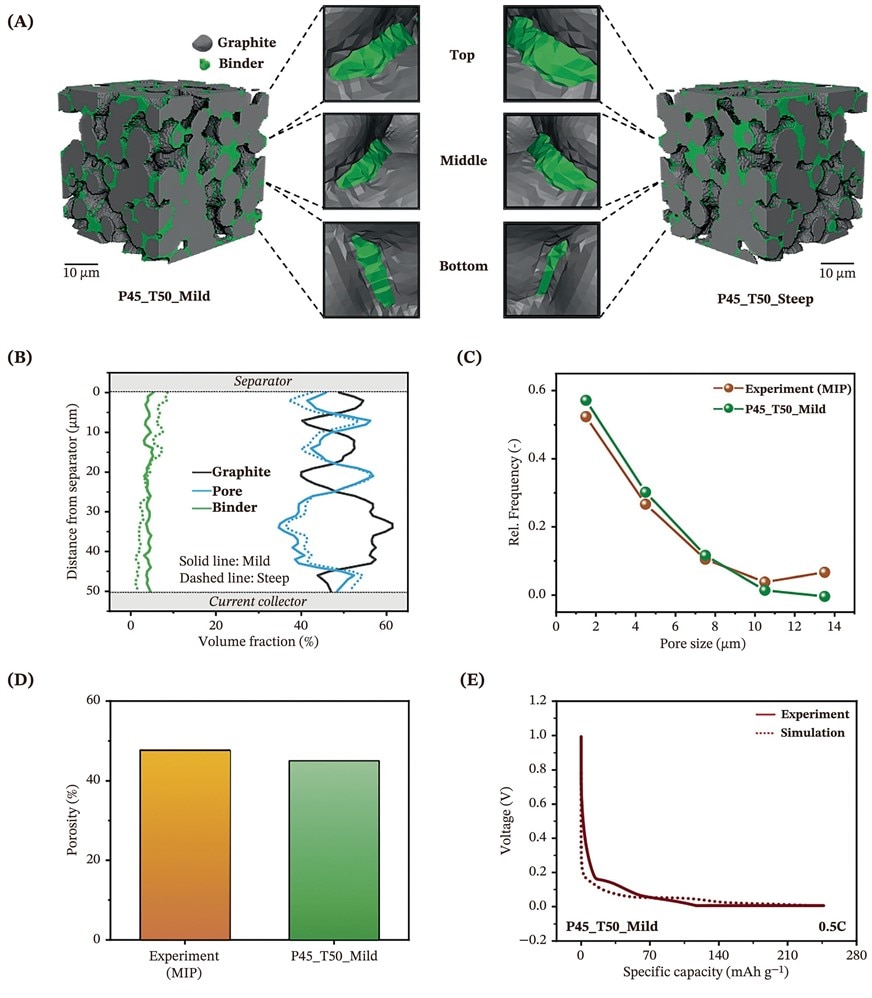
Model configuration and validation. Comparing the electrode structure and voltage-capacity profile with experimental data. (Image Credit: Kang et al., InfoMat 2026. Creative Commons Attribution License)
The researchers connected the digital twin to experimental battery data before using the virtual electrodes to investigate failure. They compared the reconstructed electrode’s pore-size distribution with the real electrode measurements. The model’s porosity differed from the experimentally measured value by less than 3%, while the simulated pore-size distribution closely resembled the experimental measurement. Additionally, they checked if the baseline model could reproduce the battery’s charging behavior.
Tests were conducted using 0.5C, 1C, 2C, and 3C charging conditions, and the model produced voltage-capacity profiles that closely matched the real battery’s measurements. The SEI thickness was measured using transmission electron microscopy and energy-dispersive spectroscopy. It used an experimental value of 150nm and 157nm. These show that the digital twin modeled the real electrode before different microstructures were tested.
The digital twin simulated fast charging at 5C, tracking the lithium transport in the electrode. It even considered lithium plating, mechanical stress, and the solid-electrolyte interphase (SEI) formation. From there, the team studied the electrode’s behavior and where degradation became concentrated.
Simulations revealed that the materials’ spatial distribution through the electrode could affect how uniformly it reacted. Steep binder gradients formed electrolyte concentration differences and disrupted lithium-ion flux throughout the electrode. As a result, the lithium was unevenly distributed, and some regions became more lithiated than others.
Transport imbalances like these affected degradation. In the lower-porosity 50-μm electrode, the steep gradient increased localized lithium plating. Meanwhile, the mild configuration had more extensive and uniform SEI formation. Close to the current collector, simulations showed around 10% more lithium plating in the steep-gradient configuration than the mild-gradient configuration. The mild configuration produced roughly 400μm3 more SEI.
The pores’ arrangement in the electrode affected how it responded to mechanical stress. Within the modeled range, higher porosity improved ionic transport and reduced the electrode’s sensitivity to binder distribution differences. Pore-rich areas functioned like mechanical buffers. Meanwhile, regions lacking porosity had greater local stress. Electrodes then developed stress hotspots, especially if regions underwent similar lithiation levels.
When the electrode thickened, the effects were more pronounced. Changing the binder distribution minimally affected the capacity (<4% deviation) within the 50-μm electrode. However, the 83μm electrode experienced stronger effects from heterogeneity. In this case, capacity differences reached up to 18% between the mild and steep configurations. Vulnerability was higher in the thicker electrode due to transport limitations across its greater depth.
With these findings, scientists could design electrode architectures with more balanced through-thickness transport and degradation behavior for fast charging.
Have a story tip? Message me here at element14.
