


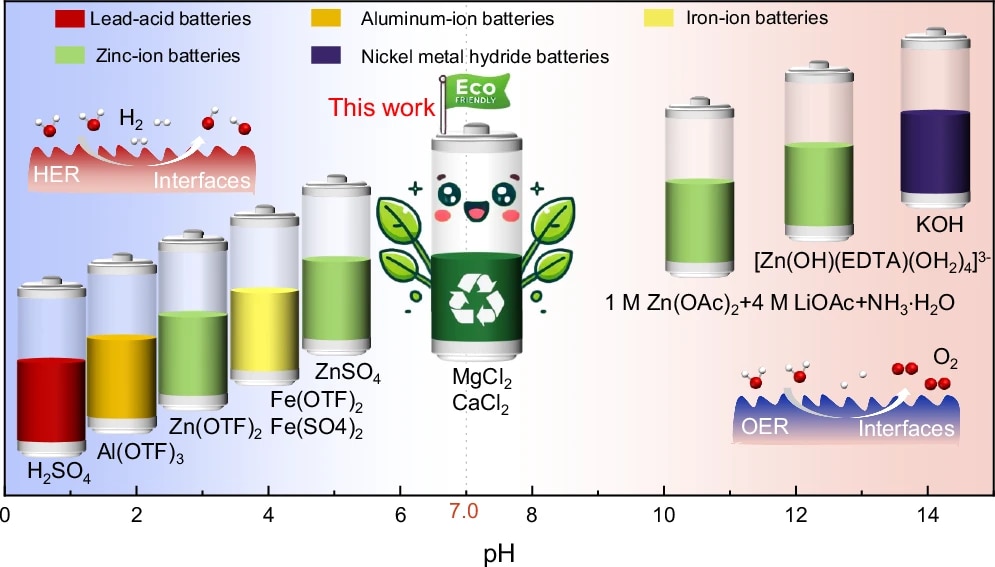
Comparing the neutral pH 7 with other battery technologies. (Image Credit: nature)
Researchers at the City University of Hong Kong have developed an aqueous battery with a pH 7 electrolyte. The battery system is built with water-based materials and can be used for long-term performance. It can also be disposed of it in the environment without special recycling equipment, making it safer than batteries with toxic chemicals.
The team built the battery with covalent organic polymer (COP)-based electrode materials. More specifically, it uses a hexaketone-tetraaminodibenzo-p-dioxide COP as the main electrode. This organic polymer is paired with a water-based electrolyte containing magnesium (Mg2+) and calcium (Ca2+) ions. By integrating and using a neutral aqueous electrolyte, the battery system is less likely to be subject to corrosion and instability that occurs in alkaline or acidic batteries.
The water battery works by reversing ion movement inside the aqueous electrolyte. While it’s running, both the Mg2+ and Ca2+ ions move between the polymer electrodes. By transferring ions this way, a charge balance forms in the battery, enabling an external circuit to drive electron flow that produces electricity. Water-based electrolytes help ensure seamless ion transport while limiting side reactions to make the system more stable.
To analyze the electrode structure’s performance, the researchers created three COP-based battery systems: Hex-TAPZ-COP, Hex-DABZ-COP, and Hex-TADD-COP. They tested all three designs under the same pH 7 aqueous electrolyte conditions, comparing electrochemical stability and energy storage. After testing, the Hex-TADD-COP version came out on top.

Electrochemical performance of the Hex-TADD-COP negative electrode. (Image Credit: nature)
During experiments, the team showed that the Hex-TADD-COP battery has a cell voltage of roughly 2.2V. Additionally, the system can deliver a capacity of 112.8 mAh g-1 and an energy density of 48.3 Wh kg-1. Although the system isn’t designed to compete with high-energy lithium-ion batteries, it’s still practical for low-power applications. More notably, the battery has a high-performance cycling stability, lasting 120,000 charge-discharge cycles without degrading.
The paper also says the battery performs well at high current densities that reach up to 20 A g-1. That suggests it can withstand rapid charge-discharge conditions without sacrificing performance.
Have a story tip? Message me here at element14.
