


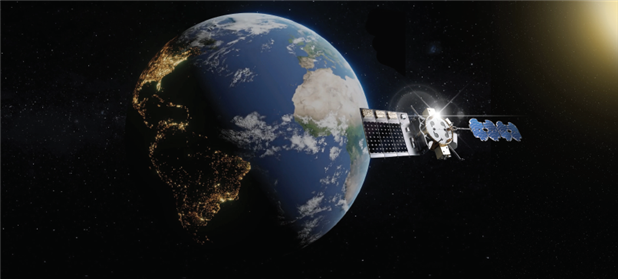
The U.S. Air Force Research Laboratory announced that its SSPIDR project received the Helios component for the Arachne spacecraft. (Image Credit: U.S. Air Force Research Laboratory)
Some old news, but I still like the concept. Worth talking about. It’s some serious science fiction come to life.
The Air Force Research Laboratory (AFRL) announced that its Space Solar Power Incremental Demonstrations and Research (SSPIDR) project received a component named Helios for its Arachne spacecraft from Northrop Grumman. Arachne is expected to launch in 2024. Helios collects power for other spacecraft, making it an essential research component and proof of concept for other ideas formed by NASA about flying to the moon and Mars.
Helios is a commoditized spacecraft bus called ESPAStar constructed from an Evolved Expendable Launch Vehicle (EEKV) Secondary Payload Adaptor (ESPA) ring. It also serves as Arachne’s bus, which houses the components needed to manage the power, thermal, communications, and spacecraft pointing/orientation control systems across the spacecraft. The bus holds the payload in place while it orbits and is where space solar beaming experiments are conducted.
“Acceptance of the Helios spacecraft bus from Northrop Grumman is a key milestone in the development of the Arachne spaceflight experiment,” said Kevin Bryant, Arachne program manager. “The Helios bus is the third vehicle in the Long Duration Propulsive ESPA product line, a technology transition effort made possible by EAGLE, an AFRL space experiment launched in 2018 to demonstrate assured access to space,” he continued.
As a commoditized bus, “Helios provides a known platform from which to demonstrate space-based power beaming technologies and concepts,” Bryant said. Instead of spending time and money developing, building, and testing the component, AFRL experts can focus on developing the science to demonstrate solar power beaming.
“The idea to use the ESPA ring as the main structure of a spacecraft started with AFRL’s [Demonstration and Science Experiments (DSX)] program and eventually led to AFRL’s EAGLE program. As a result of EAGLE, the ESPA platform has successfully been transitioned to industry and can be purchased as a commoditized spacecraft. This essentially allows AFRL to buy a spacecraft off the shelf and eliminate it from the critical path of our flight programs, allowing AFRL to concentrate our time, money, and efforts in bringing cutting-edge technologies to our warfighters,” said Kyle Gleichmann, Arachne chief engineer.
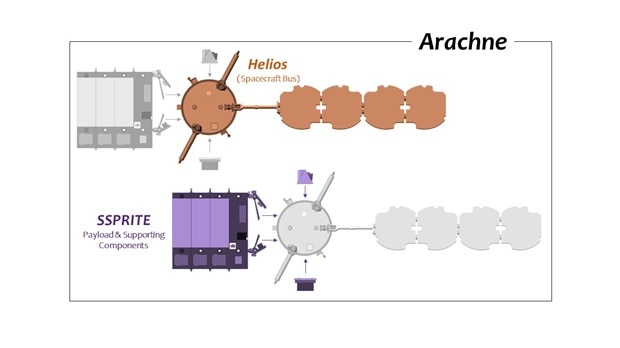
Arachne contains Helios and the Space Solar Power Radio Frequency Integrated Transmission Experiment (SSPRITE). The component is responsible for conducting Arachne’s power beaming mission. Meanwhile, Helios hosts and provides power to SSPRITE. (Image Credit: U.S. Air Force Research Laboratory)
Helios has six ports that can host payloads. However, it’s only expected to host one, which is the Space Solar Power Radio Frequency Integrated Transmission Experiment (SSPRITE). Currently being designed and built by Northrop Grumman, SSPRITE is expected to use four ports and interface with Helios to receive power for its subsystems.
The next step is to test and figure out which software, electrical wiring, and mechanical components are required to interface with the bus and construct a working spacecraft. Doing so allows AFRL’s I&T team to start making adjustments to the bus to support the mission.
“Some of the known modifications the team will make include upgrading the communications system, enhancing its ability to operate in Low Earth Orbit,” said Gleichmann. “This will increase our ability to send commands to the spacecraft and receive routine telemetry from the vehicle; uploading flight software used on previous flight experiments, and optimizing the power and communication interfaces between Helios and the primary payload, SSPRITE.”
Arachne is expected to launch in 2024, along with Helios and the SSPRITE payload. At that point, the team plans on demonstrating the “sandwich tiles” and other systems that convert solar energy to radio frequency power.
Have a story tip? Message me at: http://twitter.com/Cabe_Atwell