


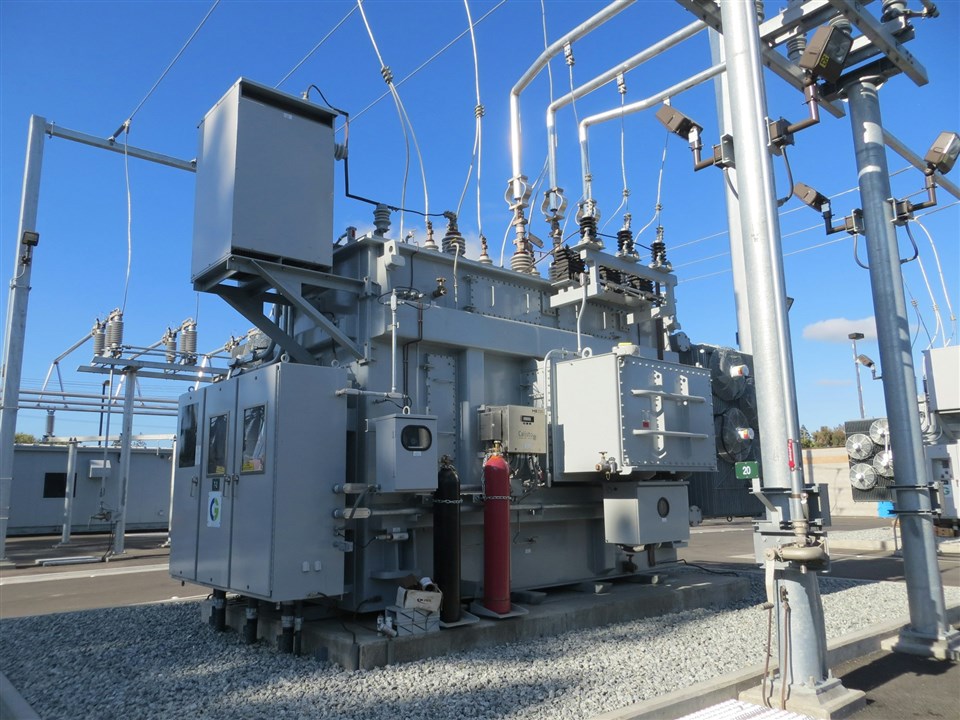
Power transformer. (Image Credit: American Public Power Association/Unsplash)
America is ambitious about a cleaner and more reliable power grid. However, it’s currently relying on old tech: 400-ton power transformers from the 1800s. These metal structures are as tall as a two-story house and convert high voltage into lower voltages, which is safer for business and home use.
It’s apparent the United States will need more transformers if it wants to expand solar or wind farms, deploy gas or nuclear plants, or have sufficient electricity for AI data centers. But there aren’t a whole lot of transformers left. And many distribution transformers in service (roughly 55%) are over 33 years old and have surpassed their expected service lives. It takes 2.5 to 3 years to build and deliver large power transformers and generator step-up units. Some higher-capacity ones may take longer.
Demand for new transformers has skyrocketed. Between 2019 and 2025, the need for generator step-up transformers increased by 274%. Meanwhile, demand for distribution transformers that lower voltages near customers rose by 30 to 80%, depending on specifications. Power transformers have become more expensive, too, with prices rising by 77% since 2019, and distribution-transformer costs rose by 78% to 95%.
Why does it take so long to build a transformer? Unlike household appliances, large transformers aren’t mass-produced. Plus, these need to be custom-engineered for the voltage, load, and location they will be deployed in. If a unit no longer works during a storm or heat wave, utilities can’t grab a replacement from a warehouse.
A narrow supply chain also contributes to this. Grain-oriented electrical steel (GOES), an important component, is processed in a way in which the magnetic crystals align in one direction. With this alignment, magnetic fields can pass through the transformer core without losing much energy. This is necessary when moving large amounts of electricity.
Not many specialized mills around the world produce GOES. America only has one of these facilities. Copper is another limitation, as a transformer needs a lot of it for the windings, and rising demand has tightened supply.
According to the U.S. CISA, making transformer designs standard instead of customizing each one could solve the issue. Standardizing them may lead to more assembly-line production and allow power utilities to use emergency spare transformers. The DoE says “grid-enhancing technologies” like real-time sensors and routing software can also help. Grid operators relying on those tools would use transmission lines more fully. According to estimates, this may boost capacity by 15 to 20% while manufacturing new equipment.
In the long run, the U.S. needs more GOES production. It also requires additional copper processing and higher capacity for large transformers. Until that happens, the transformer shortage remains hidden behind delayed clean energy projects, higher costs, and a grid that’s less prepared for outages and storms.
Have a story tip? Message me here at element14.