


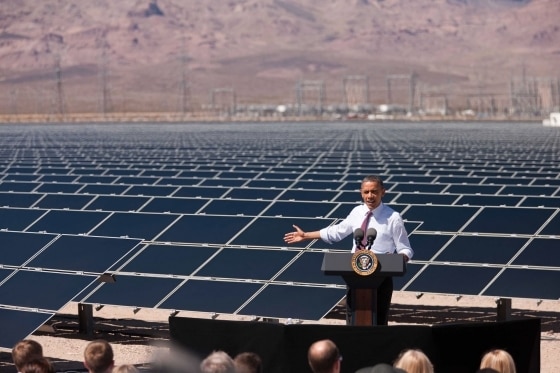
The White House announced its “New Initiative to Increase Solar Access for All Americans” initiative – a plan to make renewable energy more nationally accessible by providing low-income families with renewable energy solutions, making second mortgages for energy remodels easier to acquire and by creating 75,000 jobs in the energy sector. (image via Whitehouse.gov)
Is this another Solyndra like effort? As he’s nearing the end of his term, it seems President Barack Obama wants to go out with a bang. After legalizing same-sex marriage, the White House revealed its next play: an initiative to make solar energy more accessible in all 50 states.
The “New Initiative to Increase Solar Access for All Americans” promises to make solar energy solutions more affordable for lower- and middle-income families, while also increasing jobs and loosening restrictions on second mortgage stipulations. The first goal of the plan seeks to install 300 megawatts of renewable energy solutions into federally subsidized homes. A third of this will come from solar panels, while the other 200 megawatts will come from various sources of renewable energy – a way to begin decreasing US dependence on foreign oil.
The Solar Access plan intends to create 75,000 good paying jobs for low income and rural Americans. The Obama Administration also launched the Solar Ready Vet training program at 10 military bases, which prepares military veterans to enter into the renewable energy workforce upon completion of their service.
The new program will make renewable energy solutions more affordable for lower- and middle-income homeowners by making second mortgage restrictions more lenient. The White House said it would accomplish this by allowing homeowners to borrow up to $25,000 for energy efficient updates to their homes under the umbrella of a second mortgage, all the while providing lower interest rates.
The Solar Access proposal sounds promising. If low- and middle-income families can gain access to renewable energy, over time their utility costs would decrease, enabling them to invest in things like better education for their children. The proposition also gained logistical and financial support from private organizations and US states, totaling $520 million in pledges and promises to share the workload. Still, there are other considerations.
The return on investment for solar panels and other renewable energy sources can be up to 10 years. The ROI of solar panels specifically depends on the amount of sunshine in a particular region. Places like Seattle, for example, may not recoup an investment for 10 years, and would need to replace the panels every 25 to 30 years. With this, we cannot forget the immense failure of the Solyndra scandal – an $80 billion initiative in renewable energy that went belly up, leaving taxpayers feeling burned.
Thinking about the Solar Access initiative, however, takes viewing it from all angles. While it may not significantly decrease the cost of energy consumption, we must think about the potential decrease in the US Carbon Footprint. Currently, the US has one of the largest carbon outputs of any country. While consumer energy use is only a fraction of this number, any decrease in the burning of carbon fuel will help decrease and hopefully lessen the effects of climate change. Large-scale change always begins with smaller victories. Maybe this will be the match that can ignite an energy revolution in the US. Even if it isn’t, at least it won’t cost us another $80 billion.
C
See more news at: