element14 Community
element14 Community
    Register Log In
  • Site
  • Search
  • Log In Register
  • Community Hub
    Community Hub
    • What's New on element14
    • Feedback and Support
    • Benefits of Membership
    • Personal Blogs
    • Members Area
    • Achievement Levels
  • Learn
    Learn
    • Ask an Expert
    • eBooks
    • element14 presents
    • Learning Center
    • Tech Spotlight
    • STEM Academy
    • Webinars, Training and Events
    • Learning Groups
  • Technologies
    Technologies
    • 3D Printing
    • FPGA
    • Industrial Automation
    • Internet of Things
    • Power & Energy
    • Sensors
    • Technology Groups
  • Challenges & Projects
    Challenges & Projects
    • Design Challenges
    • element14 presents Projects
    • Project14
    • Arduino Projects
    • Raspberry Pi Projects
    • Project Groups
  • Products & Partners
    Products & Partners
    • Arduino
    • Avnet & Tria Boards Community
    • Dev Tools
    • Manufacturers
    • Multicomp Pro
    • Product Groups
    • Raspberry Pi
    • RoadTests & Reviews
  • About Us
    About the element14 Community
  • Store
    Store
    • Visit Your Store
    • Choose another store...
      • Europe
      •  Austria (German)
      •  Belgium (Dutch, French)
      •  Bulgaria (Bulgarian)
      •  Czech Republic (Czech)
      •  Denmark (Danish)
      •  Estonia (Estonian)
      •  Finland (Finnish)
      •  France (French)
      •  Germany (German)
      •  Hungary (Hungarian)
      •  Ireland
      •  Israel
      •  Italy (Italian)
      •  Latvia (Latvian)
      •  
      •  Lithuania (Lithuanian)
      •  Netherlands (Dutch)
      •  Norway (Norwegian)
      •  Poland (Polish)
      •  Portugal (Portuguese)
      •  Romania (Romanian)
      •  Russia (Russian)
      •  Slovakia (Slovak)
      •  Slovenia (Slovenian)
      •  Spain (Spanish)
      •  Sweden (Swedish)
      •  Switzerland(German, French)
      •  Turkey (Turkish)
      •  United Kingdom
      • Asia Pacific
      •  Australia
      •  China
      •  Hong Kong
      •  India
      •  Japan
      •  Korea (Korean)
      •  Malaysia
      •  New Zealand
      •  Philippines
      •  Singapore
      •  Taiwan
      •  Thailand (Thai)
      •  Vietnam
      • Americas
      •  Brazil (Portuguese)
      •  Canada
      •  Mexico (Spanish)
      •  United States
      Can't find the country/region you're looking for? Visit our export site or find a local distributor.
  • Translate
  • Profile
  • Settings
Power & Energy
  • Technologies
  • More
Power & Energy
Forum MOSFET recomendation for LTC4008 Li-ion Charger (5 cells pack)
  • Blog
  • Forum
  • Quiz
  • Documents
  • Polls
  • Events
  • Mentions
  • Sub-Groups
  • Tags
  • More
  • Cancel
  • New
Actions
  • Share
  • More
  • Cancel
Forum Thread Details
  • State Verified Answer
  • Replies 16 replies
  • Answers 4 answers
  • Subscribers 282 subscribers
  • Views 3042 views
  • Users 0 members are here
  • mosfet
  • battery
  • charger
Related

MOSFET recomendation for LTC4008 Li-ion Charger (5 cells pack)

e14 Contributor
e14 Contributor over 13 years ago

Hi,


I´m currently designing a 5 cell pack Li-ion charger with LTC4008 chip (discussion posted in Sep 2011 in this thread)

In page 15 of LTC4008 datasheet you can find the topic about the MOSFET selection.


I´m certainly lost in the proper selection. I know that logic-level MOSFETS must be used (gate voltage around (5.6V-6V), but is the first time for me designing with mosfets.


One important point is the output voltage of the carger, datasheet says that if Vout>20V then the RDSon should be little more high for reducing the ripple...


The charge voltage will be 20.5V and maximum Output Current 1.5A


I was thinking on use the mosfets that appear in the schematics of the datasheet, but has anyone any recommendation?, I mean, do I have to go deep in the mosfets area or can I use one recommended by anyone who has be involved in similar scenarios?


The only important thing in this design is the proper selection for minimum ripple current, at cost of something (as always). Efficiency for example is not a problem cause it´s a battery charger (I prefer to lost energy efficency if that means reduce ripple current in the output). I´m thinking to use a slightly high Inductor (around 40 microH) and two low ESR tantalum capacitors "surge robust" in parallel in the output of the mosfets.


Any comments are appreciated


PS: I need reference values. (What means high ... what means low... 0.001 - 0.01 ? (in mosfet parameters)

  • Sign in to reply
  • Cancel

Top Replies

  • Pradipsinh
    Pradipsinh 6 months ago in reply to Pradipsinh +1 suggested
    7.2 ah battery charger use Ltc4008 which mosfet runnig
  • e14 Contributor
    0 e14 Contributor over 13 years ago in reply to e14 Contributor

    Thank you Mike, it´s a lot of interesting info. image 

    • Cancel
    • Vote Up 0 Vote Down
    • Sign in to reply
    • Verify Answer
    • Cancel
  • e14 Contributor
    0 e14 Contributor over 13 years ago in reply to e14 Contributor

    Hi,

    As most of these mofest are obsolete, here goes my choice for a system with:


    DCIN -> 24V

    V(out)charge max -> 20.5V

    I charge max -> 1.5A (slow charge)

    I load max -> 100-200mA


    Q1A: (Named on Demoboard 496B circuit) SO-8


    SQ4431EY -> Automotive P-Channel 30 V (D-S) 175 °C MOSFET


    Reverse Transfer Capacitance Crss [140 - 175] pF

    Total Gate Chargec Qg [25 - 38] nC


    ABSOLUTE MAXIMUM RATINGS (TC = 25 °C, unless otherwise noted)

    Drain-Source Voltage VDS -30V

    Gate-Source Voltage VGS ±20V

    Continuous Drain Current TC = 25 °C Id -10.8A --- TC = 125 °C -6.2A

    Continuous Source Current (Diode Conduction) IS -5.4A

    Maximum Power Dissipation TC = 25 °C PD 6W --- TC = 125 °C 2W


    Q1B:

    Mike, nice trick with R16, Q1B and D2, now it´s clear their pourpose. But as my load will be limited to 200mA (more or less) I thought that Q2 will be happy with the power dissipation, so I´ve removed Q1B.


    Q2: SO-8


    Si4431CDY -> Load Switch/Battery Switch P-Channel 30-V MOSFET


    Reverse Transfer Capacitance Crss 145 pF

    Total Gate Chargec Qg [13 - 38] nC


    ABSOLUTE MAXIMUM RATINGS (TC = 25 °C, unless otherwise noted)

    Drain-Source Voltage VDS -30V

    Gate-Source Voltage VGS ±20V

    Continuous Drain Current Id from -6A to -9A

    Continuous Source Current (Diode Conduction) Is from -2.1A to -3.5A  <---- It should be very comfort for 200mA max (I load)

    Maximum Power Dissipation from 2W to 4W


    I have changed the BGATE mosfet to this one..


    Q7: SO-8


    FDS6612A -> Single N-Channel, Logic-Level, PowerTrench(R) MOSFET


    This N-Channel Logic Level MOSFET is produced using Fairchild Semiconductor’s  advanced PowerTrench process that has been especially tailored to minimize the on-state resistance and yet maintain superior switching performance. These devices are well suited for low voltage and battery powered applications where low in-line power loss and fast switching are required.


    Reverse Transfer Capacitance Crss 55 pF

    Total Gate Chargec Qg [5.4 - 7.6] nC  <---- It´s very nice!


    ABSOLUTE MAXIMUM RATINGS (TC = 25 °C, unless otherwise noted)

    Drain-Source Voltage VDS 30V

    Gate-Source Voltage VGS ±20V

    Continuous Drain Current Id from 8.4A (continuous) to 40A (pulsed)

    Continuous Source Current (Diode Conduction) Is 2.1A

    Maximum Power Dissipation from 1W to 2.5W


    Clearly I have chosen to stay in max Vds 30V. I assume that he ripple in the DCIn of 24V should not be beyond  29-30V.


    As I charge with a low current of 1.5A max, and the batteries are of 4,4A/h, plus the frecuency of charge will be low (two times per month estimated)... those conditions drove me to choose 30Vds max. Because the friendly conditions...if not I would choose 40Vds max.


    Cheers!


    • Cancel
    • Vote Up 0 Vote Down
    • Sign in to reply
    • Verify Answer
    • Cancel
  • e14 Contributor
    0 e14 Contributor over 13 years ago in reply to e14 Contributor

    These are the results for those mosfets after designing the pcb.


    Vout = 20.4V +- 2mV! (Voltage ripple is quite nice)


    I use 68uH inductor (SRR1260-680M) and two 10uF tantalum Surge-robust capacitors in parallel (T495D106K035ATE300)


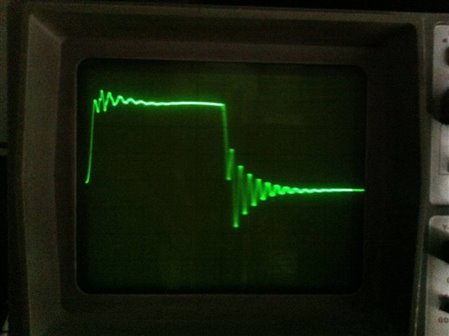
    One of the power mosfet´s gate in action:


    0.05useg / division

    2V / div


    image


    I appreciate comments about this waveform, I think it seems pretty nice...


    Cheers

    • Cancel
    • Vote Up 0 Vote Down
    • Sign in to reply
    • Verify Answer
    • Cancel
  • Pradipsinh
    0 Pradipsinh 6 months ago

    Sir my name is pradipsinh pl suggestions accu nimh 7.2v 9Ah battery  in side mosfet fire use ltc 4008 which mosfet use in side

    • Cancel
    • Vote Up -1 Vote Down
    • Sign in to reply
    • Verify Answer
    • Reject Answer
    • Cancel
  • Pradipsinh
    0 Pradipsinh 6 months ago in reply to Pradipsinh

    7.2 ah battery charger use Ltc4008 which mosfet runnig

    • Cancel
    • Vote Up +1 Vote Down
    • Sign in to reply
    • Verify Answer
    • Reject Answer
    • Cancel
  • Pradipsinh
    0 Pradipsinh 6 months ago in reply to Pradipsinh

    Which use mosfet

    • Cancel
    • Vote Up 0 Vote Down
    • Sign in to reply
    • Verify Answer
    • Reject Answer
    • Cancel
<
element14 Community

element14 is the first online community specifically for engineers. Connect with your peers and get expert answers to your questions.

  • Members
  • Learn
  • Technologies
  • Challenges & Projects
  • Products
  • Store
  • About Us
  • Feedback & Support
  • FAQs
  • Terms of Use
  • Privacy Policy
  • Legal and Copyright Notices
  • Sitemap
  • Cookies

An Avnet Company © 2026 Premier Farnell Limited. All Rights Reserved.

Premier Farnell Ltd, registered in England and Wales (no 00876412), registered office: Farnell House, Forge Lane, Leeds LS12 2NE.

Follow element14

  • X
  • Facebook
  • linkedin
  • YouTube