

Alternative Energy Solutions - Wind Turbine Pitch Control

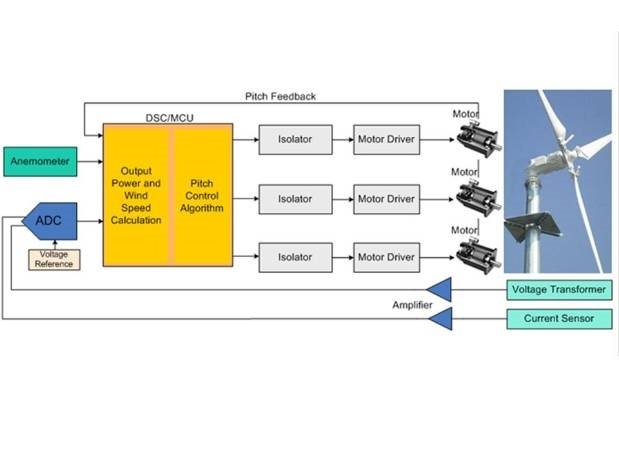
Wind Turbine pitch control system is usually built using a controller to employ the pitch control mechanisms and a feedback module for monitoring the output power. High performance MCUs or DSCs are often selected as the controllers of pitch control systems. They are responsible for giving instructions to pitch control mechanisms based on real-time wind speed, preset power rating, pitch information, and output power signal of generator. Pitch control mechanisms are commonly comprised of a motor and a motor driver. Each motor blade needs a single control mechanism, which means three mechanisms in total are required.
After the instructions given by controller are received, the motor drivers drive their associated motors to change blade incidence. Meanwhile, the real-time pitch information is sent back to controller. The feedback module, composed of voltage and current sensors, forms the feedback loop which feeds the voltage and current signals from the sensors back to the controller.
When wind speed is not higher than the rated speed, the blade incidence stay near the angle 0° (highest power point). This is similar to that of a generator with constant pitch, generating an output power that changes along with wind speed. At higher wind speeds, the pitch control mechanism changes blade incidence so that the output power of generator is within the allowed range.
| Visit > |  |
| TEXAS INSTRUMENTS | DSC | Running an Application from Internal Flash Memory on the TMS320F28xxx DSP (Rev. I) | TMS320F28xxx | Click here | |
| TEXAS INSTRUMENTS | DSC | EEPROM Emulation With the TMS320F28xxx DSCs | TMS320F28xxx | Click here | |
| TEXAS INSTRUMENTS | DSC | Optimizing Code Performance and Size for Stellaris Microcontrollers | Click here | ||
| TEXAS INSTRUMENTS | DSC | Clocking options for Stellaris Family Microcontrollers | Click here | ||
| TEXAS INSTRUMENTS | DSC | Advanced Linker Techniques for Convenient and Efficient Memory Usage | Click here | ||
| TEXAS INSTRUMENTS | DSC | Using PWM Output as a Digital-to-Analog Converter on a TMS320F280x (Rev. A) | TMS320F280x | Click here | |
| TEXAS INSTRUMENTS | DSC | Flash Programming Solutions for the TMS320F28xxx DSCs | Click here | ||
| TEXAS INSTRUMENTS | DSC | An Overview of Designing Analog Interface With TM320F28xx/28xxx DSCs (Rev. A) | TM320F28xx | Click here | |
| TEXAS INSTRUMENTS | DSC | Copying Compiler Sections from Flash to RAM on the TMS320F28xxx DSCs | TMS320F28xxx | Click here | |
| TEXAS INSTRUMENTS | DSC | Configuring Source of Multiple ePWM Trip-Zone Events | Click here | ||
| TEXAS INSTRUMENTS | DSC | TMS320F281x Boot ROM Serial Flash Programming | TMS320F281x | Click here | |
| NXP | Microcontroller | Wakeup from Deep Sleep using the CANActivity interrupt | LPC1700 | Click here | |
| NXP | Microcontroller | DSP library for LPC1700 and LPC1300 | LPC1700 | Click here | |
| NXP | Microcontroller | Using the LPC1700 power modes | LPC1700 | Click here | |
| NXP | Microcontroller | FAT library EFSL and FatFs port on NXP LPC1700 | LPC1700 | Click here | |
| NXP | Microcontroller | Memory to DAC data transfers using the LPC1700's DMA | LPC1700 | Click here | |
| NXP | Microcontroller | NXP LPC Cortex-M3 IEC60335 Class B library | LPC1700 | Click here | |
| NXP | Microcontroller | IEC 60601-1-8 audible alert generator using the LPC1700 | LPC1700 | Click here | |
| NXP | Microcontroller | LPC1700 Ethernet MII Management (MDIO) via software | LPC1700 | Click here | |
| NXP | Microcontroller | LPC1700 RTC hardware auto calibration | LPC1700 | Click here | |
| NXP | Microcontroller | LPC1700 secondary USB bootloader | LPC1700 | Click here | |
| NXP | Microcontroller | LPC1700 timer triggered memory to GPIO data transfer | LPC1700 | Click here | |
| NXP | Microcontroller | Porting uIP1.0 to LPC1700 | LPC1700 | Click here | |
| NXP | Microcontroller | Using Code Read Protection in LPC1700 | LPC1700 | Click here | |
| STMICROELECTRONICS | Microcontroller | USB DFU protocol used in the STM32 bootloader bootloader | AN3156 | STM32F10X | Click here |
| STMICROELECTRONICS | Microcontroller | USART protocol used in the STM32 bootloader | AN3155 | STM32F10X | Click here |
| STMICROELECTRONICS | Microcontroller | CAN protocol used in the STM32 bootloader | AN3154 | STM32F10X | Click here |
| STMICROELECTRONICS | Microcontroller | STM32’s ADC modes and their applications | AN3116 | STM32F10X | Click here |
| STMICROELECTRONICS | Microcontroller | Communication peripheral FIFO emulation with DMA and DMA timeout in STM32F10x microcontrollers | AN3109 | STM32F10X | Click here |
| STMICROELECTRONICS | Microcontroller | Managing the Driver Enable signal for RS-485 and IO-Link communications with the STM32’s USART | AN3070 | STM32F10X | Click here |
| STMICROELECTRONICS | Microcontroller | Configuring the NicheLite TCP/IP stack for the STM32F107xx microcontroller | AN3000 | STM32F10X | Click here |
| STMICROELECTRONICS | Microcontroller | STM8S and STM32 MCUs: a consistent 8/32-bit product line for painless migration | AN2945 | STM32F10X | Click here |
| STMICROELECTRONICS | Microcontroller | Oscillator design guide for ST microcontrollers | AN2867 | STM32F10X | Click here |
| STMICROELECTRONICS | Microcontroller | Smartcard interface with the STM32F10x microcontrollers | AN2598 | STM32F10X | Click here |
| STMICROELECTRONICS | Microcontroller | EEPROM emulation in in STM32F10x microcontrollers | AN2594 | STM32F10X | Click here |
| STMICROELECTRONICS | Microcontroller | STM32F10xxx hardware development: getting started | AN2586 | STM32F10X | Click here |
| STMICROELECTRONICS | Microcontroller | STM32F10x in-application programming using the USART | AN2557 | STM32F10X | Click here |
