


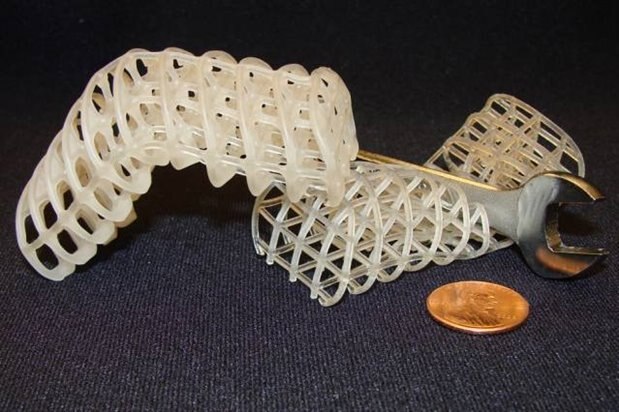
A prototype of this ‘squishy’ robot made with phase-changing materials (via MIT)
MIT and Google’s Boston Dynamic have collaborated to solve one of the age-old issues in robotic mechanics by inventing a new material. While robots are typically either created to be soft or hard, this robot can actually shift from soft or hard states to accommodate the task it need to complete. The real world applications of this are various, but it is of particular interest to the Medical field. A robot which could shift from a hard to soft state could offer novel ways of performing computer assisted operations in hard to reach places. Some speculate that the robot could also find survivors within the rubble of natural disasters and rescue them by squishing itself to fit within the cracks.
The squishable structure is created by a combination of foam, wax, and metal wiring. The inside of the tubing is made of foam which can squish and condense to a fraction of it’s size. The foam is coated with wax which allows the robot to become hard or soft depending upon whether it is heated or cooled. There are wires running along each of the foam struts which allows the user to control the phase-state of the material by heating or cooling the wax. A heated state will allow the robot to squish and become more pliable. However, the wax can be cooled to harden the structure. The material is supposed to heal itself in the event that the wax coating breaks. If the user breaks the coating, they can simple heat up the structure, and it should repair the coating.
Since the main ingredients of this structure are polyurethane foam and wax, it is surprisingly low cost so robot enthusiasts and scientists alike can create novel squishy robots to their hearts’ content.
This material is still undergoing further research and prototyping, but it looks promising. The team is still looking into other methods of creating phase-changing robots by using electromagnetism and suspended metals. This material can also be used to create realistic casing for humanoid robots.
There are lots of ideas in the pipes to work on next, but this new material opens up new avenues in the robotics world.
C
See more news at: