element14 Community
element14 Community
    Register Log In
  • Site
  • Search
  • Log In Register
  • Community Hub
    Community Hub
    • What's New on element14
    • Feedback and Support
    • Benefits of Membership
    • Personal Blogs
    • Members Area
    • Achievement Levels
  • Learn
    Learn
    • Ask an Expert
    • eBooks
    • element14 presents
    • Learning Center
    • Tech Spotlight
    • STEM Academy
    • Webinars, Training and Events
    • Learning Groups
  • Technologies
    Technologies
    • 3D Printing
    • FPGA
    • Industrial Automation
    • Internet of Things
    • Power & Energy
    • Sensors
    • Technology Groups
  • Challenges & Projects
    Challenges & Projects
    • Design Challenges
    • element14 presents Projects
    • Project14
    • Arduino Projects
    • Raspberry Pi Projects
    • Project Groups
  • Products & Partners
    Products & Partners
    • Arduino
    • Avnet & Tria Boards Community
    • Dev Tools
    • Manufacturers
    • Multicomp Pro
    • Product Groups
    • Raspberry Pi
    • RoadTests & Reviews
  • About Us
    About the element14 Community
  • Store
    Store
    • Visit Your Store
    • Choose another store...
      • Europe
      •  Austria (German)
      •  Belgium (Dutch, French)
      •  Bulgaria (Bulgarian)
      •  Czech Republic (Czech)
      •  Denmark (Danish)
      •  Estonia (Estonian)
      •  Finland (Finnish)
      •  France (French)
      •  Germany (German)
      •  Hungary (Hungarian)
      •  Ireland
      •  Israel
      •  Italy (Italian)
      •  Latvia (Latvian)
      •  
      •  Lithuania (Lithuanian)
      •  Netherlands (Dutch)
      •  Norway (Norwegian)
      •  Poland (Polish)
      •  Portugal (Portuguese)
      •  Romania (Romanian)
      •  Russia (Russian)
      •  Slovakia (Slovak)
      •  Slovenia (Slovenian)
      •  Spain (Spanish)
      •  Sweden (Swedish)
      •  Switzerland(German, French)
      •  Turkey (Turkish)
      •  United Kingdom
      • Asia Pacific
      •  Australia
      •  China
      •  Hong Kong
      •  India
      •  Japan
      •  Korea (Korean)
      •  Malaysia
      •  New Zealand
      •  Philippines
      •  Singapore
      •  Taiwan
      •  Thailand (Thai)
      •  Vietnam
      • Americas
      •  Brazil (Portuguese)
      •  Canada
      •  Mexico (Spanish)
      •  United States
      Can't find the country/region you're looking for? Visit our export site or find a local distributor.
  • Translate
  • Profile
  • Settings
Sensors
  • Technologies
  • More
Sensors
Blog Astronomers Detect Radio Signals Originating From an Exoplanet
  • Blog
  • Forum
  • Documents
  • Quiz
  • Events
  • Polls
  • Members
  • Mentions
  • Sub-Groups
  • Tags
  • More
  • Cancel
  • New
Join Sensors to participate - click to join for free!
  • Share
  • More
  • Cancel
Group Actions
  • Group RSS
  • More
  • Cancel
Engagement
  • Author Author: Catwell
  • Date Created: 8 Oct 2026 8:00 AM Date Created
  • Views 66 views
  • Likes 2 likes
  • Comments 0 comments
  • sensors
  • space
  • sensor
  • exoplanet
  • innovation
  • eso
Related
Recommended

Astronomers Detect Radio Signals Originating From an Exoplanet

Catwell
Catwell
8 Oct 2026

image

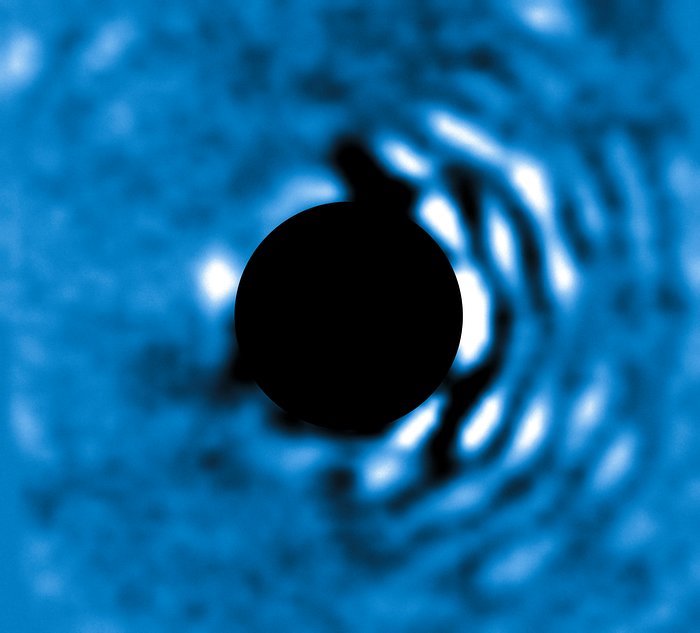
An April 2010 VLT image showing Beta Pictoris b located 6.5 AU from its star. (Image Credit: ESO)

A gas giant called Beta Pictoris b, located about 63 light-years from Earth, has been emitting strongly circularly polarized bursts. Astronomers recently detected the emissions using MeerKAT, a 64-dish radio telescope array in South Africa. According to the team, this is the first time radio signals were traced to an individual exoplanet rather than a host star. The method could enable scientists to measure the magnetic fields of planets beyond our solar system.

This is a key discovery as it’s difficult to directly measure planetary magnetic fields. They may affect a planet’s interaction with stellar winds and how a planet’s atmosphere is protected from energetic particles. Even Earth has this same effect, as the magnetic field shields the atmosphere from the solar wind.

Beta Pictoris b’s radio signals are created by a mechanism related to planetary auroras. Charged particles interacting with a planet’s magnetic field and atmosphere can produce radio waves through electron cyclotron maser instability (ECMI). Other planets, like Jupiter, in our Solar System produce similar radio emissions.

Between 2025 and 2026, MeerKAT observed Beta Pictoris b four times. It detected radio signals ranging from 0.85 to 3.5 GHz. According to the paper, the signals had rapidly varying bursts that were strongly circularly polarized. This is consistent with coherent auroral radio emissions.

Most importantly, the team determined that the radio signals came from the exoplanet and not the star or another planet in the system. Since the host star is magnetically quiet, it was easier to separate Beta Pictoris b’s faint radio emission from stellar activity. The highest radio frequency also provided researchers with data about the planet’s magnetic environment. Based on the researchers’ understanding of the signal as ECMI, 3.5 GHz suggests there is a 1.25 kilogauss magnetic field where those radio waves were produced.

The approach could pave the way toward investigating magnetism on planets outside this Solar System. In such cases, astronomers use those radio observations to analyze giant exoplanets’ magnetic environments and get better insight into how planets interact with host stars.

This can also contribute to the search for potentially habitable planets. Magnetic fields are capable of preserving a planet’s atmosphere if it gets hit with stellar activity. That makes it a key factor when determining if a distant planet provides ideal conditions for life.

Have a story tip? Message me here at element14.

  • Sign in to reply
element14 Community

element14 is the first online community specifically for engineers. Connect with your peers and get expert answers to your questions.

  • Members
  • Learn
  • Technologies
  • Challenges & Projects
  • Products
  • Store
  • About Us
  • Feedback & Support
  • FAQs
  • Terms of Use
  • Privacy Policy
  • Legal and Copyright Notices
  • Sitemap
  • Cookies

An Avnet Company © 2026 Premier Farnell Limited. All Rights Reserved.

Premier Farnell Ltd, registered in England and Wales (no 00876412), registered office: Farnell House, Forge Lane, Leeds LS12 2NE.

Follow element14

  • X
  • Facebook
  • linkedin
  • YouTube